Qingliang Temple
⭐ 3.20
Qingliang Temple, Mount Wutai Scenic Area, Xinzhou, Shanxi, China
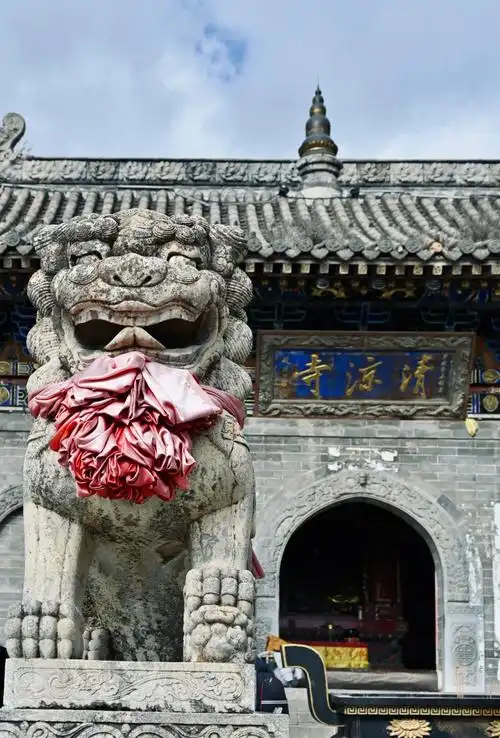 The Northern Wei dynasty era (472–493 CE) places the temple's founding in a turbulent period of world history—contemporary with the fall of the Western Roman Empire and the dawn of the Anglo-Saxon kingdoms in Britain. Empress Wu Zetian later ordered its restoration during the Tang dynasty, cementing its status as a key Buddhist training center. While the present structures date to a 1990s reconstruction funded by devout laypeople, the site preserves an unbroken thread of worship spanning fifteen centuries—comparable in spiritual continuity to European sacred sites like Montserrat in Spain or Monte Cassino in Italy, which have also been rebuilt upon their ancient foundations.
The centerpiece is the celebrated Qingliang Stone, a smooth boulder roughly 5 meters long and 2.6 meters wide resting on an open-air stone platform. Legend holds that Manjushri—the Buddhist embodiment of transcendent wisdom, often invoked by scholars and travelers—delivered sermons from this very spot, earning it the alternate name "Manjushri's Bed." In folk tradition, the stone is also called the "Dragon-Resting Stone," said to have cooled Mount Wutai's once-fiery climate when Manjushri subdued a local dragon king. For pilgrims, revering this stone symbolizes receiving the bodhisattva's blessings of wisdom and inner peace, much as medieval Christians venerated holy relics.
The temple complex follows a traditional Chinese Buddhist axial layout, modest in scale but elegantly composed. Visitors pass through an ornately carved stone paifang (memorial archway), then proceed through the Hall of Heavenly Kings, the Main Buddha Hall, the open-air stone platform, and finally the Hall of the Three Great Bodhisattvas. Though rebuilt in the 1990s, the halls faithfully reproduce classical temple proportions and house dignified statues. The carved archway in particular rewards photographers with its intricate detailing, while the surrounding pines create a tranquil natural enclosure.
Qingliang Temple occupies a unique niche on Mount Wutai, distinct from celebrated Tang-dynasty survivors like Foguang Temple and Nanchan Temple, which boast original 9th-century wooden halls. Where those sites offer architectural antiquity, Qingliang offers spiritual symbolism: it is considered the very heart of Mount Wutai's "Qingliang Culture," the Buddhist ideal of cool detachment from worldly passions—akin to the contemplative ethos of Carthusian monasteries. For travelers seeking deeper meaning beyond sightseeing, this temple provides an authentic devotional atmosphere rarely found in more tourist-heavy sites.
Admission is included in the Mount Wutai scenic area ticket, with no separate fee required. The temple sits approximately 15 kilometers southwest of Taihuai Town in Qingliang Valley, at an elevation where mountain roads are narrow, steep, and winding. Public transit does not reach the site, so visitors should arrange a private car, taxi, or rental vehicle, leaving the car in the parking area outside the entrance. Allow 30 minutes to an hour and a half for a complete visit.
Visit at dawn or dusk for the most evocative atmosphere—cool temperatures, soft light, and few other visitors allow the temple's meditative character to fully emerge. Maintain a quiet demeanor, dress modestly, and ask permission before photographing monks or worshippers. No food or drink vendors operate nearby, so bring water and light snacks. Summer days are pleasant but nights turn chilly, so pack a light jacket, and wear sturdy non-slip footwear for the moss-covered stone steps.
The Northern Wei dynasty era (472–493 CE) places the temple's founding in a turbulent period of world history—contemporary with the fall of the Western Roman Empire and the dawn of the Anglo-Saxon kingdoms in Britain. Empress Wu Zetian later ordered its restoration during the Tang dynasty, cementing its status as a key Buddhist training center. While the present structures date to a 1990s reconstruction funded by devout laypeople, the site preserves an unbroken thread of worship spanning fifteen centuries—comparable in spiritual continuity to European sacred sites like Montserrat in Spain or Monte Cassino in Italy, which have also been rebuilt upon their ancient foundations.
The centerpiece is the celebrated Qingliang Stone, a smooth boulder roughly 5 meters long and 2.6 meters wide resting on an open-air stone platform. Legend holds that Manjushri—the Buddhist embodiment of transcendent wisdom, often invoked by scholars and travelers—delivered sermons from this very spot, earning it the alternate name "Manjushri's Bed." In folk tradition, the stone is also called the "Dragon-Resting Stone," said to have cooled Mount Wutai's once-fiery climate when Manjushri subdued a local dragon king. For pilgrims, revering this stone symbolizes receiving the bodhisattva's blessings of wisdom and inner peace, much as medieval Christians venerated holy relics.
The temple complex follows a traditional Chinese Buddhist axial layout, modest in scale but elegantly composed. Visitors pass through an ornately carved stone paifang (memorial archway), then proceed through the Hall of Heavenly Kings, the Main Buddha Hall, the open-air stone platform, and finally the Hall of the Three Great Bodhisattvas. Though rebuilt in the 1990s, the halls faithfully reproduce classical temple proportions and house dignified statues. The carved archway in particular rewards photographers with its intricate detailing, while the surrounding pines create a tranquil natural enclosure.
Qingliang Temple occupies a unique niche on Mount Wutai, distinct from celebrated Tang-dynasty survivors like Foguang Temple and Nanchan Temple, which boast original 9th-century wooden halls. Where those sites offer architectural antiquity, Qingliang offers spiritual symbolism: it is considered the very heart of Mount Wutai's "Qingliang Culture," the Buddhist ideal of cool detachment from worldly passions—akin to the contemplative ethos of Carthusian monasteries. For travelers seeking deeper meaning beyond sightseeing, this temple provides an authentic devotional atmosphere rarely found in more tourist-heavy sites.
Admission is included in the Mount Wutai scenic area ticket, with no separate fee required. The temple sits approximately 15 kilometers southwest of Taihuai Town in Qingliang Valley, at an elevation where mountain roads are narrow, steep, and winding. Public transit does not reach the site, so visitors should arrange a private car, taxi, or rental vehicle, leaving the car in the parking area outside the entrance. Allow 30 minutes to an hour and a half for a complete visit.
Visit at dawn or dusk for the most evocative atmosphere—cool temperatures, soft light, and few other visitors allow the temple's meditative character to fully emerge. Maintain a quiet demeanor, dress modestly, and ask permission before photographing monks or worshippers. No food or drink vendors operate nearby, so bring water and light snacks. Summer days are pleasant but nights turn chilly, so pack a light jacket, and wear sturdy non-slip footwear for the moss-covered stone steps.