Mount Wutai Peaks
⭐ 4.60
Wutai Mountain Peaks, Xinzhou City, Shanxi Province, China
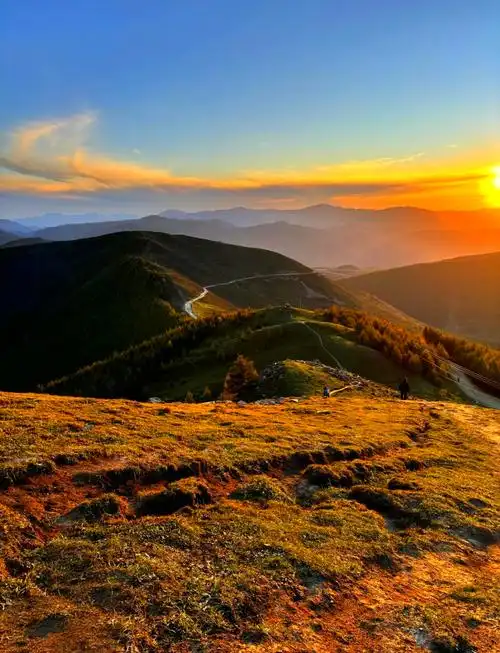 Mount Wutai ranks among China's Four Sacred Buddhist Mountains and holds the singular distinction of being Manjushri's earthly abode. While many travelers might compare it to Spain's Montserrat or Greece's Meteora—sites where monasteries cling dramatically to peaks—Wutai offers something unique: five distinct flat-topped summits, each crowned by its own sanctuary. These geological marvels were shaped by hundreds of millions of years of tectonic uplift and erosion, creating the rare phenomenon of level plateaus thrust abruptly skyward. Buddhist devotion here flourished from the Northern Wei dynasty (5th century) onward, with successive imperial patrons expanding the temple complex through the Tang, Ming, and Qing eras. Today, the terraces serve as living museums of Han-Tibetan religious architecture.
The North Terrace, known as Yedou Peak, claims the title of North China's loftiest summit at 3,061 meters—comparable in altitude to alpine refuges in the Austrian Tyrol. Its Lingying Temple enshrines the immaculate Manjushri, and on clear days the views stretch endlessly across the North China plain. The East Terrace, Wanghai Peak, offers what many consider the region's most transcendent experience: sunrise above a churning sea of clouds, watched from the ancient Wanghai Temple dedicated to wise Manjushri. The Central Terrace, Cuiyan Peak, features strangely weathered sandstone formations and the Yanjiao Temple honoring youthful Manjushri, while the West Terrace, Guayue Peak, presents the ethereal spectacle of moonlight illuminating the Falei Temple's狮子文殊 shrine. The South Terrace, Jinxiu Peak, completes the sacred circuit with wildflower-strewn meadows surrounding the Puji Temple.
What elevates Wutai beyond mere scenic beauty is its embodiment of Buddhist cosmology. The five terraces correspond to the Five Wisdoms and Five Directions of Mahayana philosophy, transforming the mountain itself into a three-dimensional mandala. For centuries, devout pilgrims have undertaken the "Great Pilgrimage"—a roughly 50-kilometer trek connecting all five summits over two days, an ordeal comparable in spiritual significance to Spain's Camino de Santiago. This ancient circuit remains active today, drawing Buddhist faithful from across East Asia, while modern visitors can experience the same sacred geography through more comfortable means.
Practical planning is essential for any successful visit. The high elevation means summer temperatures on the summits often hover around 10°C (50°F), so a windbreaker or light down jacket is indispensable even in July. The town of Taihuai serves as the main base, where shuttle buses reach the foot of each terrace. Foreign visitors should carry their original passport and book tickets through official channels in advance, as entry quotas and vehicle access are strictly regulated. The optimal season runs from May through October; winter brings heavy snow that closes most roads.
Etiquette matters deeply in this living sacred landscape. When entering temple halls, remove hats, avoid stepping on door thresholds, and walk clockwise around shrines and Buddha statues—customs similar to those observed in Tibetan monasteries. Photography of Buddhist icons is generally discouraged, so respect signs posted at each site. Hikers attempting the Great Pilgrimage should bring sturdy non-slip footwear, rain gear, high-SPF sunscreen, and a realistic assessment of their fitness, as the altitude and distance are genuinely demanding. For photographers and contemplatives alike, an early morning ascent of the East Terrace promises the journey's most unforgettable reward—a sunrise above the clouds that has inspired seekers for more than a millennium.
Mount Wutai ranks among China's Four Sacred Buddhist Mountains and holds the singular distinction of being Manjushri's earthly abode. While many travelers might compare it to Spain's Montserrat or Greece's Meteora—sites where monasteries cling dramatically to peaks—Wutai offers something unique: five distinct flat-topped summits, each crowned by its own sanctuary. These geological marvels were shaped by hundreds of millions of years of tectonic uplift and erosion, creating the rare phenomenon of level plateaus thrust abruptly skyward. Buddhist devotion here flourished from the Northern Wei dynasty (5th century) onward, with successive imperial patrons expanding the temple complex through the Tang, Ming, and Qing eras. Today, the terraces serve as living museums of Han-Tibetan religious architecture.
The North Terrace, known as Yedou Peak, claims the title of North China's loftiest summit at 3,061 meters—comparable in altitude to alpine refuges in the Austrian Tyrol. Its Lingying Temple enshrines the immaculate Manjushri, and on clear days the views stretch endlessly across the North China plain. The East Terrace, Wanghai Peak, offers what many consider the region's most transcendent experience: sunrise above a churning sea of clouds, watched from the ancient Wanghai Temple dedicated to wise Manjushri. The Central Terrace, Cuiyan Peak, features strangely weathered sandstone formations and the Yanjiao Temple honoring youthful Manjushri, while the West Terrace, Guayue Peak, presents the ethereal spectacle of moonlight illuminating the Falei Temple's狮子文殊 shrine. The South Terrace, Jinxiu Peak, completes the sacred circuit with wildflower-strewn meadows surrounding the Puji Temple.
What elevates Wutai beyond mere scenic beauty is its embodiment of Buddhist cosmology. The five terraces correspond to the Five Wisdoms and Five Directions of Mahayana philosophy, transforming the mountain itself into a three-dimensional mandala. For centuries, devout pilgrims have undertaken the "Great Pilgrimage"—a roughly 50-kilometer trek connecting all five summits over two days, an ordeal comparable in spiritual significance to Spain's Camino de Santiago. This ancient circuit remains active today, drawing Buddhist faithful from across East Asia, while modern visitors can experience the same sacred geography through more comfortable means.
Practical planning is essential for any successful visit. The high elevation means summer temperatures on the summits often hover around 10°C (50°F), so a windbreaker or light down jacket is indispensable even in July. The town of Taihuai serves as the main base, where shuttle buses reach the foot of each terrace. Foreign visitors should carry their original passport and book tickets through official channels in advance, as entry quotas and vehicle access are strictly regulated. The optimal season runs from May through October; winter brings heavy snow that closes most roads.
Etiquette matters deeply in this living sacred landscape. When entering temple halls, remove hats, avoid stepping on door thresholds, and walk clockwise around shrines and Buddha statues—customs similar to those observed in Tibetan monasteries. Photography of Buddhist icons is generally discouraged, so respect signs posted at each site. Hikers attempting the Great Pilgrimage should bring sturdy non-slip footwear, rain gear, high-SPF sunscreen, and a realistic assessment of their fitness, as the altitude and distance are genuinely demanding. For photographers and contemplatives alike, an early morning ascent of the East Terrace promises the journey's most unforgettable reward—a sunrise above the clouds that has inspired seekers for more than a millennium.