Pusading
⭐ 4.20
Pusading, Mount Wutai Scenic Area, Xinzhou, Shanxi, China
 **Imperial Origins and Sacred History**
Pusading Temple, originally known as Zhenrong Yuan, traces its origins to the Northern Wei dynasty (5th century), when Mount Wutai emerged as one of China's four sacred Buddhist mountains, each associated with a bodhisattva—here, the wisdom deity Manjushri. In 1407, the Yongle Emperor brought the temple under Tibetan Buddhist administration, and in 1660, Emperor Shunzhi converted it from a Han-style monastery to the leading "Yellow Hat" (Gelug) institution on the mountain. Emperors Kangxi, Yongzheng, Qianlong, and Jiaqing all stayed here during imperial pilgrimages, leaving behind a remarkable collection of royal gifts, calligraphy, and architectural patronage.
**Architecture: A Han-Tibetan Masterpiece**
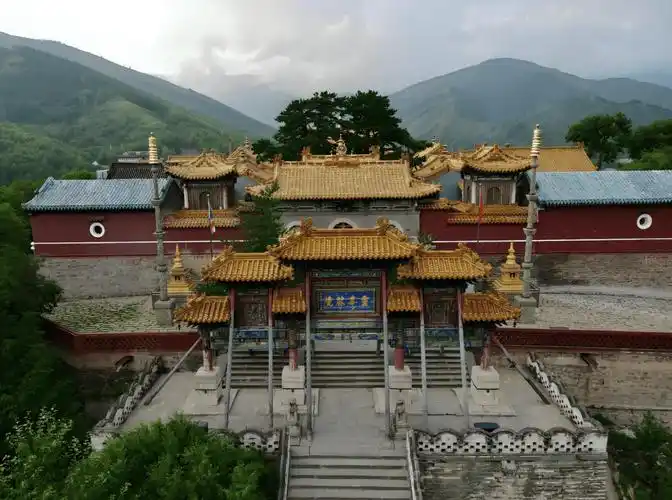
Spanning 9,160 square meters with 121 halls, Pusading is the only temple on Mount Wutai roofed entirely in golden-yellow glazed tiles—a color historically reserved for imperial structures. Built along the mountain ridge in a style comparable to Beijing's Forbidden City meets the Potala Palace in Lhasa, its crimson walls and gilded roofs create a dramatic silhouette against neighboring gray-tiled monasteries. A four-pillared, seven-eaved gateway bears Kangxi's gilded inscription "Lingfeng Shengjing" (Spiritual Peak, Sacred Realm), setting the tone for the grandeur within.
**Cultural Treasures and Living Heritage**
The temple's Imperial Stele Pavilion houses Qianlong's extraordinary stone monuments inscribed in four scripts—Chinese, Manchu, Mongol, and Tibetan—reflecting the Qing dynasty's multi-ethnic vision of empire and faith. Inside the Manjushri Hall, devotees venerate a remarkable image of the bodhisattva depicted with an arrow in his chest, said to have miraculously healed from a Qing-era assassination attempt. Pusading remains a vital pilgrimage destination for Mongol and Tibetan Buddhists, embodying centuries of cultural exchange along the routes that once connected China's imperial court to the Tibetan plateau.
**Practical Visitor Information**
Pusading is included in the Mount Wutai scenic area ticket (135 yuan)—no separate purchase required. The temple is generally open 8:00 to 17:00, with the ideal window between 9:00 and 11:00, when soft morning light enhances the golden rooftops and crowds remain thin. Visitors begin at the spirit wall at the mountain's base and must climb all 108 steps to reach the gate, so sturdy, non-slip walking shoes are essential. At over 2,800 meters elevation, summer temperatures are pleasant but winds at the summit can be strong—pack a windbreaker, sunscreen, and water.
**Recommended Route and Etiquette**
Begin at the base spirit wall, ascend the 108 steps, pass through the "Lingfeng Shengjing" gateway, and proceed through the Hall of Heavenly Kings, the Mahavira Hall, and the Manjushri Hall with its famous arrow-marked statue. Continue to the Imperial Stele Pavilion, then climb to the rear viewing platform for sweeping panoramas over Taihuai town below. Photographers will find the best contrast between red-gold temple walls and distant blue-green ridges from the upper terraces. Maintain respectful silence inside halls, never use flash on Buddhist statues, and avoid stepping on door thresholds. The annual Gelug dharma assembly, held from the 4th to 15th day of the sixth lunar month, features spectacular ritual ceremonies rarely seen elsewhere in eastern China.
**Why Visit**
For travelers drawn to the meeting point of imperial history, Tibetan Buddhism, and breathtaking mountain scenery, Pusading offers an experience unmatched in China. Few sites so vividly illustrate how Qing emperors wove Buddhist patronage into their strategy of unifying a multi-ethnic realm, while its architecture offers a visual dialogue between the Forbidden City and the Potala Palace—all set within a UNESCO-recognized landscape that has drawn pilgrims for nearly 1,500 years.
**Imperial Origins and Sacred History**
Pusading Temple, originally known as Zhenrong Yuan, traces its origins to the Northern Wei dynasty (5th century), when Mount Wutai emerged as one of China's four sacred Buddhist mountains, each associated with a bodhisattva—here, the wisdom deity Manjushri. In 1407, the Yongle Emperor brought the temple under Tibetan Buddhist administration, and in 1660, Emperor Shunzhi converted it from a Han-style monastery to the leading "Yellow Hat" (Gelug) institution on the mountain. Emperors Kangxi, Yongzheng, Qianlong, and Jiaqing all stayed here during imperial pilgrimages, leaving behind a remarkable collection of royal gifts, calligraphy, and architectural patronage.
**Architecture: A Han-Tibetan Masterpiece**
Spanning 9,160 square meters with 121 halls, Pusading is the only temple on Mount Wutai roofed entirely in golden-yellow glazed tiles—a color historically reserved for imperial structures. Built along the mountain ridge in a style comparable to Beijing's Forbidden City meets the Potala Palace in Lhasa, its crimson walls and gilded roofs create a dramatic silhouette against neighboring gray-tiled monasteries. A four-pillared, seven-eaved gateway bears Kangxi's gilded inscription "Lingfeng Shengjing" (Spiritual Peak, Sacred Realm), setting the tone for the grandeur within.
**Cultural Treasures and Living Heritage**
The temple's Imperial Stele Pavilion houses Qianlong's extraordinary stone monuments inscribed in four scripts—Chinese, Manchu, Mongol, and Tibetan—reflecting the Qing dynasty's multi-ethnic vision of empire and faith. Inside the Manjushri Hall, devotees venerate a remarkable image of the bodhisattva depicted with an arrow in his chest, said to have miraculously healed from a Qing-era assassination attempt. Pusading remains a vital pilgrimage destination for Mongol and Tibetan Buddhists, embodying centuries of cultural exchange along the routes that once connected China's imperial court to the Tibetan plateau.
**Practical Visitor Information**
Pusading is included in the Mount Wutai scenic area ticket (135 yuan)—no separate purchase required. The temple is generally open 8:00 to 17:00, with the ideal window between 9:00 and 11:00, when soft morning light enhances the golden rooftops and crowds remain thin. Visitors begin at the spirit wall at the mountain's base and must climb all 108 steps to reach the gate, so sturdy, non-slip walking shoes are essential. At over 2,800 meters elevation, summer temperatures are pleasant but winds at the summit can be strong—pack a windbreaker, sunscreen, and water.
**Recommended Route and Etiquette**
Begin at the base spirit wall, ascend the 108 steps, pass through the "Lingfeng Shengjing" gateway, and proceed through the Hall of Heavenly Kings, the Mahavira Hall, and the Manjushri Hall with its famous arrow-marked statue. Continue to the Imperial Stele Pavilion, then climb to the rear viewing platform for sweeping panoramas over Taihuai town below. Photographers will find the best contrast between red-gold temple walls and distant blue-green ridges from the upper terraces. Maintain respectful silence inside halls, never use flash on Buddhist statues, and avoid stepping on door thresholds. The annual Gelug dharma assembly, held from the 4th to 15th day of the sixth lunar month, features spectacular ritual ceremonies rarely seen elsewhere in eastern China.
**Why Visit**
For travelers drawn to the meeting point of imperial history, Tibetan Buddhism, and breathtaking mountain scenery, Pusading offers an experience unmatched in China. Few sites so vividly illustrate how Qing emperors wove Buddhist patronage into their strategy of unifying a multi-ethnic realm, while its architecture offers a visual dialogue between the Forbidden City and the Potala Palace—all set within a UNESCO-recognized landscape that has drawn pilgrims for nearly 1,500 years.