Tayuan Temple
⭐ 4.60
Tayuan Temple, Taihuai Town, Wutai Mountain Scenic Area, Xinzhou, Shanxi Province, China
 **A Sacred Mountain Older Than Most Pilgrimages**
Mount Wutai, where Tayuan Temple stands, has been a centre of Buddhism since the 1st century CE—making it one of the oldest continuously active pilgrimage sites on Earth, predating Santiago de Compostela by several centuries and rivaling Tibet's Mount Kailash in devotional importance. The temple itself became independent in 1579, during the late Ming dynasty, an era when Elizabeth I was on the English throne. In spring 1948, Mao Zedong and other Communist commanders were quartered in the abbot's quarters while plotting the final stages of China's civil war, lending the monastery an unexpected chapter in 20th-century revolutionary history.
**Architecture and Layout**
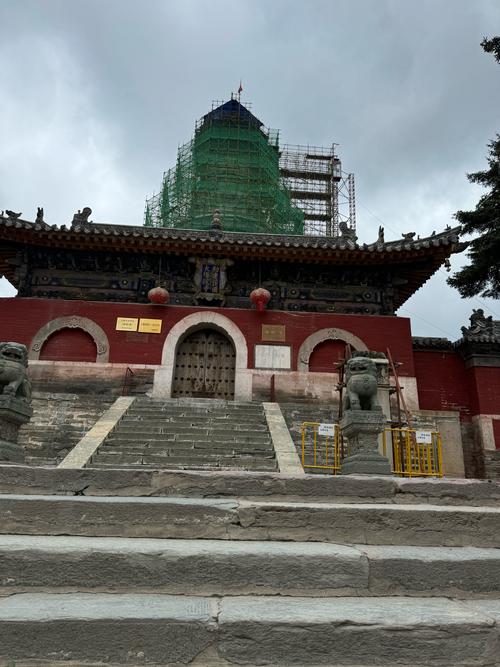
Spread across some 15,600 square metres, Tayuan Temple presents a textbook example of a Chinese Buddhist monastic compound, with 227 surviving Ming and Qing halls arrayed along a strict north-south axis. Visitors pass through the Heavenly Kings Hall, the Hall of Great Compassion and Longevity, the towering White Pagoda, and finally the Sutra Repository. The intricate dougong bracket sets, painted beams, and carved wooden archways echo the refined craftsmanship found in Beijing's Forbidden City, yet the setting—nests against forested slopes at 1,600 metres elevation—lends a serenity the capital never offers.
**The Great White Pagoda: A Yuan-Era Masterpiece**
The pagoda is the soul of the complex. Designed in the 13th century by Araniko, the legendary Nepalese architect who also crafted Beijing's iconic White Stupa at Miaoying Temple, its gleaming white stupa form soars higher than most European cathedral spires. Tradition holds that it enshrines a relic of Shakyamuni Buddha, drawing Tibetan and Mongolian pilgrims who circumambulate it clockwise, spinning prayer wheels as they go. From its pinnacle hang 252 bronze bells whose pure, lingering tones drift across the valleys—the very sound that has come to symbolise Mount Wutai itself. Just east of the main pagoda stands the more modest Manjushri Hair Pagoda, said to enshrine a strand of the bodhisattva of wisdom.
**Atmosphere and Cultural Experience**
Unlike China's showier commercial attractions, Tayuan rewards contemplation. Incense curls skyward, monks chant softly behind wooden lattices, and the dazzling white of the pagoda against vermilion walls and cobalt skies creates a scene photographers cherish. Visitors may join pilgrims turning the prayer wheels, listen to the bells at dusk, or simply sit on the stone terraces absorbing the mountain air. Respectful dress and quiet behaviour are essential; think of it as visiting a medieval monastery rather than a museum.
**Practical Information**
Admission is typically around ¥10, with opening hours from roughly 07:15 to 17:30 daily. Allow one to two hours for a thorough visit. The temple lies just south of Xiantong Temple in Taihuai Town, Wutai County, easily searchable by GPS as "Wutai Shan Tayuan Si." Comfortable walking shoes are recommended, as the surrounding lanes are cobbled and sloped.
**Why Visit and How to Plan Your Day**
Tayuan anchors the essential Mount Wutai circuit and pairs beautifully with the neighbouring Xiantong, Shuxiang, and Pusading monasteries, forming a satisfying half-day loop of Buddhist heritage. Early morning or late afternoon light softens the crowds and gilds the pagoda. Travellers with extra energy should add the steep climb up Mount Dai Luo (Dailuo Ding) for panoramic valley views—budget an additional two to three hours and roughly 1,000 stone steps for this rewarding ascent.
**A Sacred Mountain Older Than Most Pilgrimages**
Mount Wutai, where Tayuan Temple stands, has been a centre of Buddhism since the 1st century CE—making it one of the oldest continuously active pilgrimage sites on Earth, predating Santiago de Compostela by several centuries and rivaling Tibet's Mount Kailash in devotional importance. The temple itself became independent in 1579, during the late Ming dynasty, an era when Elizabeth I was on the English throne. In spring 1948, Mao Zedong and other Communist commanders were quartered in the abbot's quarters while plotting the final stages of China's civil war, lending the monastery an unexpected chapter in 20th-century revolutionary history.
**Architecture and Layout**
Spread across some 15,600 square metres, Tayuan Temple presents a textbook example of a Chinese Buddhist monastic compound, with 227 surviving Ming and Qing halls arrayed along a strict north-south axis. Visitors pass through the Heavenly Kings Hall, the Hall of Great Compassion and Longevity, the towering White Pagoda, and finally the Sutra Repository. The intricate dougong bracket sets, painted beams, and carved wooden archways echo the refined craftsmanship found in Beijing's Forbidden City, yet the setting—nests against forested slopes at 1,600 metres elevation—lends a serenity the capital never offers.
**The Great White Pagoda: A Yuan-Era Masterpiece**
The pagoda is the soul of the complex. Designed in the 13th century by Araniko, the legendary Nepalese architect who also crafted Beijing's iconic White Stupa at Miaoying Temple, its gleaming white stupa form soars higher than most European cathedral spires. Tradition holds that it enshrines a relic of Shakyamuni Buddha, drawing Tibetan and Mongolian pilgrims who circumambulate it clockwise, spinning prayer wheels as they go. From its pinnacle hang 252 bronze bells whose pure, lingering tones drift across the valleys—the very sound that has come to symbolise Mount Wutai itself. Just east of the main pagoda stands the more modest Manjushri Hair Pagoda, said to enshrine a strand of the bodhisattva of wisdom.
**Atmosphere and Cultural Experience**
Unlike China's showier commercial attractions, Tayuan rewards contemplation. Incense curls skyward, monks chant softly behind wooden lattices, and the dazzling white of the pagoda against vermilion walls and cobalt skies creates a scene photographers cherish. Visitors may join pilgrims turning the prayer wheels, listen to the bells at dusk, or simply sit on the stone terraces absorbing the mountain air. Respectful dress and quiet behaviour are essential; think of it as visiting a medieval monastery rather than a museum.
**Practical Information**
Admission is typically around ¥10, with opening hours from roughly 07:15 to 17:30 daily. Allow one to two hours for a thorough visit. The temple lies just south of Xiantong Temple in Taihuai Town, Wutai County, easily searchable by GPS as "Wutai Shan Tayuan Si." Comfortable walking shoes are recommended, as the surrounding lanes are cobbled and sloped.
**Why Visit and How to Plan Your Day**
Tayuan anchors the essential Mount Wutai circuit and pairs beautifully with the neighbouring Xiantong, Shuxiang, and Pusading monasteries, forming a satisfying half-day loop of Buddhist heritage. Early morning or late afternoon light softens the crowds and gilds the pagoda. Travellers with extra energy should add the steep climb up Mount Dai Luo (Dailuo Ding) for panoramic valley views—budget an additional two to three hours and roughly 1,000 stone steps for this rewarding ascent.