Xiantong Temple
⭐ 4.60
Xiantong Temple, Mount Wutai, Xinzhou, Shanxi, China
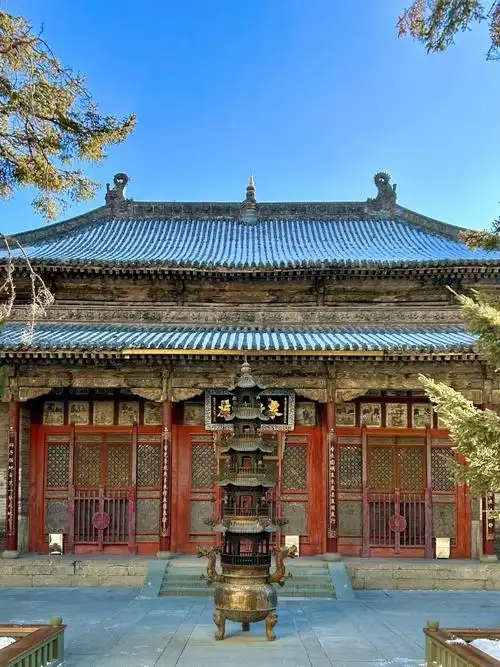 Xiantong Temple traces its origins to the Yongping era of the Eastern Han Dynasty, originally known as "Dafu Lingjiu Temple," giving it a lineage stretching back nearly two millennia—roughly contemporaneous with some of Europe's earliest Christian monastic foundations. Designated the foremost of Mount Wutai's five great Chan (Zen) complexes, it has been rebuilt and expanded numerous times across the Northern Wei, Tang, Ming, and Qing dynasties. The temple holds status as a nationally protected cultural heritage site and serves as the headquarters of Mount Wutai's Buddhist Association.
The temple's central axis features seven grand halls and over 400 rooms, an ambitious layout unmatched among the mountain's monasteries. The Ming-dynasty Bronze Hall, cast in 1606 using approximately 50,000 kilograms of copper, imitates wooden architectural forms in astonishing detail. Its walls are inlaid with countless miniature Buddha images, creating a dazzling golden interior that ranks among the largest and most artistically accomplished bronze halls in all of China, comparable in ambition to Europe's great gilded reliquaries and shrine chambers.
Equally remarkable is the Beamless Hall (Wuliang Dian), a masterpiece of Ming-era brickwork constructed entirely through corbelled vaults—no wooden beams or columns support the structure. Its exterior brick carvings are extraordinarily refined, while inside sits a statue of Amitayus, the Buddha of Infinite Life. This feat of engineering rivals Europe's great vaulted cathedrals, though achieved through purely traditional Chinese masonry techniques that have endured for more than four centuries without reinforcement.
The temple safeguards a remarkable collection of religious treasures: a bronze statue of the Thousand-Handed, Thousand-Bowled Manjushri Bodhisattva with five heads and thirteen faces, imperial calligraphic plaques bearing the brushstrokes of the Kangxi and Qianlong emperors, Tang-dynasty stone steles, and bronze pagodas. Housed in the Great Bell Tower, the "Dark Abyss Bell" weighs over 4,950 kilograms and was cast during the Ming Dynasty. Its solemn tones reportedly carry across the entire mountain, earning recognition as Mount Wutai's preeminent bronze bell and a vital artifact for studying Buddhist material culture.
Xiantong functions primarily as a cultural and historical site rather than an entertainment venue, ideally suited to visitors seeking contemplative exploration amid sacred surroundings. Maintain respectful silence within the halls, and note that flash photography is strictly prohibited. Allow two to three hours for a thoughtful visit, beginning with the Mountain Gate and proceeding through the Hall of Heavenly Kings, the Great Hall of the Buddha, the Beamless Hall, the Bronze Hall, and into the rear courtyard. Early morning visits help avoid the heaviest crowds. Modest attire covering shoulders and knees is recommended as a sign of respect.
The temple is included in the Mount Wutai scenic area pass—135 yuan in peak season, 120 yuan off-peak—with small supplementary fees possible in certain halls. Travelers typically arrive via the Wutaishan high-speed rail station or by transferring through Taiyuan, and advance booking of accommodation and transport is essential during busy periods. For Western visitors, Xiantong offers something rare: an authentic encounter with nearly two thousand years of living Buddhist heritage set within one of China's four sacred mountains—a destination that rewards those who linger, observe, and listen.
Xiantong Temple traces its origins to the Yongping era of the Eastern Han Dynasty, originally known as "Dafu Lingjiu Temple," giving it a lineage stretching back nearly two millennia—roughly contemporaneous with some of Europe's earliest Christian monastic foundations. Designated the foremost of Mount Wutai's five great Chan (Zen) complexes, it has been rebuilt and expanded numerous times across the Northern Wei, Tang, Ming, and Qing dynasties. The temple holds status as a nationally protected cultural heritage site and serves as the headquarters of Mount Wutai's Buddhist Association.
The temple's central axis features seven grand halls and over 400 rooms, an ambitious layout unmatched among the mountain's monasteries. The Ming-dynasty Bronze Hall, cast in 1606 using approximately 50,000 kilograms of copper, imitates wooden architectural forms in astonishing detail. Its walls are inlaid with countless miniature Buddha images, creating a dazzling golden interior that ranks among the largest and most artistically accomplished bronze halls in all of China, comparable in ambition to Europe's great gilded reliquaries and shrine chambers.
Equally remarkable is the Beamless Hall (Wuliang Dian), a masterpiece of Ming-era brickwork constructed entirely through corbelled vaults—no wooden beams or columns support the structure. Its exterior brick carvings are extraordinarily refined, while inside sits a statue of Amitayus, the Buddha of Infinite Life. This feat of engineering rivals Europe's great vaulted cathedrals, though achieved through purely traditional Chinese masonry techniques that have endured for more than four centuries without reinforcement.
The temple safeguards a remarkable collection of religious treasures: a bronze statue of the Thousand-Handed, Thousand-Bowled Manjushri Bodhisattva with five heads and thirteen faces, imperial calligraphic plaques bearing the brushstrokes of the Kangxi and Qianlong emperors, Tang-dynasty stone steles, and bronze pagodas. Housed in the Great Bell Tower, the "Dark Abyss Bell" weighs over 4,950 kilograms and was cast during the Ming Dynasty. Its solemn tones reportedly carry across the entire mountain, earning recognition as Mount Wutai's preeminent bronze bell and a vital artifact for studying Buddhist material culture.
Xiantong functions primarily as a cultural and historical site rather than an entertainment venue, ideally suited to visitors seeking contemplative exploration amid sacred surroundings. Maintain respectful silence within the halls, and note that flash photography is strictly prohibited. Allow two to three hours for a thoughtful visit, beginning with the Mountain Gate and proceeding through the Hall of Heavenly Kings, the Great Hall of the Buddha, the Beamless Hall, the Bronze Hall, and into the rear courtyard. Early morning visits help avoid the heaviest crowds. Modest attire covering shoulders and knees is recommended as a sign of respect.
The temple is included in the Mount Wutai scenic area pass—135 yuan in peak season, 120 yuan off-peak—with small supplementary fees possible in certain halls. Travelers typically arrive via the Wutaishan high-speed rail station or by transferring through Taiyuan, and advance booking of accommodation and transport is essential during busy periods. For Western visitors, Xiantong offers something rare: an authentic encounter with nearly two thousand years of living Buddhist heritage set within one of China's four sacred mountains—a destination that rewards those who linger, observe, and listen.