Jiuzhaigou Entrance Folk Village
⭐ 3.20
Jiuzhaigou Entrance Folk Village, Jiuzhaigou County, Aba Tibetan and Qiang Autonomous Prefecture, Sichuan Province, China
 **Historical Context**
Shuzheng Village predates Jiuzhaigou's designation as a national park in 1982, with Tibetan families claiming ancestral roots that stretch back centuries on the eastern edge of the Tibetan Plateau. This is Amdo, a culturally rich region whose inhabitants have guarded their Buddhist traditions and pastoral way of life since long before Tibet captured the Western imagination through the writings of explorers such as Alexandra David-Néel. Unlike a recreated heritage village, Shuzheng is a living community where monks still chant, grandmothers still churn butter, and children still grow up speaking Tibetan as their mother tongue.
**Architecture**
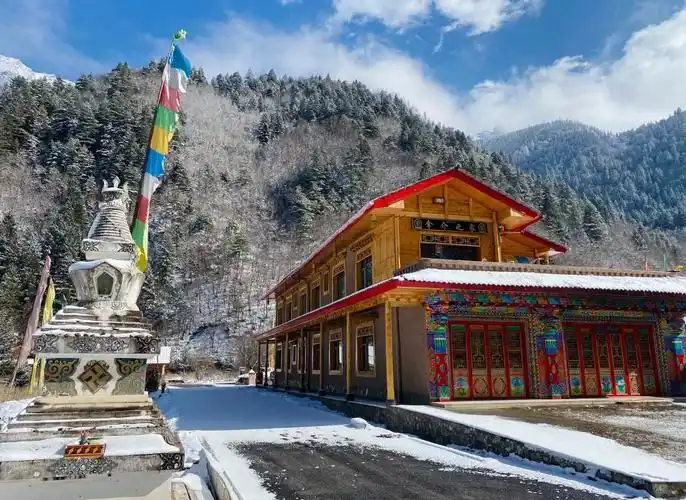
The village cascades down the hillside much like an Alpine hamlet in the Swiss Engadin, with stone-and-timber homes stacked tier upon tier against the mountain slope. Distinctive red-and-white *bianma* grass fringes the eaves, an ancient technique for insulating roofs at high altitudes. At the heart of the settlement rises the Nine-Treasure Lotus Bodhi Stupa, its gilded spire echoing the great Buddhist monuments of Kathmandu or Lhasa in miniature. Nearby, a water-powered mill has ground grain for generations, harnessing the same glacial streams that feed the jewel-toned lakes just beyond the village gate.
**Cultural Significance**
Every corner of Shuzheng whispers of Vajrayana Buddhism: prayer wheels line the lanes, whitewashed chortens mark sacred ground, and fluttering prayer flags in five colors send mantras skyward on the mountain wind. Visitors are warmly welcomed into family homes to share butter tea, barley beer, and yak meat hotpot, much as one might be received in a remote Ladakhi monastery town. In the evenings, villagers and guests link hands for the *guozhuang*, a circle dance not unlike Greek *hasapiko* or Balkan *kolo*, accompanied by throat-singing and the drone of the dramyin fiddle echoing across the valley.
**Practical Visit Information**
No separate ticket is required; simply purchase the standard Jiuzhaigou entry and sightseeing bus ticket, and book through the official Jiuzhaigou WeChat account in advance during peak season when daily visitor caps apply. Ride the park shuttle to the Shuzheng Village stop, where the village opens directly before you. A quick walk-through takes 30 to 60 minutes, but allowing 1.5 to 2 hours lets you linger over a meal, pose for photos in rented Tibetan robes, and join the evening bonfire dance. Final park entry is 2:00 PM, so plan accordingly.
**Why Visit**
In an era when so many ethnic villages are sanitized theme parks, Shuzheng offers something precious: a place where the doorways are still painted with apotropaic symbols, where butter is still churned by hand at dawn, and where you might be invited to share a meal with a family whose great-grandparents tilled this same soil. It is the human heartbeat of a landscape famous for its water and mountains, an intimate counterpoint to the grand spectacle of Jiuzhaigou's lakes and waterfalls. To walk here is to step, briefly, into a world Western tourists usually only glimpse through travelogues and photography.
**Historical Context**
Shuzheng Village predates Jiuzhaigou's designation as a national park in 1982, with Tibetan families claiming ancestral roots that stretch back centuries on the eastern edge of the Tibetan Plateau. This is Amdo, a culturally rich region whose inhabitants have guarded their Buddhist traditions and pastoral way of life since long before Tibet captured the Western imagination through the writings of explorers such as Alexandra David-Néel. Unlike a recreated heritage village, Shuzheng is a living community where monks still chant, grandmothers still churn butter, and children still grow up speaking Tibetan as their mother tongue.
**Architecture**
The village cascades down the hillside much like an Alpine hamlet in the Swiss Engadin, with stone-and-timber homes stacked tier upon tier against the mountain slope. Distinctive red-and-white *bianma* grass fringes the eaves, an ancient technique for insulating roofs at high altitudes. At the heart of the settlement rises the Nine-Treasure Lotus Bodhi Stupa, its gilded spire echoing the great Buddhist monuments of Kathmandu or Lhasa in miniature. Nearby, a water-powered mill has ground grain for generations, harnessing the same glacial streams that feed the jewel-toned lakes just beyond the village gate.
**Cultural Significance**
Every corner of Shuzheng whispers of Vajrayana Buddhism: prayer wheels line the lanes, whitewashed chortens mark sacred ground, and fluttering prayer flags in five colors send mantras skyward on the mountain wind. Visitors are warmly welcomed into family homes to share butter tea, barley beer, and yak meat hotpot, much as one might be received in a remote Ladakhi monastery town. In the evenings, villagers and guests link hands for the *guozhuang*, a circle dance not unlike Greek *hasapiko* or Balkan *kolo*, accompanied by throat-singing and the drone of the dramyin fiddle echoing across the valley.
**Practical Visit Information**
No separate ticket is required; simply purchase the standard Jiuzhaigou entry and sightseeing bus ticket, and book through the official Jiuzhaigou WeChat account in advance during peak season when daily visitor caps apply. Ride the park shuttle to the Shuzheng Village stop, where the village opens directly before you. A quick walk-through takes 30 to 60 minutes, but allowing 1.5 to 2 hours lets you linger over a meal, pose for photos in rented Tibetan robes, and join the evening bonfire dance. Final park entry is 2:00 PM, so plan accordingly.
**Why Visit**
In an era when so many ethnic villages are sanitized theme parks, Shuzheng offers something precious: a place where the doorways are still painted with apotropaic symbols, where butter is still churned by hand at dawn, and where you might be invited to share a meal with a family whose great-grandparents tilled this same soil. It is the human heartbeat of a landscape famous for its water and mountains, an intimate counterpoint to the grand spectacle of Jiuzhaigou's lakes and waterfalls. To walk here is to step, briefly, into a world Western tourists usually only glimpse through travelogues and photography.