Zangqing Folk Customs Village
⭐ 4.40
Zangqing Folk Customs Village, Jiuzhaigou County, Aba Tibetan and Qiang Autonomous Prefecture, Sichuan Province, China
 Set on the eastern edge of the Tibetan Plateau, the village lies within a region historically known as Jiarong (or Kham), a crossroads where Tibetan Buddhist civilization, Qiang indigenous traditions, and ancient Silk Route caravan cultures have mingled for over a millennium. The Qiang people, often considered among China's oldest ethnic groups, are believed to descend from the same ancestors mentioned in the 3,000-year-old oracle bone inscriptions, while the local Tibetan communities trace their spiritual lineage to the same Vajrayana Buddhist traditions that produced the great monasteries of Lhasa. This layered heritage makes the region feel like a meeting point between Asia's highlands and the medieval Tibetan Empire.
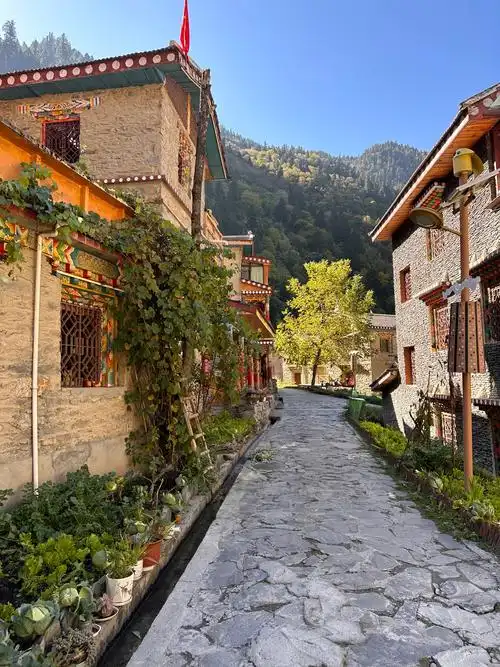
The architecture mirrors the rugged terrain, with stone-walled houses roofed in dark slate tiles echoing the building logic of Alpine villages in Switzerland or northern Italy, yet unmistakably Tibetan in detail. Prayer flags in five sacred colors flutter from every rooftop, while white stupas and mani stone piles line the pathways, much like the wayside shrines pilgrims encounter along the Camino de Santiago. The main square, framed by these colorful banners against the snowy mountain backdrop, has the theatrical staging of a medieval European hill town, only with the sound of long horns and the scent of juniper incense replacing church bells.
Culturally, the village is a living workshop rather than a museum. In the garment studios, visitors slip into heavy woolen chubas adorned with turquoise and coral, the same attire worn during the Yarlung Dynasty centuries ago, while nearby craft rooms teach cross-stitch embroidery and sachet-making using patterns passed down through generations. The culinary program draws directly from the high pastures: butter tea churned in cedar tubs, tsampa roasted barley flour, air-dried yak meat, and whole roasted lamb served family-style. Guests can even try their hand at stirring butter or distilling highland barley wine, fostering the same kind of tactile appreciation that Italian cooking schools offer to food lovers in Tuscany.
Evening brings the village's most communal spectacle. As dusk falls over the snowy peaks, villagers and visitors link hands around a roaring bonfire to dance the guozhuang, a circle dance whose origins stretch back to the Tibetan court's earliest ritual gatherings. The open-air theater then presents episodes from the Epic of King Gesar, a 20-million-word saga comparable to the Iliad and Odyssey combined, performed with painted masks and throat-singing vocals that fill the mountain air. Thangka painters and incense makers demonstrate their crafts in adjacent halls, while a small bazaar offers handcrafted souvenirs ranging from silver amulets to woven bracelets.
Practical planning is straightforward. The village operates daily from 9 a.m. to 10 p.m., and at least half a day should be reserved for the full experience, ideally structured as costume photography, a craft workshop, a traditional Tibetan lunch, a prayer-flag stroll, and the evening bonfire. It sits roughly 15 minutes by car from Jiuzhaigou's main entrance, making it easy to combine with a day in the national park. Given the altitude of over 3,000 meters, travelers should pack high-SPF sunscreen, layered clothing for sharp temperature swings, and throat lozenges for the dry mountain air. Visitors are warmly reminded to respect local customs: avoid touching others' heads, walk clockwise around prayer wheels and stupas, and never step on door thresholds.
Few places allow Western travelers to engage so directly with Tibetan and Qiang traditions while remaining so close to one of the planet's most celebrated natural landscapes. Where Jiuzhaigou dazzles with turquoise lakes and cascading waterfalls, this village enchants with human warmth, ancient rituals, and the enduring artistry of highland peoples. It is, quite simply, the cultural heart of any Sichuan itinerary.
Set on the eastern edge of the Tibetan Plateau, the village lies within a region historically known as Jiarong (or Kham), a crossroads where Tibetan Buddhist civilization, Qiang indigenous traditions, and ancient Silk Route caravan cultures have mingled for over a millennium. The Qiang people, often considered among China's oldest ethnic groups, are believed to descend from the same ancestors mentioned in the 3,000-year-old oracle bone inscriptions, while the local Tibetan communities trace their spiritual lineage to the same Vajrayana Buddhist traditions that produced the great monasteries of Lhasa. This layered heritage makes the region feel like a meeting point between Asia's highlands and the medieval Tibetan Empire.
The architecture mirrors the rugged terrain, with stone-walled houses roofed in dark slate tiles echoing the building logic of Alpine villages in Switzerland or northern Italy, yet unmistakably Tibetan in detail. Prayer flags in five sacred colors flutter from every rooftop, while white stupas and mani stone piles line the pathways, much like the wayside shrines pilgrims encounter along the Camino de Santiago. The main square, framed by these colorful banners against the snowy mountain backdrop, has the theatrical staging of a medieval European hill town, only with the sound of long horns and the scent of juniper incense replacing church bells.
Culturally, the village is a living workshop rather than a museum. In the garment studios, visitors slip into heavy woolen chubas adorned with turquoise and coral, the same attire worn during the Yarlung Dynasty centuries ago, while nearby craft rooms teach cross-stitch embroidery and sachet-making using patterns passed down through generations. The culinary program draws directly from the high pastures: butter tea churned in cedar tubs, tsampa roasted barley flour, air-dried yak meat, and whole roasted lamb served family-style. Guests can even try their hand at stirring butter or distilling highland barley wine, fostering the same kind of tactile appreciation that Italian cooking schools offer to food lovers in Tuscany.
Evening brings the village's most communal spectacle. As dusk falls over the snowy peaks, villagers and visitors link hands around a roaring bonfire to dance the guozhuang, a circle dance whose origins stretch back to the Tibetan court's earliest ritual gatherings. The open-air theater then presents episodes from the Epic of King Gesar, a 20-million-word saga comparable to the Iliad and Odyssey combined, performed with painted masks and throat-singing vocals that fill the mountain air. Thangka painters and incense makers demonstrate their crafts in adjacent halls, while a small bazaar offers handcrafted souvenirs ranging from silver amulets to woven bracelets.
Practical planning is straightforward. The village operates daily from 9 a.m. to 10 p.m., and at least half a day should be reserved for the full experience, ideally structured as costume photography, a craft workshop, a traditional Tibetan lunch, a prayer-flag stroll, and the evening bonfire. It sits roughly 15 minutes by car from Jiuzhaigou's main entrance, making it easy to combine with a day in the national park. Given the altitude of over 3,000 meters, travelers should pack high-SPF sunscreen, layered clothing for sharp temperature swings, and throat lozenges for the dry mountain air. Visitors are warmly reminded to respect local customs: avoid touching others' heads, walk clockwise around prayer wheels and stupas, and never step on door thresholds.
Few places allow Western travelers to engage so directly with Tibetan and Qiang traditions while remaining so close to one of the planet's most celebrated natural landscapes. Where Jiuzhaigou dazzles with turquoise lakes and cascading waterfalls, this village enchants with human warmth, ancient rituals, and the enduring artistry of highland peoples. It is, quite simply, the cultural heart of any Sichuan itinerary.