Zharu Temple
⭐ 3.80
Zharu Temple, Jiuzhaigou County, Aba Tibetan and Qiang Autonomous Prefecture, Sichuan Province, China
 When Zharu Temple was founded in 870 AD, Europe was still absorbing the Viking Age and Charlemagne's empire had just fragmented. The sanctuary belongs to the Bon tradition, a pre-Buddhist Himalayan faith whose roots may stretch back over four millennia—comparable to how pre-Christian Celtic practices persisted in remote parts of Europe. One of the oldest active religious sites in the Tibetan region, the temple weathered dynastic upheavals and was expanded into its present form during the Ming Wanli era (1573–1620), when Shakespeare was writing his earliest plays in Elizabethan England.
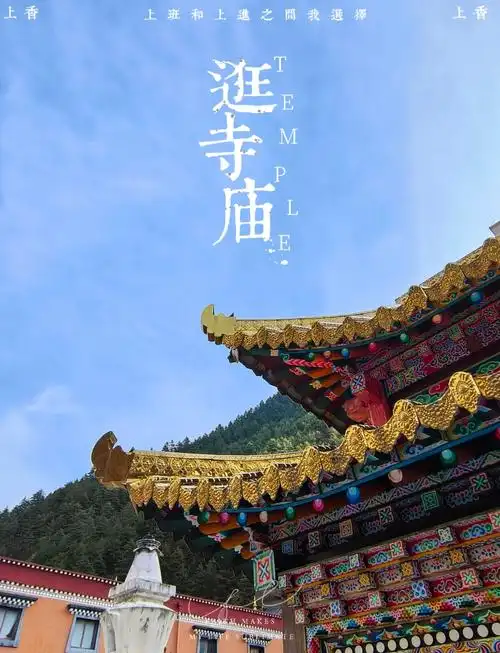
The temple complex uses traditional rammed-earth and timber construction, with gilded roofs and crimson eaves blazing against the surrounding emerald forest. Principal structures include the Great Hall housing the main shrine, a scripture library safeguarding Kangyur volumes, and the showpiece Lhatse Stupa—a soaring white tower rising some fifty meters. Inside the Great Hall stands a Shakyamuni Buddha flanked by a self-manifest golden figure and Buddhist relics, arranged according to Bon philosophy's concept of emptiness as origin. The layout channels pilgrims along a clockwise path that mirrors processional routes in medieval European cathedrals.
Zharu stands as one of the most important surviving strongholds of Yungdrung Bon, the ancient religion that long predated Buddhism's arrival on the Tibetan Plateau. Each prayer flag in white, red, yellow, green, and blue represents one of the five elements in eternal circulation. Once a year, during the Mazhi Festival on the fifteenth day of the fourth lunar month, the temple erupts into vivid ceremony: monks chant, long horns echo through the valley, and pilgrims converge to witness rituals barely changed in centuries. This unbroken continuity makes Zharu a living archaeological site.
Access to Zharu Temple is unique within Jiuzhaigou: there is no independent entrance. Visitors must first purchase a standard park ticket, then board the park's eco-friendly sightseeing shuttle and alight at the Apple Orchard stop along the Zharu Horse Trail. The temple is open daily from roughly 8:00 AM to 6:00 PM, though hours can shift with seasonal park announcements. No separate reservation or fee is required—entry is included with your Jiuzhaigou admission. Allow between one and one-and-a-half hours for a respectful visit, and note that no food or drink is sold on site.
For travelers accustomed to the visual drama of Western cathedrals, Zharu offers something profoundly different: a spiritual encounter embedded in wilderness. The site invites slow wandering along its approach path, quiet circumambulation of the stupa, and a gentle stroll through the surrounding primeval forest. Etiquette mirrors that of any sacred space—dress modestly, maintain silence inside the halls, walk clockwise around shrines and prayer wheels, and never touch statues or ritual objects. Given the high-altitude mountain setting, layered clothing, sturdy footwear, and sun protection are essential. For those seeking to balance Jiuzhaigou's celebrated lakes and waterfalls with meaningful cultural depth, Zharu Temple is unforgettable.
When Zharu Temple was founded in 870 AD, Europe was still absorbing the Viking Age and Charlemagne's empire had just fragmented. The sanctuary belongs to the Bon tradition, a pre-Buddhist Himalayan faith whose roots may stretch back over four millennia—comparable to how pre-Christian Celtic practices persisted in remote parts of Europe. One of the oldest active religious sites in the Tibetan region, the temple weathered dynastic upheavals and was expanded into its present form during the Ming Wanli era (1573–1620), when Shakespeare was writing his earliest plays in Elizabethan England.
The temple complex uses traditional rammed-earth and timber construction, with gilded roofs and crimson eaves blazing against the surrounding emerald forest. Principal structures include the Great Hall housing the main shrine, a scripture library safeguarding Kangyur volumes, and the showpiece Lhatse Stupa—a soaring white tower rising some fifty meters. Inside the Great Hall stands a Shakyamuni Buddha flanked by a self-manifest golden figure and Buddhist relics, arranged according to Bon philosophy's concept of emptiness as origin. The layout channels pilgrims along a clockwise path that mirrors processional routes in medieval European cathedrals.
Zharu stands as one of the most important surviving strongholds of Yungdrung Bon, the ancient religion that long predated Buddhism's arrival on the Tibetan Plateau. Each prayer flag in white, red, yellow, green, and blue represents one of the five elements in eternal circulation. Once a year, during the Mazhi Festival on the fifteenth day of the fourth lunar month, the temple erupts into vivid ceremony: monks chant, long horns echo through the valley, and pilgrims converge to witness rituals barely changed in centuries. This unbroken continuity makes Zharu a living archaeological site.
Access to Zharu Temple is unique within Jiuzhaigou: there is no independent entrance. Visitors must first purchase a standard park ticket, then board the park's eco-friendly sightseeing shuttle and alight at the Apple Orchard stop along the Zharu Horse Trail. The temple is open daily from roughly 8:00 AM to 6:00 PM, though hours can shift with seasonal park announcements. No separate reservation or fee is required—entry is included with your Jiuzhaigou admission. Allow between one and one-and-a-half hours for a respectful visit, and note that no food or drink is sold on site.
For travelers accustomed to the visual drama of Western cathedrals, Zharu offers something profoundly different: a spiritual encounter embedded in wilderness. The site invites slow wandering along its approach path, quiet circumambulation of the stupa, and a gentle stroll through the surrounding primeval forest. Etiquette mirrors that of any sacred space—dress modestly, maintain silence inside the halls, walk clockwise around shrines and prayer wheels, and never touch statues or ritual objects. Given the high-altitude mountain setting, layered clothing, sturdy footwear, and sun protection are essential. For those seeking to balance Jiuzhaigou's celebrated lakes and waterfalls with meaningful cultural depth, Zharu Temple is unforgettable.