Pearl Shoal Waterfall
⭐ 4.80
Pearl Shoal Waterfall, Jiuzhaigou County, Aba Tibetan and Qiang Autonomous Prefecture, Sichuan Province, China
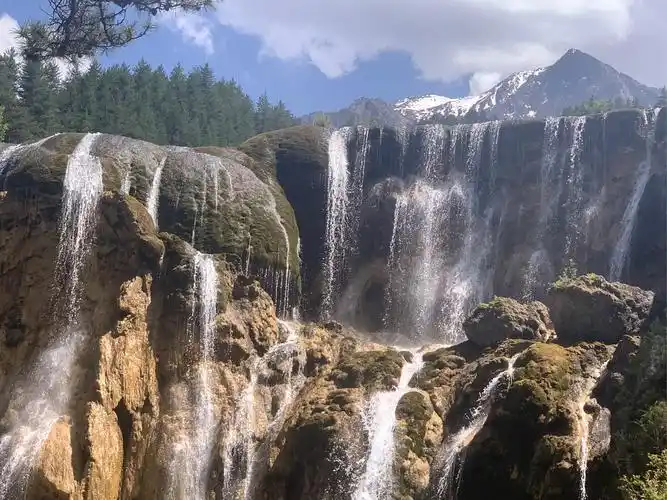 Jiuzhaigou's extraordinary landscapes took shape over roughly 25,000 years, when glacial meltwater dissolved calcium carbonate from surrounding limestone and slowly redeposited it as the terraced travertine formations seen today. Pearl Beach sits atop one of the valley's most extensive staircases of these pale, sculpted deposits—the same geological process responsible for the famous white terraces of Pamukkale in Turkey. Each splash of mineral-rich spring water adds fresh calcite, meaning the waterfall is still being built, drop by drop, with every passing season.
At 162.5 meters across the crest and plunging 21 meters—with sections dropping to 40 meters—Pearl Beach ranks among China's broadest travertine falls. Where the rest of Jiuzhaigou is celebrated for glassy, mirror-still lakes often likened to Alpine reflections in Switzerland or the Italian Dolomites, here the valley roars. A wide crescent of churning white water fans out beneath a curving precipice, and wooden boardwalks thread directly across the torrent above, allowing visitors to approach within meters of the thundering spray without ever leaving the path.
For generations of viewers across East Asia, Pearl Beach is inseparable from the unforgettable opening credits of the 1986 television adaptation of "Journey to the West," where the monk Tripitaka and his three disciples—Monkey, Pigsy, and Sandy—begin their pilgrimage across this very cascade. That six-second shot, rebroadcast countless times over four decades, has turned the waterfall into a pilgrimage site for fans retracing the legendary 7th-century journey of the real monk Xuanzang to India. Geologists and pop-culture pilgrims alike find it a rare convergence of natural spectacle and shared memory.
The roar of Pearl Beach can be heard long before the falls come into view, and the windborne mist can drench a visitor within seconds of stepping onto the lower boardwalk. Between 2 and 4 PM on sunny afternoons, the low-angle sun pierces the spray to forge vivid rainbows that arc across the churning white water—a fleeting phenomenon photographers prize. Early risers, meanwhile, are rewarded with thinner crowds and softer, golden light along the upstream travertine pools, where the namesake pearl-like droplets glint most clearly against the shadowed forest.
The waterfall lies within the Jiuzhaigou National Park and requires no separate ticket; standard park entry plus the mandatory shuttle bus grants access to all viewing areas. Travelers should ride the bus to the "Pearl Beach" stop and descend the left-hand boardwalk toward either the base platform or the mid-level overlook. Allow 40 to 60 minutes for the visit. Arrive between 7 and 9 AM for quieter conditions and softer light, or schedule for mid-afternoon if rainbows are the priority. Sturdy, waterproof shoes with good grip are essential, as boardwalks grow treacherous when wet.
Strict park rules prohibit stepping onto the travertine terraces or wading into the flow, both to protect the fragile calcite ecosystem that has taken millennia to form and to prevent accidents in the near-freezing water. The mineral-rich cascade is not potable. At 2,433 meters above sea level, the altitude can leave visitors short of breath on stairs, so pace yourself. Summer days bring intense UV radiation and sharp temperature drops after dark—layered clothing, sunscreen, hats, and water are non-negotiable. During peak season, reserve park entry through official channels well in advance to avoid being turned away at the gate.
Jiuzhaigou's extraordinary landscapes took shape over roughly 25,000 years, when glacial meltwater dissolved calcium carbonate from surrounding limestone and slowly redeposited it as the terraced travertine formations seen today. Pearl Beach sits atop one of the valley's most extensive staircases of these pale, sculpted deposits—the same geological process responsible for the famous white terraces of Pamukkale in Turkey. Each splash of mineral-rich spring water adds fresh calcite, meaning the waterfall is still being built, drop by drop, with every passing season.
At 162.5 meters across the crest and plunging 21 meters—with sections dropping to 40 meters—Pearl Beach ranks among China's broadest travertine falls. Where the rest of Jiuzhaigou is celebrated for glassy, mirror-still lakes often likened to Alpine reflections in Switzerland or the Italian Dolomites, here the valley roars. A wide crescent of churning white water fans out beneath a curving precipice, and wooden boardwalks thread directly across the torrent above, allowing visitors to approach within meters of the thundering spray without ever leaving the path.
For generations of viewers across East Asia, Pearl Beach is inseparable from the unforgettable opening credits of the 1986 television adaptation of "Journey to the West," where the monk Tripitaka and his three disciples—Monkey, Pigsy, and Sandy—begin their pilgrimage across this very cascade. That six-second shot, rebroadcast countless times over four decades, has turned the waterfall into a pilgrimage site for fans retracing the legendary 7th-century journey of the real monk Xuanzang to India. Geologists and pop-culture pilgrims alike find it a rare convergence of natural spectacle and shared memory.
The roar of Pearl Beach can be heard long before the falls come into view, and the windborne mist can drench a visitor within seconds of stepping onto the lower boardwalk. Between 2 and 4 PM on sunny afternoons, the low-angle sun pierces the spray to forge vivid rainbows that arc across the churning white water—a fleeting phenomenon photographers prize. Early risers, meanwhile, are rewarded with thinner crowds and softer, golden light along the upstream travertine pools, where the namesake pearl-like droplets glint most clearly against the shadowed forest.
The waterfall lies within the Jiuzhaigou National Park and requires no separate ticket; standard park entry plus the mandatory shuttle bus grants access to all viewing areas. Travelers should ride the bus to the "Pearl Beach" stop and descend the left-hand boardwalk toward either the base platform or the mid-level overlook. Allow 40 to 60 minutes for the visit. Arrive between 7 and 9 AM for quieter conditions and softer light, or schedule for mid-afternoon if rainbows are the priority. Sturdy, waterproof shoes with good grip are essential, as boardwalks grow treacherous when wet.
Strict park rules prohibit stepping onto the travertine terraces or wading into the flow, both to protect the fragile calcite ecosystem that has taken millennia to form and to prevent accidents in the near-freezing water. The mineral-rich cascade is not potable. At 2,433 meters above sea level, the altitude can leave visitors short of breath on stairs, so pace yourself. Summer days bring intense UV radiation and sharp temperature drops after dark—layered clothing, sunscreen, hats, and water are non-negotiable. During peak season, reserve park entry through official channels well in advance to avoid being turned away at the gate.