Panda Lake
⭐ 4.70
Panda Lake Scenic Area, Jiuzhaigou County, Aba Tibetan and Qiang Autonomous Prefecture, Sichuan Province, China
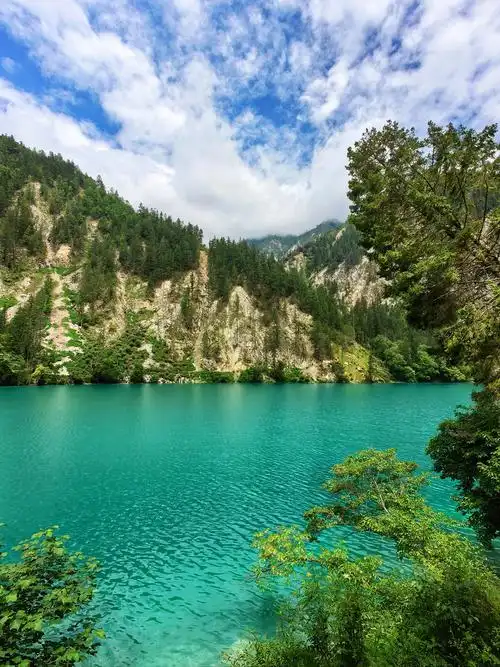 **A Glacial Masterpiece in the Tibetan Foothills**
Panda Lake sits high in the Rize Valley of Jiuzhaigou, a UNESCO World Heritage landscape in Aba Prefecture, where Tibetan and Qiang communities have long considered the mountains sacred. Formed some 20,000 years ago when glacial moraines dammed a mountain stream, the lake belongs to the same family of travertine-rich waters as Croatia's Plitvice Lakes, though Jiuzhaigou's setting feels closer to the high Dolomites or the mirrored lochs of the Scottish Highlands. The very name "Jiuzhaigou" means "Nine-Village Valley," referring to the nine Tibetan settlements that historically thrived here before the valley became a protected reserve in 1982.
**The Lake and Its Living Mosaic**
Mineral-rich waters give the lake its extraordinary color, shifting from translucent peacock blue to deep emerald depending on the light. The celebrated "panda rocks" are calcium carbonate deposits that naturally mimic the animal's playful black-and-white markings, a phenomenon locals have whispered about for generations, with some also claiming real pandas once drank here. The reflection of crimson maples, golden birches, and snow-capped peaks turns the surface into what 17th-century European travelers to Alpine lakes would have called a "second sky," where heaven and earth become indistinguishable.
**Panda Lake Waterfall**
A short walk down a wooden boardwalk from the lake's northern bridge reveals the valley's tallest cascade. Plunging roughly 80 meters in three thunderous tiers, it compares in drama to Norway's Vøringsfossen or Slovenia's Savica Waterfall, though framed by bamboo groves and fir forest rather than bare cliffs. Summer visitors encounter roaring torrents and rainbow-tinted spray; winter rewards the patient with glittering ice columns, a phenomenon echoed in Switzerland's frozen Staubbach.
**Wildlife and Conservation**
The lake hosts one of Jiuzhaigou's healthiest populations of the rare alpine naked carp, a slow-growing species that serves as a barometer of water purity. Dense arrow bamboo around the shoreline shelters pheasants, musk deer, and occasionally giant pandas venturing from higher elevations. Strict rules prohibit drone flights, single-use plastics, feeding fish, or touching the fragile travertine, ensuring this ecosystem remains as pristine for future travelers as the Li River karst has remained for Chinese painters across the centuries.
**Planning Your Visit**
Panda Lake is included in Jiuzhaigou's main entrance ticket (235 yuan peak season, May–November; 170 yuan low season), which also covers the mandatory shuttle bus. Reserve online well in advance for July through October; demand rivals that for Banff or Yellowstone in summer. Board the official shuttle at the valley entrance and ride to Panda Lake Station, walking briefly from Arrow Bamboo Lake. Aim for 9–11 a.m., when soft light favors reflections and crowds thin; allow 1.5–2 hours to circle the lake, descend to the waterfall, and continue onward to the famous Five-Color Lake.
**Why It Belongs on Your Itinerary**
For Western travelers accustomed to the carefully manicured vistas of the Alps or the geological spectacle of Yellowstone, Panda Lake offers something rarer: a place where cultural mythology, Pleistocene geology, and living biodiversity converge into a single, breathtaking frame. Whether you arrive in the lush green of June or the painterly palette of late October, this is the soul of Jiuzhaigou, a valley where water itself becomes the work of art.
**A Glacial Masterpiece in the Tibetan Foothills**
Panda Lake sits high in the Rize Valley of Jiuzhaigou, a UNESCO World Heritage landscape in Aba Prefecture, where Tibetan and Qiang communities have long considered the mountains sacred. Formed some 20,000 years ago when glacial moraines dammed a mountain stream, the lake belongs to the same family of travertine-rich waters as Croatia's Plitvice Lakes, though Jiuzhaigou's setting feels closer to the high Dolomites or the mirrored lochs of the Scottish Highlands. The very name "Jiuzhaigou" means "Nine-Village Valley," referring to the nine Tibetan settlements that historically thrived here before the valley became a protected reserve in 1982.
**The Lake and Its Living Mosaic**
Mineral-rich waters give the lake its extraordinary color, shifting from translucent peacock blue to deep emerald depending on the light. The celebrated "panda rocks" are calcium carbonate deposits that naturally mimic the animal's playful black-and-white markings, a phenomenon locals have whispered about for generations, with some also claiming real pandas once drank here. The reflection of crimson maples, golden birches, and snow-capped peaks turns the surface into what 17th-century European travelers to Alpine lakes would have called a "second sky," where heaven and earth become indistinguishable.
**Panda Lake Waterfall**
A short walk down a wooden boardwalk from the lake's northern bridge reveals the valley's tallest cascade. Plunging roughly 80 meters in three thunderous tiers, it compares in drama to Norway's Vøringsfossen or Slovenia's Savica Waterfall, though framed by bamboo groves and fir forest rather than bare cliffs. Summer visitors encounter roaring torrents and rainbow-tinted spray; winter rewards the patient with glittering ice columns, a phenomenon echoed in Switzerland's frozen Staubbach.
**Wildlife and Conservation**
The lake hosts one of Jiuzhaigou's healthiest populations of the rare alpine naked carp, a slow-growing species that serves as a barometer of water purity. Dense arrow bamboo around the shoreline shelters pheasants, musk deer, and occasionally giant pandas venturing from higher elevations. Strict rules prohibit drone flights, single-use plastics, feeding fish, or touching the fragile travertine, ensuring this ecosystem remains as pristine for future travelers as the Li River karst has remained for Chinese painters across the centuries.
**Planning Your Visit**
Panda Lake is included in Jiuzhaigou's main entrance ticket (235 yuan peak season, May–November; 170 yuan low season), which also covers the mandatory shuttle bus. Reserve online well in advance for July through October; demand rivals that for Banff or Yellowstone in summer. Board the official shuttle at the valley entrance and ride to Panda Lake Station, walking briefly from Arrow Bamboo Lake. Aim for 9–11 a.m., when soft light favors reflections and crowds thin; allow 1.5–2 hours to circle the lake, descend to the waterfall, and continue onward to the famous Five-Color Lake.
**Why It Belongs on Your Itinerary**
For Western travelers accustomed to the carefully manicured vistas of the Alps or the geological spectacle of Yellowstone, Panda Lake offers something rarer: a place where cultural mythology, Pleistocene geology, and living biodiversity converge into a single, breathtaking frame. Whether you arrive in the lush green of June or the painterly palette of late October, this is the soul of Jiuzhaigou, a valley where water itself becomes the work of art.