Zhongshan Bridge
⭐ 4.20
Zhongshan Bridge, Chengguan District, Lanzhou City, Gansu Province, China
 Historical Context
Zhongshan Bridge was completed in 1909, in the twilight years of the Qing Dynasty—a turbulent period when China was opening to foreign trade and modern technology. The bridge was designed by an American engineering firm and built by the German company Thiele & Co. of Tianjin, with Chinese craftsmen contributing labor and costing over 300,000 taels of silver. Constructed in the same era as Britain's Forth Bridge and the Titanic, it represents the global golden age of iron-and-steel engineering. Originally called the Lanzhou Yellow River Iron Bridge, it was renamed in 1942 to honor Sun Yat-sen—the "Father of Modern China" whose revolutionary vision parallels that of George Washington for Americans.
Architecture
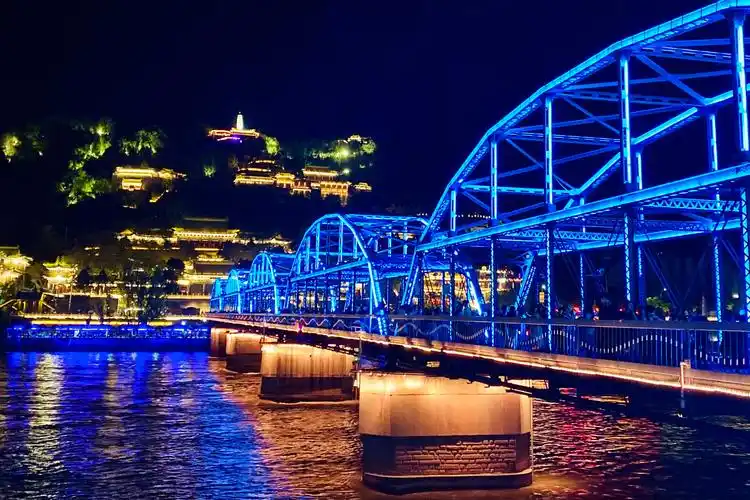
Stretching 233.5 meters across the Yellow River, the bridge rests on four piers supporting five spans of through-type steel truss construction—a design pioneered in Victorian Britain and familiar from landmarks like London's Tower Bridge. Its 8.36-meter width once accommodated carriages and pedestrians, but since 2004 the span has been reserved exclusively for foot traffic. The dark iron framework contrasts strikingly with traditional Chinese memorial archways at its approaches, creating a rare dialogue between Western industrial engineering and Chinese classical aesthetics—a visual fusion rarely seen among the world's historic bridges.
Cultural Significance
Dubbed the "First Bridge of the Yellow River," Zhongshan Bridge has become Lanzhou's defining symbol and a powerful emblem of Yellow River civilization. It stands as a tangible link between China's ancient Silk Road heritage and its modern industrial awakening. Below the bridge, traditional sheepskin rafts—used for over a millennium as river transport and still operating today—create a fascinating temporal dialogue with the steel structure above. This juxtaposition of ancient and modern, organic and industrial, makes the site a profound meditation on Chinese history and resilience.
Practical Information
The bridge sits beneath White Pagoda Mountain in Lanzhou's Chengguan District, along Binhe Road. Take Metro Line 1 to Xiguan Station, then walk about 500 meters, or catch one of numerous bus routes. Admission is free and the bridge is open 24 hours; summer illumination begins around 8:00 PM. Most signage is in Chinese only, so download a translation app beforehand and carry cash—some nearby vendors cannot accept mobile payments. The riverside promenade connects easily to the Yellow River Mother Sculpture and Jinchenguan Cultural Museum, all within walking distance.
Recommended Itinerary
Arrive two hours before sunset and climb White Pagoda Mountain for panoramic views of the bridge and city. Descend to walk across the span as evening light gilds the ironwork. After dark, watch the illumination shimmer on the water, then continue to the south bank promenade for a ride on a traditional sheepskin raft or sip a "Three-Cover Tea" served in a classic lidded bowl. The riverside breeze can be brisk at night, even in summer, so bring a light jacket. Avoid weekends and holidays, when crowds peak at sunset.
Historical Context
Zhongshan Bridge was completed in 1909, in the twilight years of the Qing Dynasty—a turbulent period when China was opening to foreign trade and modern technology. The bridge was designed by an American engineering firm and built by the German company Thiele & Co. of Tianjin, with Chinese craftsmen contributing labor and costing over 300,000 taels of silver. Constructed in the same era as Britain's Forth Bridge and the Titanic, it represents the global golden age of iron-and-steel engineering. Originally called the Lanzhou Yellow River Iron Bridge, it was renamed in 1942 to honor Sun Yat-sen—the "Father of Modern China" whose revolutionary vision parallels that of George Washington for Americans.
Architecture
Stretching 233.5 meters across the Yellow River, the bridge rests on four piers supporting five spans of through-type steel truss construction—a design pioneered in Victorian Britain and familiar from landmarks like London's Tower Bridge. Its 8.36-meter width once accommodated carriages and pedestrians, but since 2004 the span has been reserved exclusively for foot traffic. The dark iron framework contrasts strikingly with traditional Chinese memorial archways at its approaches, creating a rare dialogue between Western industrial engineering and Chinese classical aesthetics—a visual fusion rarely seen among the world's historic bridges.
Cultural Significance
Dubbed the "First Bridge of the Yellow River," Zhongshan Bridge has become Lanzhou's defining symbol and a powerful emblem of Yellow River civilization. It stands as a tangible link between China's ancient Silk Road heritage and its modern industrial awakening. Below the bridge, traditional sheepskin rafts—used for over a millennium as river transport and still operating today—create a fascinating temporal dialogue with the steel structure above. This juxtaposition of ancient and modern, organic and industrial, makes the site a profound meditation on Chinese history and resilience.
Practical Information
The bridge sits beneath White Pagoda Mountain in Lanzhou's Chengguan District, along Binhe Road. Take Metro Line 1 to Xiguan Station, then walk about 500 meters, or catch one of numerous bus routes. Admission is free and the bridge is open 24 hours; summer illumination begins around 8:00 PM. Most signage is in Chinese only, so download a translation app beforehand and carry cash—some nearby vendors cannot accept mobile payments. The riverside promenade connects easily to the Yellow River Mother Sculpture and Jinchenguan Cultural Museum, all within walking distance.
Recommended Itinerary
Arrive two hours before sunset and climb White Pagoda Mountain for panoramic views of the bridge and city. Descend to walk across the span as evening light gilds the ironwork. After dark, watch the illumination shimmer on the water, then continue to the south bank promenade for a ride on a traditional sheepskin raft or sip a "Three-Cover Tea" served in a classic lidded bowl. The riverside breeze can be brisk at night, even in summer, so bring a light jacket. Avoid weekends and holidays, when crowds peak at sunset.