Liu'an People's Square
⭐ 2.50
People's Square, Jin'an District, Liu'an City, Anhui Province, China
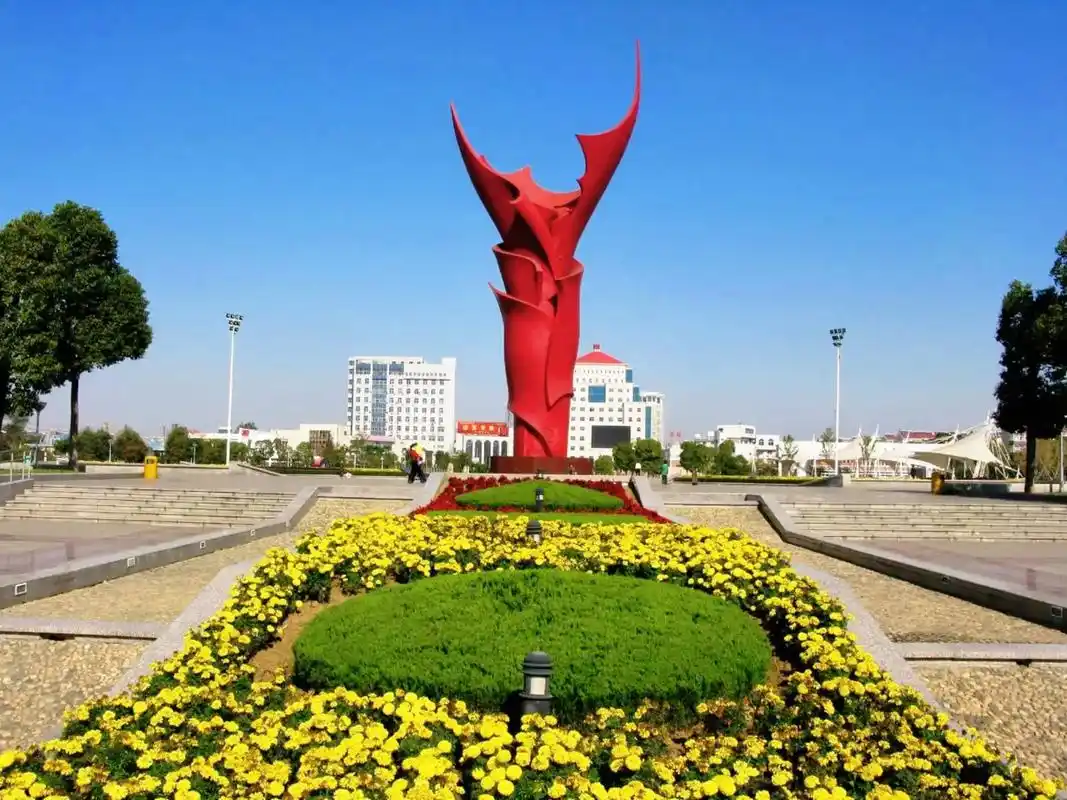 Liu'an People's Square is not a relic of antiquity but a product of China's 21st-century urban renaissance. Conceived in the 2000s as a companion to the new municipal government complex on Fozi Ling Road, it answered a real civic need: the historic core of this western Anhui city had long lacked a true central gathering space. In scale and ambition, it recalls the great civic squares of post-war European reconstruction — think of Warsaw's Plac Defilad or the rebuilt public forums of German cities — though here the purpose is gentler, focused on daily leisure rather than national commemoration. The square has since matured into the social anchor of a city transitioning from market-town traditions to modern metropolitan life.
Architecturally, the designers embraced a "surface open, underground composite" philosophy that will feel familiar to anyone who has explored a Scandinavian or Dutch urban renewal project. Above ground, the layout is deliberately simple: broad paved plazas, winding footpaths, clusters of trees and shrubs, and subtle sunken seating areas. Beneath the surface lies a single basement level with a 3.6-metre clearance, ingeniously combining civil defence shelter infrastructure, public parking, and accessibility provisions. After dark, the square transforms as lighting washes across the geometric planes, lending a layered, almost theatrical quality that photographers — particularly those drawn to contemporary Chinese cityscapes — will appreciate.
The square's true value lies not in concrete or steel but in the daily theatre of public life it hosts. From sunrise, retirees unroll their mats for tai chi; by evening, the open spaces fill with dancers performing the choreographed routines known as *guangchang wu*, families with children, and couples seeking cooler air. This unscripted choreography of ordinary existence is what makes the site compelling for international visitors — it is the Chinese cousin of observing locals at a Madrid *plaza mayor* or a Lisbon neighbourhood square, but with its own distinctly Anhui cadence. Visitors are welcome to watch, photograph respectfully, and absorb a scene rarely staged for tourists.
Practical details are straightforward: the square is open year-round with no admission fee, no performances, and no rides. The optimal window is between 17:00 and 20:00, when temperatures are most comfortable, the lighting design is fully active, and resident activity peaks. Underground parking makes driving or a taxi convenient, and the square pairs naturally with a look at the adjacent government buildings. Those interested in the region's revolutionary history can extend their visit to the Red Army Square scenic area or the Pi-Shi-Hang Irrigation Memorial, which commemorate western Anhui's role in both the communist struggle and post-1949 nation-building. Nearby shops are limited, so carry water and wear comfortable flat shoes.
A final note for Western travellers: do not confuse this plaza with Yeji District People's Square, located some 30 kilometres away in a separate administrative area. The site is primarily a space for local residents, so visitors should observe quiet decorum, respect the unhurried pace of those using the square, and avoid disrupting tai chi or dance groups. Before setting out, check with the Liu'an Culture and Tourism Bureau or your hotel front desk for any temporary closures or scheduled events that might affect the atmosphere you came to experience.
Liu'an People's Square is not a relic of antiquity but a product of China's 21st-century urban renaissance. Conceived in the 2000s as a companion to the new municipal government complex on Fozi Ling Road, it answered a real civic need: the historic core of this western Anhui city had long lacked a true central gathering space. In scale and ambition, it recalls the great civic squares of post-war European reconstruction — think of Warsaw's Plac Defilad or the rebuilt public forums of German cities — though here the purpose is gentler, focused on daily leisure rather than national commemoration. The square has since matured into the social anchor of a city transitioning from market-town traditions to modern metropolitan life.
Architecturally, the designers embraced a "surface open, underground composite" philosophy that will feel familiar to anyone who has explored a Scandinavian or Dutch urban renewal project. Above ground, the layout is deliberately simple: broad paved plazas, winding footpaths, clusters of trees and shrubs, and subtle sunken seating areas. Beneath the surface lies a single basement level with a 3.6-metre clearance, ingeniously combining civil defence shelter infrastructure, public parking, and accessibility provisions. After dark, the square transforms as lighting washes across the geometric planes, lending a layered, almost theatrical quality that photographers — particularly those drawn to contemporary Chinese cityscapes — will appreciate.
The square's true value lies not in concrete or steel but in the daily theatre of public life it hosts. From sunrise, retirees unroll their mats for tai chi; by evening, the open spaces fill with dancers performing the choreographed routines known as *guangchang wu*, families with children, and couples seeking cooler air. This unscripted choreography of ordinary existence is what makes the site compelling for international visitors — it is the Chinese cousin of observing locals at a Madrid *plaza mayor* or a Lisbon neighbourhood square, but with its own distinctly Anhui cadence. Visitors are welcome to watch, photograph respectfully, and absorb a scene rarely staged for tourists.
Practical details are straightforward: the square is open year-round with no admission fee, no performances, and no rides. The optimal window is between 17:00 and 20:00, when temperatures are most comfortable, the lighting design is fully active, and resident activity peaks. Underground parking makes driving or a taxi convenient, and the square pairs naturally with a look at the adjacent government buildings. Those interested in the region's revolutionary history can extend their visit to the Red Army Square scenic area or the Pi-Shi-Hang Irrigation Memorial, which commemorate western Anhui's role in both the communist struggle and post-1949 nation-building. Nearby shops are limited, so carry water and wear comfortable flat shoes.
A final note for Western travellers: do not confuse this plaza with Yeji District People's Square, located some 30 kilometres away in a separate administrative area. The site is primarily a space for local residents, so visitors should observe quiet decorum, respect the unhurried pace of those using the square, and avoid disrupting tai chi or dance groups. Before setting out, check with the Liu'an Culture and Tourism Bureau or your hotel front desk for any temporary closures or scheduled events that might affect the atmosphere you came to experience.