Shuzheng Lakes
⭐ 4.60
Shuzheng Lakes, Jiuzhaigou County, Aba Tibetan and Qiang Autonomous Prefecture, Sichuan Province, China
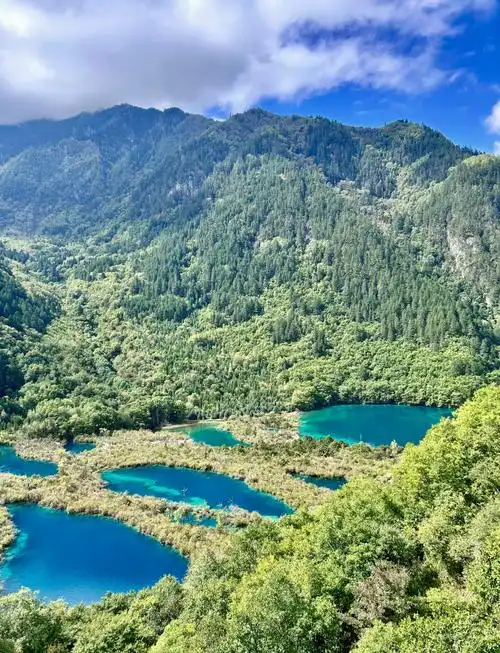 Geologically, Shuzheng Qunhai is part of one of Earth's most extraordinary karst hydrological systems, where calcium-carbonate-rich spring water has spent millennia building natural dams that would rival the tiered travertine terraces of Pamukkale in Turkey or the cascade formations of Plitvice Lakes in Croatia. Sitting between 2,187 and 2,280 meters elevation in the Min Mountains of northern Sichuan, the 19 interconnected lakes account for roughly 40 percent of Jiuzhaigou's total lake volume. The valley stretches 13.8 kilometers through primeval forest, and the interplay of mineral-rich water, ancient woodlands, and vertical drop creates what hydrologists consider a living laboratory of travertine formation—a landscape essentially unique on the planet.
Architecturally, the site showcases a remarkable dialogue between human craftsmanship and natural engineering. The calcified dams themselves, some centuries old, function as organic masonry that grows thicker with each passing season. Traditional Tibetan watermills dot the lakeshore, their wooden wheels still grinding barley much as they did during the Ming and Qing dynasties, while nearby mani stone piles and prayer wheels anchor the landscape in Buddhist devotional practice. Handcrafted wooden boardwalks, designed to hover just above the water without disturbing the fragile travertine, allow visitors to traverse the scene much as pilgrims once followed mountain shrine routes in the Alps or the Japanese Kumano Kodō.
Culturally, Shuzheng is the spiritual and social heart of Jiuzhaigou's Tibetan and Qiang communities. White stupas and colorful prayer flags flutter along the shoreline, marking sacred spaces that have drawn worshippers for over a thousand years—predating even Lhasa's Jokhang Temple, with which they share devotional kinship. The nearby Shuzheng Village preserves the architectural traditions of both ethnic groups, with stone-and-timber Qiang watchtower influences echoing the fortified towers found in the Caucasus, while the Tibetan homes reflect the broader Himalayan cultural sphere. Visiting respectfully offers travelers an authentic encounter with two of China's most distinctive minority cultures.
Practically speaking, the best access is via the park's sightseeing shuttle to either Rhinoceros Lake or Shuzheng Village stops, followed by a gentle downhill walk along wooden boardwalks. The recommended route—Rhinoceros Lake, Tiger Lake, Shuzheng Waterfall, Shuzheng Qunhai, Double Dragon Lake—takes 1 to 1.5 hours, though photographers should allow 45 to 60 extra minutes. Entry is included in the main Jiuzhaigou ticket. Autumn (late September through November) delivers peak color as the surrounding forests blaze in red and gold against turquoise water; summer brings powerful waterfalls and lush greenery; winter transforms everything into a silent ice kingdom of hanging frozen cascades and crystalline trees.
At approximately 2,200 meters elevation, mild altitude adjustment is advisable on the first day—comparable to the thinner air of Aspen, Colorado, or the Spanish Sierra Nevada. August brings monsoon rains and slippery boardwalks, so waterproof footwear and rain gear are essential. Visitors should remain strictly on designated walkways, never enter closed-off areas, and avoid tossing anything into the lakes. As you pass through Shuzheng Village, observe local customs: do not touch prayer wheels or walk clockwise around shrines, and ask permission before photographing villagers. Those who travel thoughtfully will find Shuzheng Qunhai not merely a scenic stop but a profound encounter with the living harmony between mountain, water, and Tibetan culture.
Geologically, Shuzheng Qunhai is part of one of Earth's most extraordinary karst hydrological systems, where calcium-carbonate-rich spring water has spent millennia building natural dams that would rival the tiered travertine terraces of Pamukkale in Turkey or the cascade formations of Plitvice Lakes in Croatia. Sitting between 2,187 and 2,280 meters elevation in the Min Mountains of northern Sichuan, the 19 interconnected lakes account for roughly 40 percent of Jiuzhaigou's total lake volume. The valley stretches 13.8 kilometers through primeval forest, and the interplay of mineral-rich water, ancient woodlands, and vertical drop creates what hydrologists consider a living laboratory of travertine formation—a landscape essentially unique on the planet.
Architecturally, the site showcases a remarkable dialogue between human craftsmanship and natural engineering. The calcified dams themselves, some centuries old, function as organic masonry that grows thicker with each passing season. Traditional Tibetan watermills dot the lakeshore, their wooden wheels still grinding barley much as they did during the Ming and Qing dynasties, while nearby mani stone piles and prayer wheels anchor the landscape in Buddhist devotional practice. Handcrafted wooden boardwalks, designed to hover just above the water without disturbing the fragile travertine, allow visitors to traverse the scene much as pilgrims once followed mountain shrine routes in the Alps or the Japanese Kumano Kodō.
Culturally, Shuzheng is the spiritual and social heart of Jiuzhaigou's Tibetan and Qiang communities. White stupas and colorful prayer flags flutter along the shoreline, marking sacred spaces that have drawn worshippers for over a thousand years—predating even Lhasa's Jokhang Temple, with which they share devotional kinship. The nearby Shuzheng Village preserves the architectural traditions of both ethnic groups, with stone-and-timber Qiang watchtower influences echoing the fortified towers found in the Caucasus, while the Tibetan homes reflect the broader Himalayan cultural sphere. Visiting respectfully offers travelers an authentic encounter with two of China's most distinctive minority cultures.
Practically speaking, the best access is via the park's sightseeing shuttle to either Rhinoceros Lake or Shuzheng Village stops, followed by a gentle downhill walk along wooden boardwalks. The recommended route—Rhinoceros Lake, Tiger Lake, Shuzheng Waterfall, Shuzheng Qunhai, Double Dragon Lake—takes 1 to 1.5 hours, though photographers should allow 45 to 60 extra minutes. Entry is included in the main Jiuzhaigou ticket. Autumn (late September through November) delivers peak color as the surrounding forests blaze in red and gold against turquoise water; summer brings powerful waterfalls and lush greenery; winter transforms everything into a silent ice kingdom of hanging frozen cascades and crystalline trees.
At approximately 2,200 meters elevation, mild altitude adjustment is advisable on the first day—comparable to the thinner air of Aspen, Colorado, or the Spanish Sierra Nevada. August brings monsoon rains and slippery boardwalks, so waterproof footwear and rain gear are essential. Visitors should remain strictly on designated walkways, never enter closed-off areas, and avoid tossing anything into the lakes. As you pass through Shuzheng Village, observe local customs: do not touch prayer wheels or walk clockwise around shrines, and ask permission before photographing villagers. Those who travel thoughtfully will find Shuzheng Qunhai not merely a scenic stop but a profound encounter with the living harmony between mountain, water, and Tibetan culture.