Yujin Bridge
⭐ 3.80
Yujin Bridge, Shizhong District, Leshan City, Sichuan Province, China
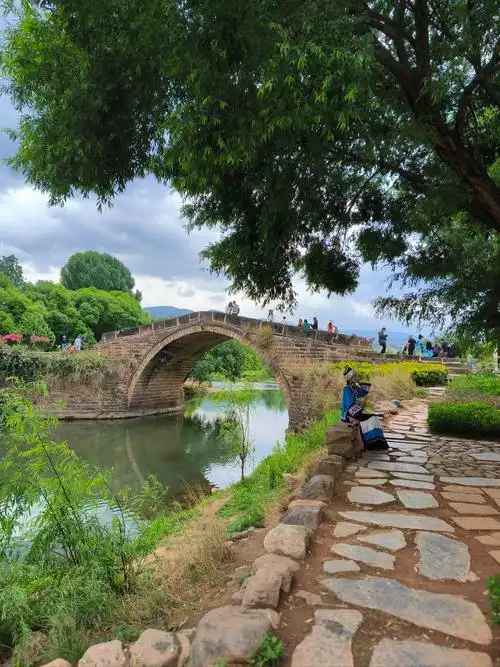 Yujin Bridge traces its origins to the twilight of the Ming dynasty and the dawn of the Qing, though the present structure was substantially rebuilt during the 1930s. For centuries it served as a vital chokepoint on the Tea Horse Road's Yunnan-Tibet route, where mule caravans—often numbering in the hundreds of beasts—navigated the treacherous mountain passes between Yunnan, Sichuan, and Lhasa. Think of it as a rustic cousin to the stone bridges of medieval Europe: while Europe's bridges carried pilgrims and merchants along the Rhine or the Italian peninsula, Yujin carried the lifeblood of the southwestern frontier trade. The shallow, polished hollows gouged into its flagstones are tangible relics of that era, as eloquent as any document in tracing the rhythms of pre-modern Asian commerce.
Architecturally, the bridge is a study in restrained elegance. Local blue-grey limestone is laid in a precise single-arch span over the Heihui River, a structural choice both economical and enduring. At either end, the parapets are ornamented with traditional Bai carvings—stylized turtle heads said to ward off floodwaters, alongside the curiously lifelike giant salamanders native to these mountain streams. The contrast between the rough-hewn decorative stones and the silken smoothness of the central walking surface—polished by uncountable generations of hoof traffic—gives the bridge a quietly cinematic quality.
Culturally, the bridge stands as a meeting point of three worlds: the Bai people of Dali, Han traders from the interior, and Tibetan highlanders. A small shrine at one abutment still receives offerings from villagers who regard the bridge as more than mere infrastructure. A Qing-era stele inscribed by the scholar Zhao Fan preserves the names of those who funded its upkeep, offering a rare paper trail to complement the stone one. It is now recognized on Yunnan's official water-cultural heritage list.
Visiting is refreshingly uncomplicated. The bridge is open around the clock, free of charge, with no reservation required. Shaxi lies roughly two hours by car from Lijiang Sanyi Airport and about two and a half hours from Dali Fengyi Airport; arranging a private driver or shared transfer is the most practical option. Within the town itself, accommodation ranges from boutique guesthouses to simpler family-run inns, and the bridge pairs naturally with visits to nearby Sideng Street, the centuries-old theatrical stage, and the atmospheric Pioneer Bookstore outpost.
The finest light arrives in the half-hour after sunrise and again at sunset, when river mists drift beneath the arch and the limestone glows softly—conditions beloved by photographers chasing a traditional Chinese ink-wash aesthetic. Wear sturdy, non-slip footwear (the stones turn treacherous in the rainy season, which runs roughly June through September), and bring a light jacket for the cool mornings and evenings. Take your time crossing; linger over the hoof prints, the stone creatures, and perhaps a conversation with an elder whose grandfather once drove mules across this very span.
Why visit? In an age of expressways and high-speed rail, Yujin Bridge offers something increasingly rare: an unmediated encounter with the slow, deliberate pulse of the old Silk Road world. It is history you can feel underfoot.
Yujin Bridge traces its origins to the twilight of the Ming dynasty and the dawn of the Qing, though the present structure was substantially rebuilt during the 1930s. For centuries it served as a vital chokepoint on the Tea Horse Road's Yunnan-Tibet route, where mule caravans—often numbering in the hundreds of beasts—navigated the treacherous mountain passes between Yunnan, Sichuan, and Lhasa. Think of it as a rustic cousin to the stone bridges of medieval Europe: while Europe's bridges carried pilgrims and merchants along the Rhine or the Italian peninsula, Yujin carried the lifeblood of the southwestern frontier trade. The shallow, polished hollows gouged into its flagstones are tangible relics of that era, as eloquent as any document in tracing the rhythms of pre-modern Asian commerce.
Architecturally, the bridge is a study in restrained elegance. Local blue-grey limestone is laid in a precise single-arch span over the Heihui River, a structural choice both economical and enduring. At either end, the parapets are ornamented with traditional Bai carvings—stylized turtle heads said to ward off floodwaters, alongside the curiously lifelike giant salamanders native to these mountain streams. The contrast between the rough-hewn decorative stones and the silken smoothness of the central walking surface—polished by uncountable generations of hoof traffic—gives the bridge a quietly cinematic quality.
Culturally, the bridge stands as a meeting point of three worlds: the Bai people of Dali, Han traders from the interior, and Tibetan highlanders. A small shrine at one abutment still receives offerings from villagers who regard the bridge as more than mere infrastructure. A Qing-era stele inscribed by the scholar Zhao Fan preserves the names of those who funded its upkeep, offering a rare paper trail to complement the stone one. It is now recognized on Yunnan's official water-cultural heritage list.
Visiting is refreshingly uncomplicated. The bridge is open around the clock, free of charge, with no reservation required. Shaxi lies roughly two hours by car from Lijiang Sanyi Airport and about two and a half hours from Dali Fengyi Airport; arranging a private driver or shared transfer is the most practical option. Within the town itself, accommodation ranges from boutique guesthouses to simpler family-run inns, and the bridge pairs naturally with visits to nearby Sideng Street, the centuries-old theatrical stage, and the atmospheric Pioneer Bookstore outpost.
The finest light arrives in the half-hour after sunrise and again at sunset, when river mists drift beneath the arch and the limestone glows softly—conditions beloved by photographers chasing a traditional Chinese ink-wash aesthetic. Wear sturdy, non-slip footwear (the stones turn treacherous in the rainy season, which runs roughly June through September), and bring a light jacket for the cool mornings and evenings. Take your time crossing; linger over the hoof prints, the stone creatures, and perhaps a conversation with an elder whose grandfather once drove mules across this very span.
Why visit? In an age of expressways and high-speed rail, Yujin Bridge offers something increasingly rare: an unmediated encounter with the slow, deliberate pulse of the old Silk Road world. It is history you can feel underfoot.