Giant Buddha Temple
⭐ 4.60
Dafosi, Shizhong District, Leshan, Sichuan, China
 Historical Context
Lingyun Temple was established during the Kaiyuan era of the Tang dynasty (713–741 CE), predating the Giant Buddha's carving by several decades. This places its origins in the same golden age of Buddhist expansion that produced Japan's Todai-ji and Korea's Bulguksa—though Lingyun's lineage traces directly to the Himalayan Buddhist transmission route. Rebuilt in 1667 under the Kangxi Emperor after earlier Ming-Qing cycles of prosperity and ruin, the surviving complex stands as tangible proof of over a millennium of continuous worship at one of China's most spiritually charged river junctions.
Architecture
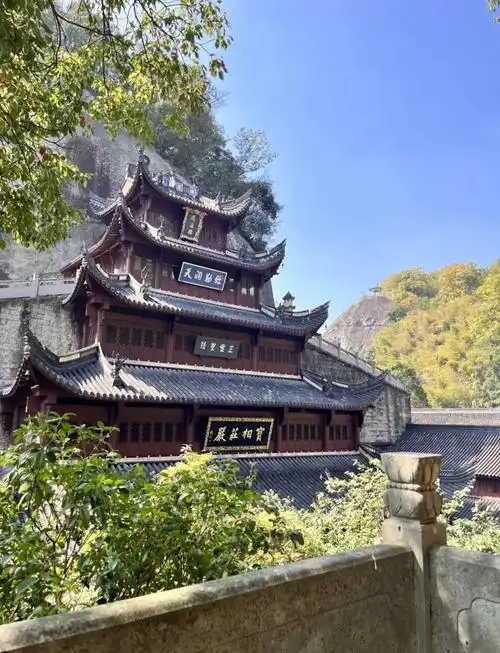
The temple cascades down the mountainside in a symmetrical triple-courtyard plan, ascending from the Heavenly Kings Hall through the Mahavira Hall to the Sutra Library. Sweeping upturned eaves, painted beams, and carved brackets recall the visual rhythm of imperial Chinese palace halls—yet the entire ensemble is dwarfed by the 233-foot Buddha carved directly into the cliff beyond. Stone steles, ancient pines, and auxiliary structures like the Lingbao Pagoda and Dongpo Tower link the temple into a sweeping cultural landscape that rivals the integrated monastic settings of Meteora in Greece.
Cultural Significance
As the spiritual heart of the UNESCO-listed Leshan Giant Buddha Scenic Area, Lingyun embodies the rare Chinese ideal of "temple and Buddha as one, mountain and water in harmony." Famous poets Su Shi (Su Dongpo) and Li Bai are said to have lingered here composing verses, linking the site to the broader Song-dynasty literati tradition. The temple also preserves invaluable evidence of how Tang-era Buddhism spread westward into the Ba-Shu cultural region, making it as historically resonant as the great pilgrimage monasteries of medieval Europe.
Practical Visit Information
A combined ticket covering Lingyun Temple, the Giant Buddha, Wuyou Temple, and Mahao Cliff Tombs costs 80 RMB per person. From 2025, paper tickets are abolished—visitors simply swipe their ID at the gate, while an overseas-traveler service station offers multilingual audio guides and passport check-in at the manual lane. Peak-season hours (April 1–October 7) run 7:30 am–6:30 pm; off-season hours shift to 8:00 am–5:30 pm. The site is roughly 2 hours by high-speed rail from Chengdu.
Why Visit
What makes Lingyun unforgettable is the seamless fusion of sacred architecture, monumental sculpture, and river landscape—a scale of ambition that puts one in mind of Michelangelo's Sistine Chapel combined with the cliff grandeur of Mont Saint-Michel. Climb the Nine-Bend Plank Path to stand at the Buddha's feet, or take the 40-minute ferry from Jiazhou Wharf to see the entire mountain collapse into the profile of a reclining Buddha across the skyline. Aim for spring (March–May) or autumn (September–November), and arrive at opening time during peak months to beat the queues on the cliff walkways.
Historical Context
Lingyun Temple was established during the Kaiyuan era of the Tang dynasty (713–741 CE), predating the Giant Buddha's carving by several decades. This places its origins in the same golden age of Buddhist expansion that produced Japan's Todai-ji and Korea's Bulguksa—though Lingyun's lineage traces directly to the Himalayan Buddhist transmission route. Rebuilt in 1667 under the Kangxi Emperor after earlier Ming-Qing cycles of prosperity and ruin, the surviving complex stands as tangible proof of over a millennium of continuous worship at one of China's most spiritually charged river junctions.
Architecture
The temple cascades down the mountainside in a symmetrical triple-courtyard plan, ascending from the Heavenly Kings Hall through the Mahavira Hall to the Sutra Library. Sweeping upturned eaves, painted beams, and carved brackets recall the visual rhythm of imperial Chinese palace halls—yet the entire ensemble is dwarfed by the 233-foot Buddha carved directly into the cliff beyond. Stone steles, ancient pines, and auxiliary structures like the Lingbao Pagoda and Dongpo Tower link the temple into a sweeping cultural landscape that rivals the integrated monastic settings of Meteora in Greece.
Cultural Significance
As the spiritual heart of the UNESCO-listed Leshan Giant Buddha Scenic Area, Lingyun embodies the rare Chinese ideal of "temple and Buddha as one, mountain and water in harmony." Famous poets Su Shi (Su Dongpo) and Li Bai are said to have lingered here composing verses, linking the site to the broader Song-dynasty literati tradition. The temple also preserves invaluable evidence of how Tang-era Buddhism spread westward into the Ba-Shu cultural region, making it as historically resonant as the great pilgrimage monasteries of medieval Europe.
Practical Visit Information
A combined ticket covering Lingyun Temple, the Giant Buddha, Wuyou Temple, and Mahao Cliff Tombs costs 80 RMB per person. From 2025, paper tickets are abolished—visitors simply swipe their ID at the gate, while an overseas-traveler service station offers multilingual audio guides and passport check-in at the manual lane. Peak-season hours (April 1–October 7) run 7:30 am–6:30 pm; off-season hours shift to 8:00 am–5:30 pm. The site is roughly 2 hours by high-speed rail from Chengdu.
Why Visit
What makes Lingyun unforgettable is the seamless fusion of sacred architecture, monumental sculpture, and river landscape—a scale of ambition that puts one in mind of Michelangelo's Sistine Chapel combined with the cliff grandeur of Mont Saint-Michel. Climb the Nine-Bend Plank Path to stand at the Buddha's feet, or take the 40-minute ferry from Jiazhou Wharf to see the entire mountain collapse into the profile of a reclining Buddha across the skyline. Aim for spring (March–May) or autumn (September–November), and arrive at opening time during peak months to beat the queues on the cliff walkways.