Leshan Giant Buddha
⭐ 4.60
Bizi Street, Shizhong District, Leshan City, Sichuan Province, China
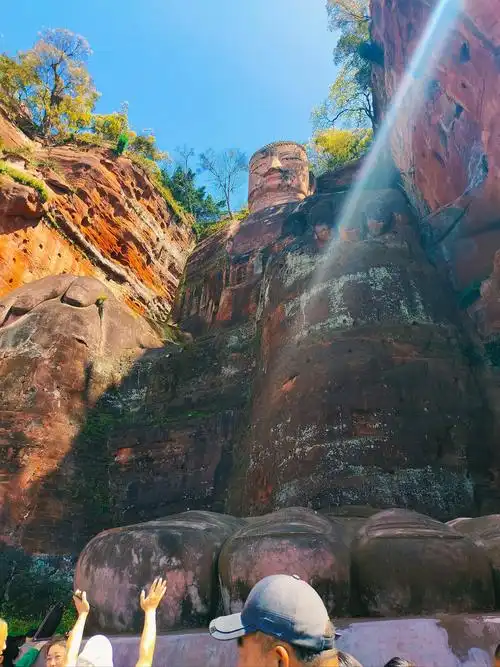 The Leshan Giant Buddha has no real European equivalent in scale and ambition, but it invites comparison with the great medieval cathedrals—think of Chartres or Cologne, but hewn from a living cliff rather than built upward. Construction began in 713 CE during the Tang Dynasty, an era that paralleled the early Abbasid Caliphate in the Islamic world and the reign of the Byzantine iconoclasts. The monk Haitong launched the project hoping to calm the turbulent waters where the Min, Dadu, and Qingyi rivers meet, a stretch notorious for sinking boats. After Haitong's death, work continued under his disciples and finally a governor named Zhang, with the colossal figure completed in 803 CE—a nine-decade labor of devotion that fused Buddhist faith with practical hydraulic engineering.
What makes Leshan remarkable is the marriage of art and ancient drainage technology. The 71-meter seated Maitreya—roughly twice the height of the Colossus of Rhodes in antiquity's wonder list—features a head 14.7 meters tall, shoulders 28 meters across, and ears 7 meters long. Remarkably, a hidden network of channels woven through the hair curls and garment folds channels rainwater away from the body, a sophisticated system that has preserved the sculpture for over 1,200 years. The thousand plus tightly coiled hair buns are not merely decorative but functional, channeling moisture through an internal labyrinth to the body and behind the ears, then down to the river below.
Beyond the main Buddha, the surrounding landscape holds layers of Chinese history. The Lingyun Temple above the head dates to the Qing Dynasty, while the nearby Wuyou Temple and Mahao Cliff Tombs reveal Han Dynasty burial practices from nearly two millennia earlier. From certain river viewpoints, the entire mountain range forms a natural reclining Buddha measuring several kilometers long, a chance geological coincidence that local monks long ago read as sacred. This interplay of carved monument, ancient tomb art, and natural iconography makes the site unusually layered for visitors accustomed to single-focus landmarks.
For practical planning, the site offers two approaches. Hikers enter through the North Gate for around 80 RMB, descending the winding Nine-Turn Plank Path down the cliff face to reach the Buddha's massive feet—a 2.5 to 3.5 hour experience that lets you literally "hug the Buddha's foot," a popular Chinese custom. Those preferring an easier option can take a riverboat ticket for about 70 RMB, which glides past the figure in 30 to 40 minutes with a five to ten minute stop for photography. Reserve tickets in advance through the official WeChat mini-program, especially in spring and autumn peak seasons, as walk-ups often sell out.
Best visited in spring or autumn when Sichuan's famously humid climate is gentler, photographers should aim for early morning or late afternoon light. Sturdy non-slip shoes are essential—the plank paths get treacherous after rain, and umbrellas are advisable year-round. After exploring, the nearby Jiaxing Road and Zhanggongqiao food streets reward visitors with Leshan specialties like qiaojiao beef hotpot, sweet-skin duck, and crispy fried skewers, dishes far less known abroad than Sichuan classics from Chengdu, making them a delicious discovery in their own right.
The Leshan Giant Buddha has no real European equivalent in scale and ambition, but it invites comparison with the great medieval cathedrals—think of Chartres or Cologne, but hewn from a living cliff rather than built upward. Construction began in 713 CE during the Tang Dynasty, an era that paralleled the early Abbasid Caliphate in the Islamic world and the reign of the Byzantine iconoclasts. The monk Haitong launched the project hoping to calm the turbulent waters where the Min, Dadu, and Qingyi rivers meet, a stretch notorious for sinking boats. After Haitong's death, work continued under his disciples and finally a governor named Zhang, with the colossal figure completed in 803 CE—a nine-decade labor of devotion that fused Buddhist faith with practical hydraulic engineering.
What makes Leshan remarkable is the marriage of art and ancient drainage technology. The 71-meter seated Maitreya—roughly twice the height of the Colossus of Rhodes in antiquity's wonder list—features a head 14.7 meters tall, shoulders 28 meters across, and ears 7 meters long. Remarkably, a hidden network of channels woven through the hair curls and garment folds channels rainwater away from the body, a sophisticated system that has preserved the sculpture for over 1,200 years. The thousand plus tightly coiled hair buns are not merely decorative but functional, channeling moisture through an internal labyrinth to the body and behind the ears, then down to the river below.
Beyond the main Buddha, the surrounding landscape holds layers of Chinese history. The Lingyun Temple above the head dates to the Qing Dynasty, while the nearby Wuyou Temple and Mahao Cliff Tombs reveal Han Dynasty burial practices from nearly two millennia earlier. From certain river viewpoints, the entire mountain range forms a natural reclining Buddha measuring several kilometers long, a chance geological coincidence that local monks long ago read as sacred. This interplay of carved monument, ancient tomb art, and natural iconography makes the site unusually layered for visitors accustomed to single-focus landmarks.
For practical planning, the site offers two approaches. Hikers enter through the North Gate for around 80 RMB, descending the winding Nine-Turn Plank Path down the cliff face to reach the Buddha's massive feet—a 2.5 to 3.5 hour experience that lets you literally "hug the Buddha's foot," a popular Chinese custom. Those preferring an easier option can take a riverboat ticket for about 70 RMB, which glides past the figure in 30 to 40 minutes with a five to ten minute stop for photography. Reserve tickets in advance through the official WeChat mini-program, especially in spring and autumn peak seasons, as walk-ups often sell out.
Best visited in spring or autumn when Sichuan's famously humid climate is gentler, photographers should aim for early morning or late afternoon light. Sturdy non-slip shoes are essential—the plank paths get treacherous after rain, and umbrellas are advisable year-round. After exploring, the nearby Jiaxing Road and Zhanggongqiao food streets reward visitors with Leshan specialties like qiaojiao beef hotpot, sweet-skin duck, and crispy fried skewers, dishes far less known abroad than Sichuan classics from Chengdu, making them a delicious discovery in their own right.