Jade Dragon Snow Mountain
⭐ 4.60
Lijiang City, Yunnan Province, China
 Imagine the Alps tilted south and planted at the latitude of Rome—that is the rough geological equivalent of Jade Dragon Snow Mountain, whose thirteen summits tower above the subtropical valleys of northwestern Yunnan. Forged as the Indian plate thrusts into Asia, the range stretches 75 kilometers end-to-end, with permanent snow and glacier ice clinging to peaks above 4,000 meters. Standing in the same belt as the Himalayas, it is the southernmost snow massif in the Northern Hemisphere and the only place where temperate maritime glaciers are found this close to the equator. For Western travelers used to European alpine scenery, the visual punch of jagged ice walls rising above flower-filled meadows feels both familiar and strangely tropical.
For the Naxi people, the dominant ethnic group of Lijiang, this mountain is no scenic backdrop but a living deity. They honor it as the incarnation of Sanduo, a sky-born warrior-god who, according to the centuries-old Dongba pictographic scriptures, safeguards the valleys below. Painted in scrolls and invoked in ritual dances, Sanduo transforms the range into the sacred axis of an animist tradition unique to this corner of China—a cousin, in spirit, to Shinto mountain worship or the sacred peaks of Tibetan Buddhism. Annual Sanduo festivals draw worshippers in embroidered dress to the foothills each February, while nearby Lijiang Old Town, a UNESCO World Heritage Site, keeps the broader Naxi culture very much alive.
The mountain's softer face appears at Blue Moon Valley, where glacier meltwater filters through limestone and copper-rich sediments to produce water the color of Wedgwood china. Walkways thread past four turquoise pools flanked by fan-shaped travertine terraces—echoes, in miniature, of Pamukkale in Turkey or the tiered lakes of Band-e-Amir in Afghanistan. For theatrical drama, director Zhang Yimou, architect of the 2008 Beijing Olympics opening, stages "Impression Lijiang," a three-hundred-performer pageant on a 3,100-meter meadow with the snow peaks rising as a stage curtain. Arrive at dawn, when sunlight gilds the central massif in rose gold for the fleeting "Golden Sunrise on the Mountain" effect that has inspired Chinese painters for centuries.
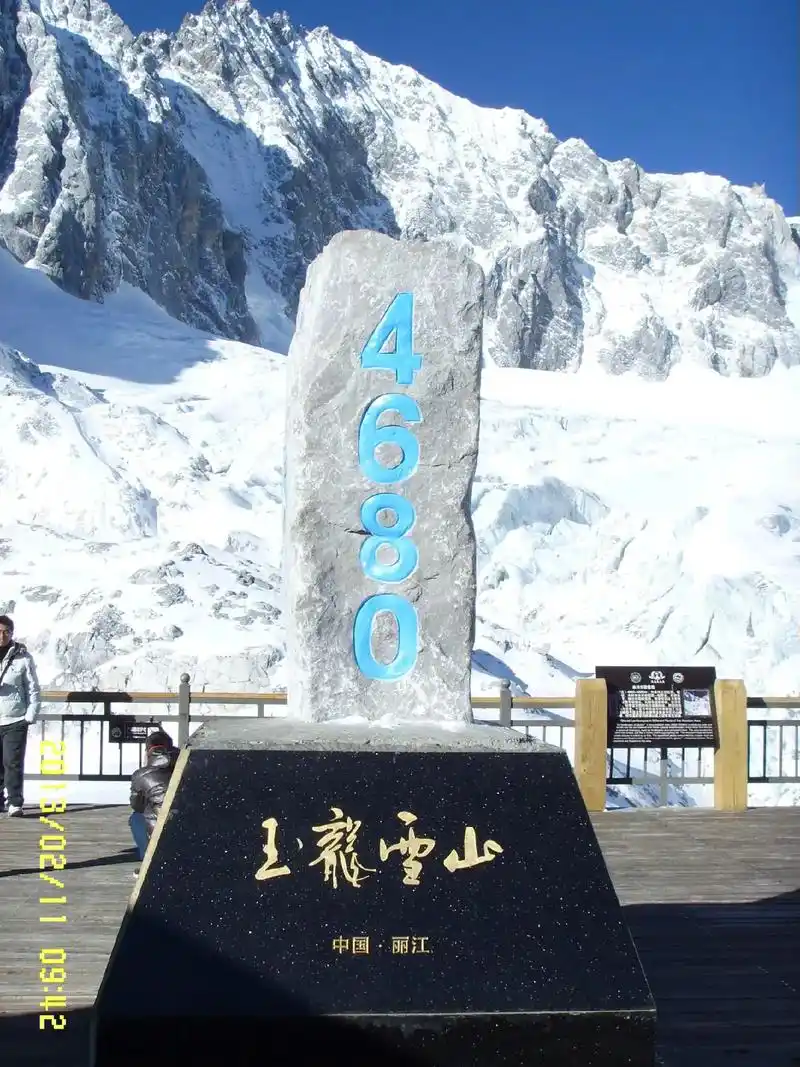
Reaching the upper mountain means choosing one of three cableways—your ticket literally dictates your altitude. The Glacier Park cable car climbs to 4,506 meters, the highest commercial lift in southern Asia, and a final footpath carries you to a 4,680-meter observation deck for face-to-face encounters with ice walls a hundred meters tall. Expect thin air and possible altitude sickness if you fly in straight from sea level. For a gentler experience, the Yunshan Ping line stops at 3,240 meters, dropping visitors into a hushed forest of dwarf spruces beside an alpine meadow—favored by families and the height-averse. The Yak Meadow midway cable car reaches roughly 3,700 meters and rewards riders with sweeping vistas of all thirteen peaks in one glittering arc.
Lijiang Sanyi International Airport lies barely 30 kilometers south, with direct flights from Kunming, Chengdu, and several Southeast Asian hubs, while a high-speed rail line now connects the old town to Kunming in roughly three hours. Base yourself in cobbled Lijiang Old Town for atmospheric inns and Naxi cuisine, then budget a full day for the mountain; cable-car tickets, park entry, and shuttle buses typically come as a combined pass purchased online in advance and timed in half-hour slots. The dry months from November to May deliver the bluest skies and the best chance of "Golden Sunrise"; summer rains wrap the peaks in mist, atmospheric but glacier-concealing. Pack layered clothing—temperatures can swing 25°C between the valley floor and the glacier deck, even in summer.
What makes the mountain unforgettable is the sheer geographical impossibility of it all—misty subtropical valleys giving way within an hour to a wall of permanent ice. Few places compress such wildly different ecosystems into a single ascent, few sacred peaks rival the spiritual depth of Naxi Dongba tradition, and few alpine panoramas are framed by a UNESCO-enshrined old town at their feet. Whether you ride the highest cableway in the region or simply sip tea in a Lijiang teahouse while the peaks blush at dawn, Jade Dragon Snow Mountain remains the defining image of any Yunnan journey.
Imagine the Alps tilted south and planted at the latitude of Rome—that is the rough geological equivalent of Jade Dragon Snow Mountain, whose thirteen summits tower above the subtropical valleys of northwestern Yunnan. Forged as the Indian plate thrusts into Asia, the range stretches 75 kilometers end-to-end, with permanent snow and glacier ice clinging to peaks above 4,000 meters. Standing in the same belt as the Himalayas, it is the southernmost snow massif in the Northern Hemisphere and the only place where temperate maritime glaciers are found this close to the equator. For Western travelers used to European alpine scenery, the visual punch of jagged ice walls rising above flower-filled meadows feels both familiar and strangely tropical.
For the Naxi people, the dominant ethnic group of Lijiang, this mountain is no scenic backdrop but a living deity. They honor it as the incarnation of Sanduo, a sky-born warrior-god who, according to the centuries-old Dongba pictographic scriptures, safeguards the valleys below. Painted in scrolls and invoked in ritual dances, Sanduo transforms the range into the sacred axis of an animist tradition unique to this corner of China—a cousin, in spirit, to Shinto mountain worship or the sacred peaks of Tibetan Buddhism. Annual Sanduo festivals draw worshippers in embroidered dress to the foothills each February, while nearby Lijiang Old Town, a UNESCO World Heritage Site, keeps the broader Naxi culture very much alive.
The mountain's softer face appears at Blue Moon Valley, where glacier meltwater filters through limestone and copper-rich sediments to produce water the color of Wedgwood china. Walkways thread past four turquoise pools flanked by fan-shaped travertine terraces—echoes, in miniature, of Pamukkale in Turkey or the tiered lakes of Band-e-Amir in Afghanistan. For theatrical drama, director Zhang Yimou, architect of the 2008 Beijing Olympics opening, stages "Impression Lijiang," a three-hundred-performer pageant on a 3,100-meter meadow with the snow peaks rising as a stage curtain. Arrive at dawn, when sunlight gilds the central massif in rose gold for the fleeting "Golden Sunrise on the Mountain" effect that has inspired Chinese painters for centuries.
Reaching the upper mountain means choosing one of three cableways—your ticket literally dictates your altitude. The Glacier Park cable car climbs to 4,506 meters, the highest commercial lift in southern Asia, and a final footpath carries you to a 4,680-meter observation deck for face-to-face encounters with ice walls a hundred meters tall. Expect thin air and possible altitude sickness if you fly in straight from sea level. For a gentler experience, the Yunshan Ping line stops at 3,240 meters, dropping visitors into a hushed forest of dwarf spruces beside an alpine meadow—favored by families and the height-averse. The Yak Meadow midway cable car reaches roughly 3,700 meters and rewards riders with sweeping vistas of all thirteen peaks in one glittering arc.
Lijiang Sanyi International Airport lies barely 30 kilometers south, with direct flights from Kunming, Chengdu, and several Southeast Asian hubs, while a high-speed rail line now connects the old town to Kunming in roughly three hours. Base yourself in cobbled Lijiang Old Town for atmospheric inns and Naxi cuisine, then budget a full day for the mountain; cable-car tickets, park entry, and shuttle buses typically come as a combined pass purchased online in advance and timed in half-hour slots. The dry months from November to May deliver the bluest skies and the best chance of "Golden Sunrise"; summer rains wrap the peaks in mist, atmospheric but glacier-concealing. Pack layered clothing—temperatures can swing 25°C between the valley floor and the glacier deck, even in summer.
What makes the mountain unforgettable is the sheer geographical impossibility of it all—misty subtropical valleys giving way within an hour to a wall of permanent ice. Few places compress such wildly different ecosystems into a single ascent, few sacred peaks rival the spiritual depth of Naxi Dongba tradition, and few alpine panoramas are framed by a UNESCO-enshrined old town at their feet. Whether you ride the highest cableway in the region or simply sip tea in a Lijiang teahouse while the peaks blush at dawn, Jade Dragon Snow Mountain remains the defining image of any Yunnan journey.