Mu Mansion
⭐ 4.70
Gucheng District, Lijiang, Yunnan, China
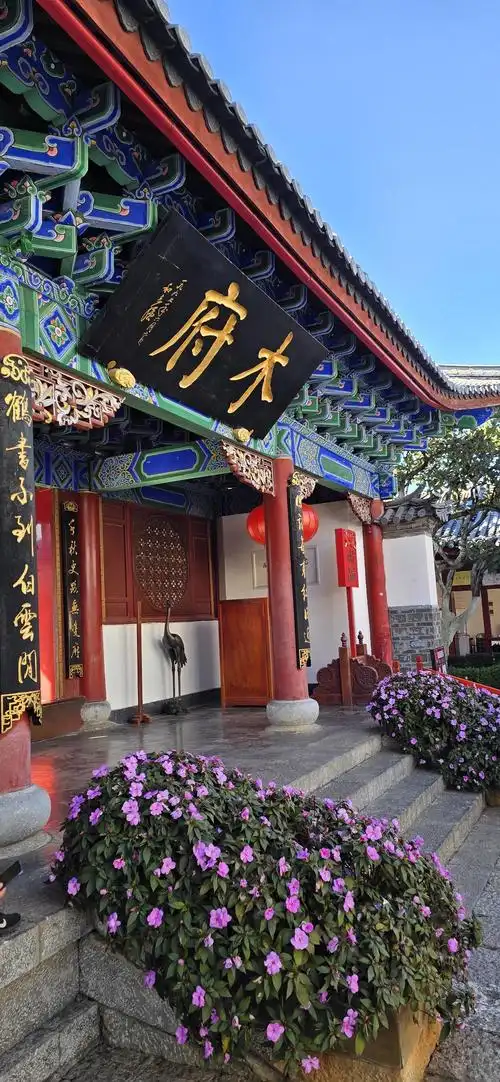 The Mu Mansion traces its origins to the Yuan dynasty (13th century) and reached its zenith under the Ming and Qing, when the Mu clan governed this corner of southwest China for 47 generations. The great Ming-era traveler Xu Xiake, often compared to a Chinese Marco Polo, marveled that "its halls rival those of kings." The original complex was razed in the chaos of the late Qing, but a meticulous 1999 reconstruction on the original footprint restored its imperial grandeur. Think of it as a smaller, hill-country cousin to Beijing's Forbidden City, built not by emperors but by frontier lords who balanced allegiance to Beijing with the cultural identity of their Naxi subjects.
The architecture unfolds along a rigid north-south axis in classic Chinese palatial style: the Loyalty Arch, Council Hall, Wanjuan Library, Protector Hall, Yuyin Tower, and finally the Three Purities Hall crowning the hill. The Council Hall's coffered ceiling features a four-clawed golden dragon, a symbol of authority granted by the emperor rather than usurped. In Wanjuan Library, Confucian, Buddhist, and Daoist classics sit alongside Naxi Dongba manuscripts, one of the world's few remaining pictographic scripts. The craftsmanship is a fusion masterclass: Han-style dougong brackets and upturned eaves meet intricately carved Naxi wooden screens, Bai ethnic polychrome painting, and Tibetan decorative motifs.
Beyond politics, the mansion reveals a society that prized learning over martial display. The "Heaven Rains Fragrance" gate reads in Naxi as "go forth and study," a phrase strikingly reminiscent of the humanist ideals flourishing in Renaissance Italy at the same time the Mu chieftains were commissioning their scholars. A stele bears calligraphy by Yang Shen, a famed Ming dynasty examination champion and literary dissident exiled to Yunnan. Every courtyard speaks to a delicate balancing act: Han imperial orthodoxy grafted onto indigenous Naxi traditions, with Tibetan Buddhist and Bai artistic influences woven through.
Visiting is straightforward. Adult admission is 40 yuan (about $5.50), with discounts around 36 yuan online; students and seniors over 60 pay half price, and certain groups enter free. Doors open daily from 09:00 to 17:30, with last tickets and entry at 17:00. The most important tip: free guided tours in Chinese depart every 10 to 15 minutes and last roughly 1.5 to 2 hours. These are excellent even for non-speakers, as guides often speak some English; without one, much of the symbolism passes unnoticed. In summer, an evening "Meet Mu Mansion" light show runs separately for an additional fee.
For the best experience, arrive between 9 and 11 a.m., when soft light flatters the carved wood and crowds are thin. Wear flat, non-slip shoes; the old stone is unforgiving in rain, and an umbrella is wise in summer. Ignore touts at the entrance offering "expert" paid guides, the official ones are free and well-trained. Pair your visit with a Dongba papermaking workshop and the White Temple frescoes north of town to round out a full picture of Naxi civilization, a living tapestry the size of Tuscany has no real parallel to.
This is not merely an Old Town sight but the cultural heart of Lijiang itself. Where else can you stand in a single courtyard and read 470 years of frontier governance, religious syncretism, and literary ambition? For travelers seeking depth behind the postcard views of canals and lanterns, the Mu Mansion is the single most rewarding stop in southwestern China.
The Mu Mansion traces its origins to the Yuan dynasty (13th century) and reached its zenith under the Ming and Qing, when the Mu clan governed this corner of southwest China for 47 generations. The great Ming-era traveler Xu Xiake, often compared to a Chinese Marco Polo, marveled that "its halls rival those of kings." The original complex was razed in the chaos of the late Qing, but a meticulous 1999 reconstruction on the original footprint restored its imperial grandeur. Think of it as a smaller, hill-country cousin to Beijing's Forbidden City, built not by emperors but by frontier lords who balanced allegiance to Beijing with the cultural identity of their Naxi subjects.
The architecture unfolds along a rigid north-south axis in classic Chinese palatial style: the Loyalty Arch, Council Hall, Wanjuan Library, Protector Hall, Yuyin Tower, and finally the Three Purities Hall crowning the hill. The Council Hall's coffered ceiling features a four-clawed golden dragon, a symbol of authority granted by the emperor rather than usurped. In Wanjuan Library, Confucian, Buddhist, and Daoist classics sit alongside Naxi Dongba manuscripts, one of the world's few remaining pictographic scripts. The craftsmanship is a fusion masterclass: Han-style dougong brackets and upturned eaves meet intricately carved Naxi wooden screens, Bai ethnic polychrome painting, and Tibetan decorative motifs.
Beyond politics, the mansion reveals a society that prized learning over martial display. The "Heaven Rains Fragrance" gate reads in Naxi as "go forth and study," a phrase strikingly reminiscent of the humanist ideals flourishing in Renaissance Italy at the same time the Mu chieftains were commissioning their scholars. A stele bears calligraphy by Yang Shen, a famed Ming dynasty examination champion and literary dissident exiled to Yunnan. Every courtyard speaks to a delicate balancing act: Han imperial orthodoxy grafted onto indigenous Naxi traditions, with Tibetan Buddhist and Bai artistic influences woven through.
Visiting is straightforward. Adult admission is 40 yuan (about $5.50), with discounts around 36 yuan online; students and seniors over 60 pay half price, and certain groups enter free. Doors open daily from 09:00 to 17:30, with last tickets and entry at 17:00. The most important tip: free guided tours in Chinese depart every 10 to 15 minutes and last roughly 1.5 to 2 hours. These are excellent even for non-speakers, as guides often speak some English; without one, much of the symbolism passes unnoticed. In summer, an evening "Meet Mu Mansion" light show runs separately for an additional fee.
For the best experience, arrive between 9 and 11 a.m., when soft light flatters the carved wood and crowds are thin. Wear flat, non-slip shoes; the old stone is unforgiving in rain, and an umbrella is wise in summer. Ignore touts at the entrance offering "expert" paid guides, the official ones are free and well-trained. Pair your visit with a Dongba papermaking workshop and the White Temple frescoes north of town to round out a full picture of Naxi civilization, a living tapestry the size of Tuscany has no real parallel to.
This is not merely an Old Town sight but the cultural heart of Lijiang itself. Where else can you stand in a single courtyard and read 470 years of frontier governance, religious syncretism, and literary ambition? For travelers seeking depth behind the postcard views of canals and lanterns, the Mu Mansion is the single most rewarding stop in southwestern China.