Lu'an Tea Valley
⭐ 4.20
Dushan Town, Yu'an District, Lu'an City, Anhui Province, China
 Tea has shaped civilizations from the Tang dynasty to the breakfast tables of London, and China's southeastern Anhui Province has been a quiet powerhouse in that story for over a millennium. Lu'an Guapian, the signature leaf of this valley, ranks among China's "Ten Famous Teas" and was historically tribute-offered to Qing dynasty emperors. Unlike the bud-only refinement of Japanese gyokuro or the oxidation of Indian Assam, Guapian is crafted from single mature leaves—stripped of bud and stem—then roasted in a precise sequence of wok-firing steps that define its chestnut aroma. Participating in this UNESCO-recognized heritage craft places visitors inside a living chapter of global tea history.
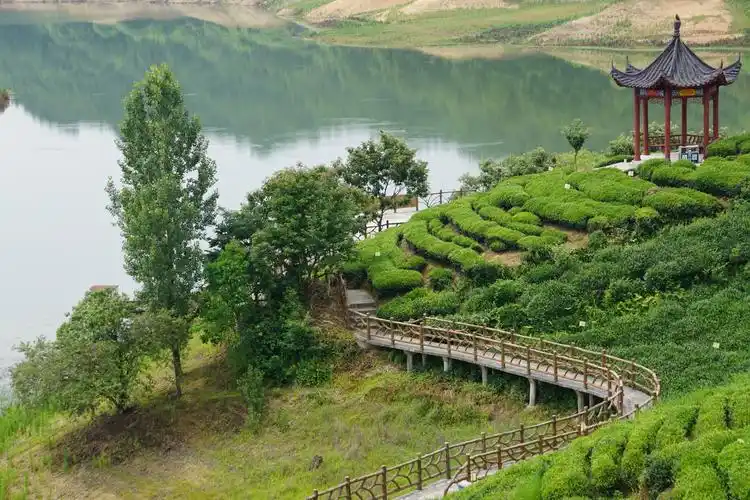
The landscape itself rivals the great lake districts of Europe. Set against the mirror-still Xianghongdian Reservoir—one of Anhui's largest mountain lakes, created by dam-building in the 1950s—the terrain echoes the watery fjord scenery of Norway's Geirangerfjord or Italy's Lake Como, but dressed in undulating green tea hedges instead of vineyards or pine forests. A 5.4-kilometer timber boardwalk ribbons through the plantations, while a 4,000-meter waterfront promenade leads to a cable-suspended pedestrian bridge that swings gently above the water—a modest cousin, perhaps, to Portugal's notorious 516 Arouca.
A short boat ride delivers visitors to "Yujian Island," a photogenic haven where a pristine white wedding chapel, waterfront timber cabins, and lake-side swings create a scene reminiscent of a Wes Anderson film set. It is here that the region's strict agricultural discipline meets modern leisure: tea fields stretching toward mist-cloaked peaks provide a soft, painterly backdrop that photographers and influencers adore, yet behind the postcard glamour lies an authentic working landscape that produces premium green tea every spring.
Dining in the valley is an exercise in regional pride. The inventive "Guapian Latte" pairs bitter tea notes with silky milk foam, while reservoir fish stewed with fermented black beans, and free-range chicken hotpots anchor the menu in farmhouse tradition. Boutique homestays such as Spring Mountain Willow Lodge and Autumn Cloud Forest Retreat offer fire-heated tea ceremonies and forest-fed swimming pools, evoking the rustic luxury of an Austrian alpine hideaway—though here, the surrounding forests yield tea leaves rather than cheese.
Reaching the park takes roughly one hour by car from Lu'an city; self-driving is strongly recommended as public transit requires multiple changes through rural township buses. Entry to the park is free, though boat rides, study programs, and hands-on tea-processing workshops carry additional fees. Plan your visit between late March and May, when tender spring leaves are harvested, or September through October, when crisp mountain air sharpens the autumn colors. Avoid heavy weekends to fully savor the valley's signature tranquility.
Tea has shaped civilizations from the Tang dynasty to the breakfast tables of London, and China's southeastern Anhui Province has been a quiet powerhouse in that story for over a millennium. Lu'an Guapian, the signature leaf of this valley, ranks among China's "Ten Famous Teas" and was historically tribute-offered to Qing dynasty emperors. Unlike the bud-only refinement of Japanese gyokuro or the oxidation of Indian Assam, Guapian is crafted from single mature leaves—stripped of bud and stem—then roasted in a precise sequence of wok-firing steps that define its chestnut aroma. Participating in this UNESCO-recognized heritage craft places visitors inside a living chapter of global tea history.
The landscape itself rivals the great lake districts of Europe. Set against the mirror-still Xianghongdian Reservoir—one of Anhui's largest mountain lakes, created by dam-building in the 1950s—the terrain echoes the watery fjord scenery of Norway's Geirangerfjord or Italy's Lake Como, but dressed in undulating green tea hedges instead of vineyards or pine forests. A 5.4-kilometer timber boardwalk ribbons through the plantations, while a 4,000-meter waterfront promenade leads to a cable-suspended pedestrian bridge that swings gently above the water—a modest cousin, perhaps, to Portugal's notorious 516 Arouca.
A short boat ride delivers visitors to "Yujian Island," a photogenic haven where a pristine white wedding chapel, waterfront timber cabins, and lake-side swings create a scene reminiscent of a Wes Anderson film set. It is here that the region's strict agricultural discipline meets modern leisure: tea fields stretching toward mist-cloaked peaks provide a soft, painterly backdrop that photographers and influencers adore, yet behind the postcard glamour lies an authentic working landscape that produces premium green tea every spring.
Dining in the valley is an exercise in regional pride. The inventive "Guapian Latte" pairs bitter tea notes with silky milk foam, while reservoir fish stewed with fermented black beans, and free-range chicken hotpots anchor the menu in farmhouse tradition. Boutique homestays such as Spring Mountain Willow Lodge and Autumn Cloud Forest Retreat offer fire-heated tea ceremonies and forest-fed swimming pools, evoking the rustic luxury of an Austrian alpine hideaway—though here, the surrounding forests yield tea leaves rather than cheese.
Reaching the park takes roughly one hour by car from Lu'an city; self-driving is strongly recommended as public transit requires multiple changes through rural township buses. Entry to the park is free, though boat rides, study programs, and hands-on tea-processing workshops carry additional fees. Plan your visit between late March and May, when tender spring leaves are harvested, or September through October, when crisp mountain air sharpens the autumn colors. Avoid heavy weekends to fully savor the valley's signature tranquility.