Yalu River Scenic Area
⭐ 4.20
Yalu River Scenic Area, Liaoning Province, China
 The Yalu River forms one of Asia's most politically charged natural boundaries, a 210-kilometer stretch of waterway separating northeast China's Liaoning Province from the Democratic People's Republic of Korea. Often compared to the Rhine for its historic role as a strategic frontier, the river today serves as both a scenic corridor and an open-air museum of twentieth-century geopolitics. The Dandong waterfront is freely accessible, with leafy promenades ideal for cycling, while evening brings a surreal spectacle: the glittering Chinese skyline mirrored against the largely darkened northern bank across the water.
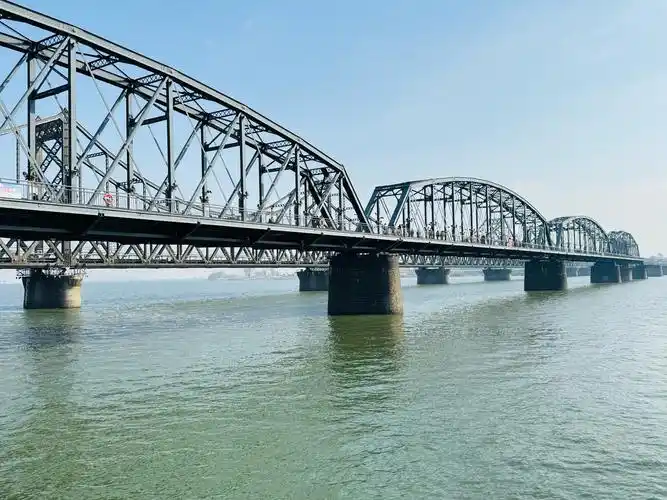
No landmark captures the area's weight of history like the Yalu River Broken Bridge, originally completed in 1911 as a key rail link between Manchuria and the Korean peninsula. Severely damaged by American bombing during the Korean War (1950-53), the bridge now stands half-destroyed, its twisted girders and pockmarked steel serving as a visceral reminder of the conflict that still divides the peninsula today. Visitors can walk the surviving span for roughly 30 yuan, touching bomb craters with their own hands while gazing across at Sinuiju's dimly lit streets—a scene with few parallels outside the former Iron Curtain.
Roughly 30 minutes' drive from downtown Dandong, the Hushan section claims a remarkable distinction as the eastern starting point of the Ming Dynasty Great Wall. While far less famous than the restored ramparts at Badaling near Beijing, Hushan offers something its crowded cousin cannot: a frontier panorama where the Great Wall literally tumbles into a river bordering a sovereign nation. The "One Step Across" monument marks the closest point where a traveler could, before modern border controls, legally step into North Korean territory. Entry costs around 60 yuan, though visitors should note the steep, sometimes uneven steps.
For many travelers, a Yalu River cruise ranks as the highlight of any Dandong visit. Boats ferry visitors from designated docks just south of the Broken Bridge to midstream, allowing an unusually close—yet carefully managed—glance at daily North Korean life across the water. Daytime tickets run 60-80 yuan, with summer evening cruises proving especially atmospheric when both riverbanks light up. Strict rules govern every voyage: life jackets are mandatory, telephoto photography of military personnel is forbidden, and any attempt to cross the waterline or toss objects toward the opposite bank results in immediate expulsion.
The Korean War Memorial Hall on the Dandong waterfront provides essential context, offering a chronologically arranged account of the 1950-53 conflict through artifacts, photographs, and veteran testimony. Admission is free, though advance reservation is required. Best visiting windows are April-May, when spring blossoms frame the river, and September-October, when autumn colors ignite the surrounding hills; summer brings humidity and August fog, while winter delivers stark but bitterly windy scenery. Plan at least half a day—ideally a full day—to absorb both the natural beauty and the sobering history on offer.
The Yalu River forms one of Asia's most politically charged natural boundaries, a 210-kilometer stretch of waterway separating northeast China's Liaoning Province from the Democratic People's Republic of Korea. Often compared to the Rhine for its historic role as a strategic frontier, the river today serves as both a scenic corridor and an open-air museum of twentieth-century geopolitics. The Dandong waterfront is freely accessible, with leafy promenades ideal for cycling, while evening brings a surreal spectacle: the glittering Chinese skyline mirrored against the largely darkened northern bank across the water.
No landmark captures the area's weight of history like the Yalu River Broken Bridge, originally completed in 1911 as a key rail link between Manchuria and the Korean peninsula. Severely damaged by American bombing during the Korean War (1950-53), the bridge now stands half-destroyed, its twisted girders and pockmarked steel serving as a visceral reminder of the conflict that still divides the peninsula today. Visitors can walk the surviving span for roughly 30 yuan, touching bomb craters with their own hands while gazing across at Sinuiju's dimly lit streets—a scene with few parallels outside the former Iron Curtain.
Roughly 30 minutes' drive from downtown Dandong, the Hushan section claims a remarkable distinction as the eastern starting point of the Ming Dynasty Great Wall. While far less famous than the restored ramparts at Badaling near Beijing, Hushan offers something its crowded cousin cannot: a frontier panorama where the Great Wall literally tumbles into a river bordering a sovereign nation. The "One Step Across" monument marks the closest point where a traveler could, before modern border controls, legally step into North Korean territory. Entry costs around 60 yuan, though visitors should note the steep, sometimes uneven steps.
For many travelers, a Yalu River cruise ranks as the highlight of any Dandong visit. Boats ferry visitors from designated docks just south of the Broken Bridge to midstream, allowing an unusually close—yet carefully managed—glance at daily North Korean life across the water. Daytime tickets run 60-80 yuan, with summer evening cruises proving especially atmospheric when both riverbanks light up. Strict rules govern every voyage: life jackets are mandatory, telephoto photography of military personnel is forbidden, and any attempt to cross the waterline or toss objects toward the opposite bank results in immediate expulsion.
The Korean War Memorial Hall on the Dandong waterfront provides essential context, offering a chronologically arranged account of the 1950-53 conflict through artifacts, photographs, and veteran testimony. Admission is free, though advance reservation is required. Best visiting windows are April-May, when spring blossoms frame the river, and September-October, when autumn colors ignite the surrounding hills; summer brings humidity and August fog, while winter delivers stark but bitterly windy scenery. Plan at least half a day—ideally a full day—to absorb both the natural beauty and the sobering history on offer.