Memorial Hall of the War to Resist U.S. Aggression and Aid Korea
⭐ 5.00
Memorial Hall of the War to Resist U.S. Aggression and Aid Korea, Liaoning Province, China
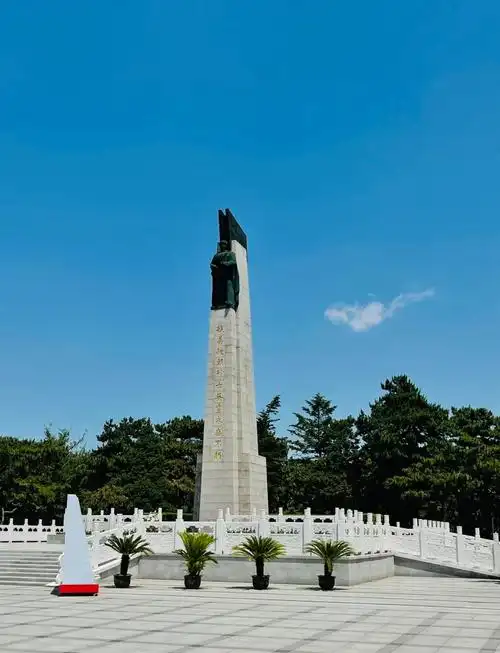 Founded in 1958 and substantially rebuilt before reopening in 2020, the memorial occupies 182,000 square meters of hillside commanding panoramic views toward the Korean Peninsula. For Western visitors, its scale and solemnity evoke comparisons to Treptower Park in Berlin or the American Cemetery at Normandy—places where nations process collective trauma through monumental architecture. The complex comprises four sections: the towering memorial shaft, exhibition halls, the panorama pavilion, and an open-air defense education park displaying decommissioned heavy weaponry. The 53-meter tower symbolically marks the year 1953 when the armistice silenced the guns.
The main exhibition building stretches along 1,549 meters of gallery space, divided into six thematic halls covering the war's origins, key campaigns, the "Resist America, Aid Korea" movement at home, Sino-Korean solidarity, fallen heroes, and postwar commemoration. Roughly 2,000 artifacts are displayed, including Marshal Peng Dehuai's command vehicle and shell-scarred earth from the legendary Battle of Shangganling. Augmented-reality and virtual-reality stations bring the trenches to life for younger visitors, though the curatorial tone remains decidedly reverential rather than entertainment-oriented.
The undisputed highlight is the panorama hall, where "Battle of the Chongchon River" surrounds viewers in a 132-meter-circumference, 16-meter-high cylindrical painting enhanced by synchronized lighting, sound effects, and a sculpted foreground diorama. The immersive technique recalls the great 19th-century panorama paintings of Waterloo and Gettysburg, here redeployed to recreate the Second Campaign's decisive encirclement of UN forces. Visitors typically describe the experience as viscerally overwhelming.
The outdoor defense education park displays a MiG-15 fighter, T-34 tank, and Katyusha rocket launcher—hardware familiar to military-history enthusiasts and Cold War buffs. Admission is free but requires real-name booking via the official WeChat account at least a day in advance; the museum closes Mondays except on Chinese public holidays. Bring your passport, observe respectful silence, and arrive for free guided tours at 10:00 and 14:00. English-language audio guides can be arranged with advance notice.
Plan two to three hours and follow the recommended route: defense park first, then the memorial tower, the main halls descending floor by floor, finishing with the panorama as emotional crescendo. The museum sits at No. 7 Shanshang Street, Zhenxing District; buses 102 and 103 stop nearby, and free parking is available. Afterwards, walk to the broken Yalu River Bridge and the Sino-Korean Friendship Bridge—both within a kilometer—to complete Dandong's half-day "Heroic City" red-heritage circuit along the riverfront.
Founded in 1958 and substantially rebuilt before reopening in 2020, the memorial occupies 182,000 square meters of hillside commanding panoramic views toward the Korean Peninsula. For Western visitors, its scale and solemnity evoke comparisons to Treptower Park in Berlin or the American Cemetery at Normandy—places where nations process collective trauma through monumental architecture. The complex comprises four sections: the towering memorial shaft, exhibition halls, the panorama pavilion, and an open-air defense education park displaying decommissioned heavy weaponry. The 53-meter tower symbolically marks the year 1953 when the armistice silenced the guns.
The main exhibition building stretches along 1,549 meters of gallery space, divided into six thematic halls covering the war's origins, key campaigns, the "Resist America, Aid Korea" movement at home, Sino-Korean solidarity, fallen heroes, and postwar commemoration. Roughly 2,000 artifacts are displayed, including Marshal Peng Dehuai's command vehicle and shell-scarred earth from the legendary Battle of Shangganling. Augmented-reality and virtual-reality stations bring the trenches to life for younger visitors, though the curatorial tone remains decidedly reverential rather than entertainment-oriented.
The undisputed highlight is the panorama hall, where "Battle of the Chongchon River" surrounds viewers in a 132-meter-circumference, 16-meter-high cylindrical painting enhanced by synchronized lighting, sound effects, and a sculpted foreground diorama. The immersive technique recalls the great 19th-century panorama paintings of Waterloo and Gettysburg, here redeployed to recreate the Second Campaign's decisive encirclement of UN forces. Visitors typically describe the experience as viscerally overwhelming.
The outdoor defense education park displays a MiG-15 fighter, T-34 tank, and Katyusha rocket launcher—hardware familiar to military-history enthusiasts and Cold War buffs. Admission is free but requires real-name booking via the official WeChat account at least a day in advance; the museum closes Mondays except on Chinese public holidays. Bring your passport, observe respectful silence, and arrive for free guided tours at 10:00 and 14:00. English-language audio guides can be arranged with advance notice.
Plan two to three hours and follow the recommended route: defense park first, then the memorial tower, the main halls descending floor by floor, finishing with the panorama as emotional crescendo. The museum sits at No. 7 Shanshang Street, Zhenxing District; buses 102 and 103 stop nearby, and free parking is available. Afterwards, walk to the broken Yalu River Bridge and the Sino-Korean Friendship Bridge—both within a kilometer—to complete Dandong's half-day "Heroic City" red-heritage circuit along the riverfront.