Han Dynasty Beacon Tower Site
⭐ 3.00
Shapotou District, Zhongwei City, Ningxia Hui Autonomous Region, China
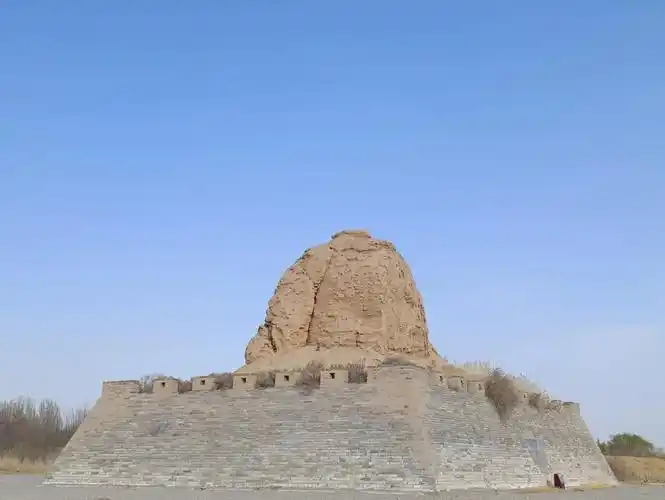 The Sifangdun beacon dates to the reign of Emperor Wu of Han around the 2nd century BC, an era when imperial China pushed its frontier deep into the arid northwest. Comparable in purpose to Rome's limes or Britain's Hadrian's Wall, it formed a critical node in a vast signal network using smoke and fire to relay messages across hundreds of kilometers. During the Ming Dynasty's Jiajing period, the site was reinforced and a "mutual market" added, shifting its role from purely military to a hybrid commercial-military outpost that regulated trade with nomadic peoples.
The tower is a square frustum of rammed earth—the same technique that built segments of the Great Wall. Its current form rises roughly 14 meters from a base of 32 meters per side, exceptionally massive for a beacon and earning it a reputation as the largest such structure predating the Ming era. Visitors can still discern the horizontal tamping lines, each layer 10 to 15 centimeters thick, where builders mixed local gravel and sand into the loess for stability. Despite a millennium of wind erosion, the silhouette remains remarkably intact, offering a rare window into Han-era engineering.
Sifangdun once commanded the northern branch of the ancient Silk Road, where Han garrisons, Tang merchants, and later caravan traders converged. It is more than a military relic; it is a stone-and-earth witness to centuries of dialogue between agrarian China and the nomadic worlds of the steppe. The surrounding landscape still carries traces of Han-era barracks and Ming and Qing-era ramparts, making the site a layered historical document. Standing solitary against the desert sky and the still waters of nearby lakes, the tower reads almost as a frozen border poem—evoking the same melancholy grandeur as ruined caravanserais across Central Asia.
The site sits within the Great Desert Frontier Pass scenic area, roughly 8 kilometers west of Zhongwei's urban center. Access is easiest by car or taxi, and admission is bundled into the scenic area's combined ticket. On-site interpretation is primarily in Chinese, so arranging a Chinese-speaking guide in advance is highly recommended. The rammed-earth fabric is fragile—climbing, carving, scraping soil, or flying drones nearby is strictly prohibited and subject to fines. Surrounding amenities lean toward adventure tourism, with go-kart tracks and casual restaurants; visitors seeking contemplative atmosphere should come ready to conjure it themselves.
Late afternoon to sunset is the magical window, when amber light gilds the tower's battered edges and shadows sharpen its monumental geometry. Pair the visit with the neighboring Shapotou 5A scenic area—famed for its dunes, Yellow River bends, and Desert Wonderland—to craft a seamless "antiquity meets nature" day itinerary. Optional extensions include the wetland views of Dragon Palace Lake or a quiet stroll through nearby poplar forests. August brings Zhongwei's hottest, driest weather, demanding sun protection, ample drinking water, and gear for windblown sand. Note: Sifangdun should not be confused with another beacon of the same name in Minqian County, Gansu.
The Sifangdun beacon dates to the reign of Emperor Wu of Han around the 2nd century BC, an era when imperial China pushed its frontier deep into the arid northwest. Comparable in purpose to Rome's limes or Britain's Hadrian's Wall, it formed a critical node in a vast signal network using smoke and fire to relay messages across hundreds of kilometers. During the Ming Dynasty's Jiajing period, the site was reinforced and a "mutual market" added, shifting its role from purely military to a hybrid commercial-military outpost that regulated trade with nomadic peoples.
The tower is a square frustum of rammed earth—the same technique that built segments of the Great Wall. Its current form rises roughly 14 meters from a base of 32 meters per side, exceptionally massive for a beacon and earning it a reputation as the largest such structure predating the Ming era. Visitors can still discern the horizontal tamping lines, each layer 10 to 15 centimeters thick, where builders mixed local gravel and sand into the loess for stability. Despite a millennium of wind erosion, the silhouette remains remarkably intact, offering a rare window into Han-era engineering.
Sifangdun once commanded the northern branch of the ancient Silk Road, where Han garrisons, Tang merchants, and later caravan traders converged. It is more than a military relic; it is a stone-and-earth witness to centuries of dialogue between agrarian China and the nomadic worlds of the steppe. The surrounding landscape still carries traces of Han-era barracks and Ming and Qing-era ramparts, making the site a layered historical document. Standing solitary against the desert sky and the still waters of nearby lakes, the tower reads almost as a frozen border poem—evoking the same melancholy grandeur as ruined caravanserais across Central Asia.
The site sits within the Great Desert Frontier Pass scenic area, roughly 8 kilometers west of Zhongwei's urban center. Access is easiest by car or taxi, and admission is bundled into the scenic area's combined ticket. On-site interpretation is primarily in Chinese, so arranging a Chinese-speaking guide in advance is highly recommended. The rammed-earth fabric is fragile—climbing, carving, scraping soil, or flying drones nearby is strictly prohibited and subject to fines. Surrounding amenities lean toward adventure tourism, with go-kart tracks and casual restaurants; visitors seeking contemplative atmosphere should come ready to conjure it themselves.
Late afternoon to sunset is the magical window, when amber light gilds the tower's battered edges and shadows sharpen its monumental geometry. Pair the visit with the neighboring Shapotou 5A scenic area—famed for its dunes, Yellow River bends, and Desert Wonderland—to craft a seamless "antiquity meets nature" day itinerary. Optional extensions include the wetland views of Dragon Palace Lake or a quiet stroll through nearby poplar forests. August brings Zhongwei's hottest, driest weather, demanding sun protection, ample drinking water, and gear for windblown sand. Note: Sifangdun should not be confused with another beacon of the same name in Minqian County, Gansu.