Zhenbeipu Western Film Studio
⭐ 4.50
Zhenbeipu Western Film Studio, Yinchuan City, Ningxia Hui Autonomous Region, China
 **Historical Roots on the Wild Frontier**
The compound's foundations reach back to the 15th century, when Ming and later Qing emperors fortified this stretch of the northwestern frontier against nomadic incursions along what approximates today's Silk Road corridor. Comparable to the abandoned presidios of the American Southwest or the crumbling Moorish alcázars of southern Spain, the twin fortress towns once guarded the empire's vulnerable borderland. After centuries of neglect, celebrated writer Zhang Xianliang acquired the ruins in 1993 and transformed them into a working film set and cultural park, embodying China's late-20th-century awakening to heritage tourism. A museum honors his vision under the slogan "Chinese cinema walks to the world from here."
**Three Cinematic Zones**
The complex unfolds across three atmospheric districts. Qing City serves as the iconic backdrop for "A Chinese Odyssey," where visitors retrace the moonlit ramparts where the hero bids farewell to his beloved. Ming City evokes the lawless frontier of "New Dragon Gate Inn" and the sorghum fields of Zhang Yimou's masterpiece, its famous "Moon Gate" archway rivaling the photogenic appeal of any Andalusian hacienda. Old Yinchuan Street, a recreated 1930s commercial lane, channels the faded elegance of vintage Shanghai and Old Hanoi, complete with teahouses, a post office, and shophouses where costumed guides bring the Republican era to life.
**Architecture and Visual Magic**
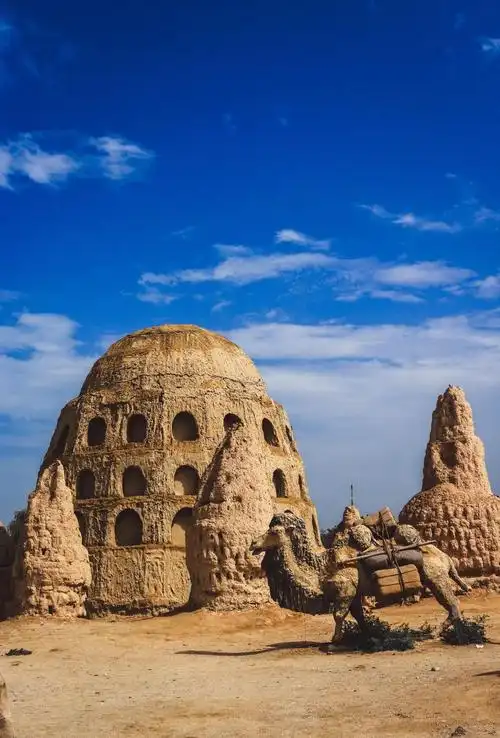
The aesthetic draws entirely on vernacular frontier building: thick tamped-earth walls, weathered timber gates, and the surrounding Gobi-style dunes that filter light into honeyed amber tones. Like the set pieces of Almería's Tabernas Desert in Italy's Cinecittà, the architecture is deliberately unpolished, allowing filmmakers to manufacture grit on demand. Over 200 preserved film sets remain scattered across the grounds, and rental shops offer traditional swordsman robes or the white veil of Zixia Fairy for visitors wanting to step into the frame themselves. Cinematographers prize the late-afternoon backlighting, when every silhouette takes on a cinematic glow.
**Practical Visitor Information**
Summer hours run 8:00 to 18:00, with selected zones extending to 22:00 during peak season; winter hours are 9:00 to 17:00. Admission is ¥80 for adults (roughly $11, slightly cheaper online), with half-price tickets for students and minors, free entry for children under 1.2 m or six years old, and seniors over 60 with ID. Allow 3.5 to 5 hours; the recommended route flows Qing City → Old Yinchuan Street → Ming City without backtracking. Sun protection is essential, as shade is scarce and midday temperatures regularly exceed 35°C in July.
**Getting There and Beyond**
Yinchuan Hedong International Airport lies about 50 km east, and the studio sits 30 minutes by taxi (around ¥80) or the dedicated tourist Bus 3 from downtown. Self-driving travelers exit the G110 expressway near the Helan Mountains. Pair your visit with the UNESCO-worthy rock engravings of Helan Mountain, just 25 minutes north, or the mysterious imperial tombs of the Western Xia Dynasty, a short drive west, both offering complementary lenses on northwestern China's layered history.
**Why Film Fans Make the Pilgrimage**
For devotees of Hong Kong wuxia classics and Zhang Yimou's celebrated color-saturated dramas, walking these corridors is the equivalent of standing on the bridge of the Titanic or the Kansas wheat field from "Wicked": a chance to inhabit the imagination of beloved screen moments. Beyond the nostalgia, the site offers something rare in modern China, an unscripted, sunbaked authenticity where weathered walls still exhale the dust of Genghis Khan's steppe and the romance of movie magic in equal measure.
**Historical Roots on the Wild Frontier**
The compound's foundations reach back to the 15th century, when Ming and later Qing emperors fortified this stretch of the northwestern frontier against nomadic incursions along what approximates today's Silk Road corridor. Comparable to the abandoned presidios of the American Southwest or the crumbling Moorish alcázars of southern Spain, the twin fortress towns once guarded the empire's vulnerable borderland. After centuries of neglect, celebrated writer Zhang Xianliang acquired the ruins in 1993 and transformed them into a working film set and cultural park, embodying China's late-20th-century awakening to heritage tourism. A museum honors his vision under the slogan "Chinese cinema walks to the world from here."
**Three Cinematic Zones**
The complex unfolds across three atmospheric districts. Qing City serves as the iconic backdrop for "A Chinese Odyssey," where visitors retrace the moonlit ramparts where the hero bids farewell to his beloved. Ming City evokes the lawless frontier of "New Dragon Gate Inn" and the sorghum fields of Zhang Yimou's masterpiece, its famous "Moon Gate" archway rivaling the photogenic appeal of any Andalusian hacienda. Old Yinchuan Street, a recreated 1930s commercial lane, channels the faded elegance of vintage Shanghai and Old Hanoi, complete with teahouses, a post office, and shophouses where costumed guides bring the Republican era to life.
**Architecture and Visual Magic**
The aesthetic draws entirely on vernacular frontier building: thick tamped-earth walls, weathered timber gates, and the surrounding Gobi-style dunes that filter light into honeyed amber tones. Like the set pieces of Almería's Tabernas Desert in Italy's Cinecittà, the architecture is deliberately unpolished, allowing filmmakers to manufacture grit on demand. Over 200 preserved film sets remain scattered across the grounds, and rental shops offer traditional swordsman robes or the white veil of Zixia Fairy for visitors wanting to step into the frame themselves. Cinematographers prize the late-afternoon backlighting, when every silhouette takes on a cinematic glow.
**Practical Visitor Information**
Summer hours run 8:00 to 18:00, with selected zones extending to 22:00 during peak season; winter hours are 9:00 to 17:00. Admission is ¥80 for adults (roughly $11, slightly cheaper online), with half-price tickets for students and minors, free entry for children under 1.2 m or six years old, and seniors over 60 with ID. Allow 3.5 to 5 hours; the recommended route flows Qing City → Old Yinchuan Street → Ming City without backtracking. Sun protection is essential, as shade is scarce and midday temperatures regularly exceed 35°C in July.
**Getting There and Beyond**
Yinchuan Hedong International Airport lies about 50 km east, and the studio sits 30 minutes by taxi (around ¥80) or the dedicated tourist Bus 3 from downtown. Self-driving travelers exit the G110 expressway near the Helan Mountains. Pair your visit with the UNESCO-worthy rock engravings of Helan Mountain, just 25 minutes north, or the mysterious imperial tombs of the Western Xia Dynasty, a short drive west, both offering complementary lenses on northwestern China's layered history.
**Why Film Fans Make the Pilgrimage**
For devotees of Hong Kong wuxia classics and Zhang Yimou's celebrated color-saturated dramas, walking these corridors is the equivalent of standing on the bridge of the Titanic or the Kansas wheat field from "Wicked": a chance to inhabit the imagination of beloved screen moments. Beyond the nostalgia, the site offers something rare in modern China, an unscripted, sunbaked authenticity where weathered walls still exhale the dust of Genghis Khan's steppe and the romance of movie magic in equal measure.