Zhongwei Drum Tower
⭐ 3.80
Zhongwei Drum Tower, Shapotou District, Zhongwei City, Ningxia Hui Autonomous Region, China
 Built in 1631 during the late Ming dynasty—contemporary with the Thirty Years' War ravaging Europe—and rebuilt in its original form after a fire in 1831, Zhongwei Drum Tower has watched over the Silk Road's eastern approaches for nearly four centuries. While St. Peter's Basilica rose in Rome and Christopher Wren's churches reshaped London, this frontier outpost was reinforcing its own civic identity. Originally a watch post and time-keeping landmark, it served the same anchoring role as the medieval bell towers dominating town squares from Bruges to Florence. Today it ranks among the best-preserved late-imperial municipal towers in northwest China.
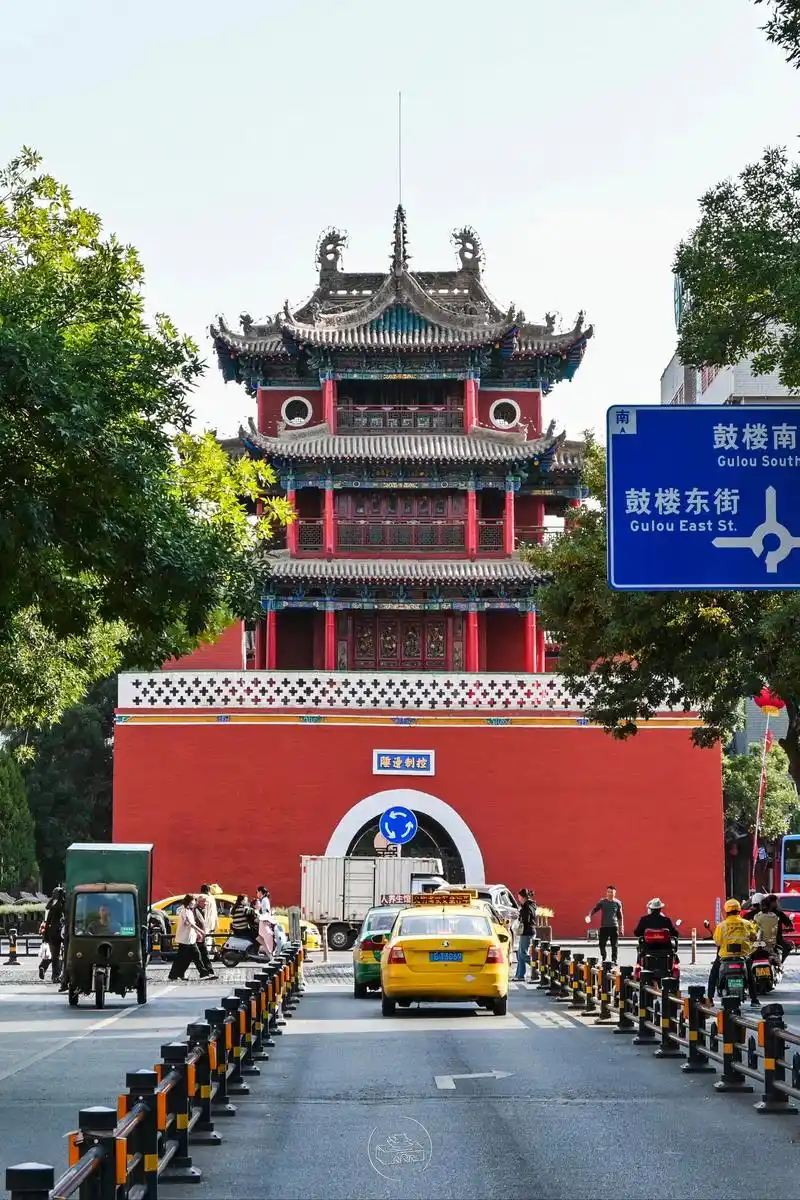
The structure follows a classic Chinese gate-tower template: a square masonry base pierced by a cross-shaped tunnel through which four streets converge, supporting a three-story wooden pavilion topped by a sweeping, multi-eaved roof in the traditional xieshan (resting-mountain) style. At 30 meters, it is shorter than Florence's Palazzo Vecchio tower but echoes that medieval Italian campanile in proportion and civic presence. The interior—rarely open to the public—features an elaborate octagonal caisson ceiling decorated with the Bagua trigrams, carved wooden immortals, and glazed ceramic dragons chasing pearls, showcasing the decorative refinement typical of high Qing craftsmanship.
Four plaques hang above each arched passage, each bearing a terse four-character motto that distills the regional geography. Facing east, "Locking the Bronze Gorge" points toward the Yellow River's dramatic gorge; south, "Confronting the Incense Cliffs" references nearby rock formations; west, "Drawing the Sands" invokes the breezes of the Shapotou dunes; and north, "Controlling the Borderlands" asserts frontier authority. These inscriptions function as a poetic cartography, orienting visitors within Ningxia's landscape—much as medieval European city gates were emblazoned with mottos proclaiming civic pride and territorial reach.
The drum tower is located at the intersection of Gulou South Street and Gulou East Street, just south of the old department store in the Shapotou District. Exterior viewing is free and unrestricted around the clock, though the inner museum (Zhongwei City Museum now occupies part of the structure) opens only sporadically for special exhibitions—ask locally or check on arrival. There is no climbing access. Within a five-minute walk you can reach the ornate Gaomiao Security Temple and the food stalls of Xiangyang pedestrian street, where lamb skewers and Hui Muslim noodles reward hungry travelers.
Plan your visit for the golden hour between 17:30 and 20:00, when sunset gilds the green-grey roof tiles and electric lights trace the upturned eaves—prime conditions for photography. Circle the base slowly, reading each plaque and looking up through the cross-arched passage to capture the layered rooflines against the sky. Allow 15 to 20 minutes for the tower itself, then extend your half-day into the labyrinthine lanes beyond, where the smoky open-air kitchens and Hui Muslim street food reveal the gritty charm of a northwestern frontier town.
Built in 1631 during the late Ming dynasty—contemporary with the Thirty Years' War ravaging Europe—and rebuilt in its original form after a fire in 1831, Zhongwei Drum Tower has watched over the Silk Road's eastern approaches for nearly four centuries. While St. Peter's Basilica rose in Rome and Christopher Wren's churches reshaped London, this frontier outpost was reinforcing its own civic identity. Originally a watch post and time-keeping landmark, it served the same anchoring role as the medieval bell towers dominating town squares from Bruges to Florence. Today it ranks among the best-preserved late-imperial municipal towers in northwest China.
The structure follows a classic Chinese gate-tower template: a square masonry base pierced by a cross-shaped tunnel through which four streets converge, supporting a three-story wooden pavilion topped by a sweeping, multi-eaved roof in the traditional xieshan (resting-mountain) style. At 30 meters, it is shorter than Florence's Palazzo Vecchio tower but echoes that medieval Italian campanile in proportion and civic presence. The interior—rarely open to the public—features an elaborate octagonal caisson ceiling decorated with the Bagua trigrams, carved wooden immortals, and glazed ceramic dragons chasing pearls, showcasing the decorative refinement typical of high Qing craftsmanship.
Four plaques hang above each arched passage, each bearing a terse four-character motto that distills the regional geography. Facing east, "Locking the Bronze Gorge" points toward the Yellow River's dramatic gorge; south, "Confronting the Incense Cliffs" references nearby rock formations; west, "Drawing the Sands" invokes the breezes of the Shapotou dunes; and north, "Controlling the Borderlands" asserts frontier authority. These inscriptions function as a poetic cartography, orienting visitors within Ningxia's landscape—much as medieval European city gates were emblazoned with mottos proclaiming civic pride and territorial reach.
The drum tower is located at the intersection of Gulou South Street and Gulou East Street, just south of the old department store in the Shapotou District. Exterior viewing is free and unrestricted around the clock, though the inner museum (Zhongwei City Museum now occupies part of the structure) opens only sporadically for special exhibitions—ask locally or check on arrival. There is no climbing access. Within a five-minute walk you can reach the ornate Gaomiao Security Temple and the food stalls of Xiangyang pedestrian street, where lamb skewers and Hui Muslim noodles reward hungry travelers.
Plan your visit for the golden hour between 17:30 and 20:00, when sunset gilds the green-grey roof tiles and electric lights trace the upturned eaves—prime conditions for photography. Circle the base slowly, reading each plaque and looking up through the cross-arched passage to capture the layered rooflines against the sky. Allow 15 to 20 minutes for the tower itself, then extend your half-day into the labyrinthine lanes beyond, where the smoky open-air kitchens and Hui Muslim street food reveal the gritty charm of a northwestern frontier town.