Shapotou Tourist Area
⭐ 4.80
Zhongwei City, Ningxia Hui Autonomous Region, China
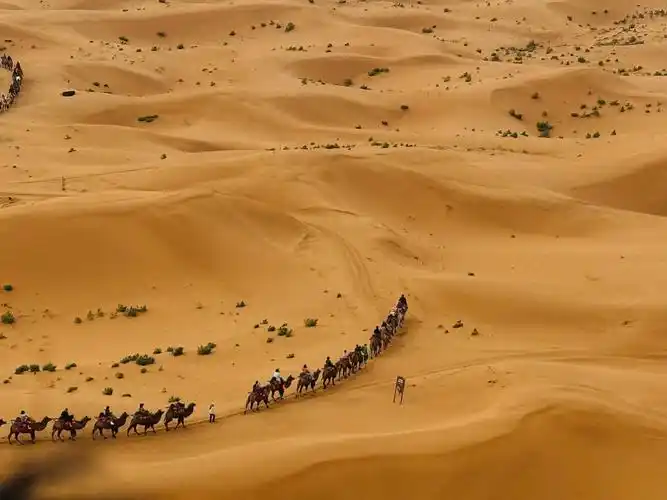 Where camel caravans once carried silk across Asia, Shapotou today offers a tangible link to the Silk Road—one of history's most consequential trade routes. Situated where Ningxia, Inner Mongolia, and Gansu meet, this stretch served as a vital oasis and river crossing for merchants traveling between Chang'an and the Western Regions. Like the caravanserais of the Levant or Venice's medieval trading posts, Shapotou was a place where cultures, currencies, and ideas converged. Visitors experience this heritage firsthand through camel rides into the dunes and traditional sheepskin raft trips, echoing the river commerce of ancient times.
The defining spectacle here is the rare meeting of two titans: the Tengger Desert and the Yellow River. Picture the Sahara pressing against the Nile, or Namibia's Sossusvlei dunes meeting an inland sea—this is China's equivalent, where 30-meter dunes cascade toward flowing water. From the Wang Wei Observation Platform, named for the Tang dynasty poet who immortalized these vistas in 759 AD, visitors gaze upon the very scene described in his famous couplet: "In the vast desert, a lone column of smoke rises straight; above the long river, the setting sun glows round." The contrast between golden sand and silver-green water is genuinely singular.
Beyond scenery, Shapotou preserves living traditions connecting visitors to northwest China's pastoral soul. The sheepskin raft, an ingenious flotation craft dating back over a millennium, remains active transport and is officially recognized intangible cultural heritage. Boatmen paddle while singing folk songs, much like Venetian gondoliers once did in their own waterways. Equally evocative are camel treks tracing ancient merchant routes, the rhythmic "jingling of camel bells" becoming a metaphor for the entire Silk Road experience. The site also pioneered modern dune-stabilization efforts begun in the 1950s, a remarkable chapter of environmental engineering comparable to Dutch land reclamation.
Adventure and serenity coexist in carefully curated zones connected by shuttle buses. Thrill-seekers hurtle down the 100-meter sand slope on sleds, accompanied by the mysterious "Sand Slope Bell" phenomenon, where shifting grains create resonant booming sounds. The "Flying Yellow River" zipline spans the water at exhilarating height, while dune buggies and camel caravans venture deeper into the desert. For quieter moments, the Desert Star Hotel offers overnight stays among the dunes, where the Milky Way arches overhead with a clarity comparable to Atacama or Namib desert lodges.
Plan your visit between April-May or September-October, when temperatures hover pleasantly between 15-25°C. Summer, especially August, brings intense midday heat exceeding 35°C and strong UV—schedule desert activities for early morning or late afternoon, retreating to the river zone or indoor venues at noon. Basic admission runs 80-100 RMB, but most travelers opt for combination tickets (400-500 RMB) bundling popular experiences. Allocate at least half a day, ideally a full day. The site sits 25 km from Zhongwei city, accessible by bus or taxi, with on-site hotels and restaurants.
Shapotou deserves a place on any serious Asia itinerary because few places on Earth compress so much variety into one accessible location—desert, river, mountain, oasis, history, and adventure within a single day. Where else can you slide down singing dunes at dawn, raft down the Yellow River while folk songs echo across the water, and stargaze from a luxury desert camp the same evening? It is a landscape both ancient and alive, where Tang poetry still describes what your eyes see. For Western travelers seeking the raw, poetic northwest beyond China's megacities, Shapotou delivers the breathtaking frontier in concentrated form.
Where camel caravans once carried silk across Asia, Shapotou today offers a tangible link to the Silk Road—one of history's most consequential trade routes. Situated where Ningxia, Inner Mongolia, and Gansu meet, this stretch served as a vital oasis and river crossing for merchants traveling between Chang'an and the Western Regions. Like the caravanserais of the Levant or Venice's medieval trading posts, Shapotou was a place where cultures, currencies, and ideas converged. Visitors experience this heritage firsthand through camel rides into the dunes and traditional sheepskin raft trips, echoing the river commerce of ancient times.
The defining spectacle here is the rare meeting of two titans: the Tengger Desert and the Yellow River. Picture the Sahara pressing against the Nile, or Namibia's Sossusvlei dunes meeting an inland sea—this is China's equivalent, where 30-meter dunes cascade toward flowing water. From the Wang Wei Observation Platform, named for the Tang dynasty poet who immortalized these vistas in 759 AD, visitors gaze upon the very scene described in his famous couplet: "In the vast desert, a lone column of smoke rises straight; above the long river, the setting sun glows round." The contrast between golden sand and silver-green water is genuinely singular.
Beyond scenery, Shapotou preserves living traditions connecting visitors to northwest China's pastoral soul. The sheepskin raft, an ingenious flotation craft dating back over a millennium, remains active transport and is officially recognized intangible cultural heritage. Boatmen paddle while singing folk songs, much like Venetian gondoliers once did in their own waterways. Equally evocative are camel treks tracing ancient merchant routes, the rhythmic "jingling of camel bells" becoming a metaphor for the entire Silk Road experience. The site also pioneered modern dune-stabilization efforts begun in the 1950s, a remarkable chapter of environmental engineering comparable to Dutch land reclamation.
Adventure and serenity coexist in carefully curated zones connected by shuttle buses. Thrill-seekers hurtle down the 100-meter sand slope on sleds, accompanied by the mysterious "Sand Slope Bell" phenomenon, where shifting grains create resonant booming sounds. The "Flying Yellow River" zipline spans the water at exhilarating height, while dune buggies and camel caravans venture deeper into the desert. For quieter moments, the Desert Star Hotel offers overnight stays among the dunes, where the Milky Way arches overhead with a clarity comparable to Atacama or Namib desert lodges.
Plan your visit between April-May or September-October, when temperatures hover pleasantly between 15-25°C. Summer, especially August, brings intense midday heat exceeding 35°C and strong UV—schedule desert activities for early morning or late afternoon, retreating to the river zone or indoor venues at noon. Basic admission runs 80-100 RMB, but most travelers opt for combination tickets (400-500 RMB) bundling popular experiences. Allocate at least half a day, ideally a full day. The site sits 25 km from Zhongwei city, accessible by bus or taxi, with on-site hotels and restaurants.
Shapotou deserves a place on any serious Asia itinerary because few places on Earth compress so much variety into one accessible location—desert, river, mountain, oasis, history, and adventure within a single day. Where else can you slide down singing dunes at dawn, raft down the Yellow River while folk songs echo across the water, and stargaze from a luxury desert camp the same evening? It is a landscape both ancient and alive, where Tang poetry still describes what your eyes see. For Western travelers seeking the raw, poetic northwest beyond China's megacities, Shapotou delivers the breathtaking frontier in concentrated form.