Liu'an Ancient City Wall Ruins
⭐ 2.50
Liu'an Ancient City Wall Ruins, Jin'an District, Liu'an City, Anhui Province, China
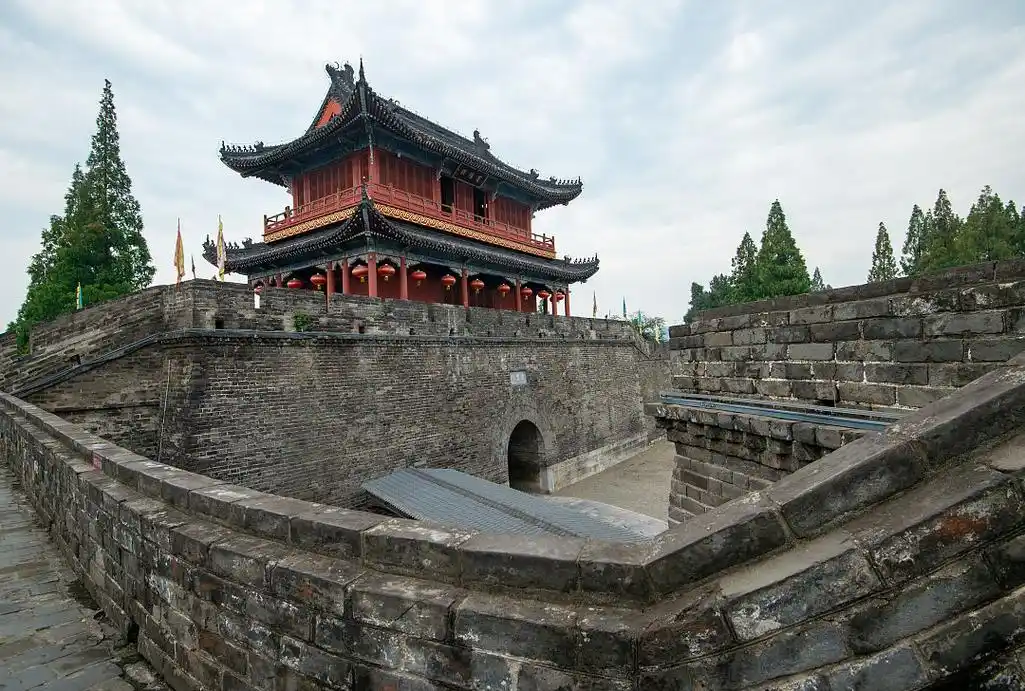 The Liu'an Ancient City Wall traces its origins to the Sui and Tang dynasties (581–907 CE), when earthen ramparts first encircled this strategic Jianghuai town. Its present form, however, dates to 1380, when the Hongwu Emperor—the founder of the Ming Dynasty—ordered a massive reconstruction in brick and stone, comparable in scale and timing to the better-known Nanjing city walls. Over the following centuries, the wall witnessed the turbulent Ming and Qing reigns, peasant uprisings, and the 1938 Battle of Liu'an during the Second Sino-Japanese War, episodes comparable to Europe's sieges during the Hundred Years' War in their intensity and lasting civic memory.
Today, only two sections survive: about 140 meters near Yunlu Bridge and around 180 meters along Gulou Street. The northern Yunlu Bridge segment was carefully restored in 2003 and 2024 during Pi River flood-control works, exposing its Ming-dynasty stone foundation and Qing-era brick repairs, alongside a recreated "Dragon-Coiling Stone" and a small pavilion. By contrast, the Gulou Street stretch remains wild and overgrown, half-swallowed by vegetation and surrounded by modest residential lanes—an atmosphere that some travelers liken to Rome's lesser-known ancient ruins, where time and neglect have produced their own haunting beauty.
Architecturally, the wall exemplifies classic Ming defensive design: a strip-stone base supporting a thick body of fired brick, with crenellations long since lost. For scholars and enthusiasts of Chinese fortification, the masonry offers a tangible specimen of Jianghuai military architecture, a regional cousin of the great walls of Xi'an or Beijing but built to guard river crossings rather than steppe frontiers. The interplay of crumbling brick, river light, and twilight shadows has made it a favorite subject for photographers seeking something atmospherically distinct from the country's more famous monuments.
The site is free, open around the clock, and offers no formal visitor center or ticketing. Chinese-language signage dominates the location, so travelers should download a translation app beforehand. The golden hour between 16:30 and 18:30 is widely considered the most rewarding, when the sinking sun silhouettes the brickwork against the rippling Pi River. Taxis and local buses serve the "Yunlu Bridge" and "Chengbei Primary School" stops, though visitors will need to walk or use a shared bicycle to move between the two surviving stretches.
For a richer half-day outing, pair the ruins with the nearby Liu'an Confucian Temple—adjacent to the Gulou section and containing a small exhibit on the 1938 battle—and the Wanxi Museum, a nationally ranked institution on Fozi Ridge Road that contextualizes the wall within the broader history of western Anhui. Travelers with extra time might continue roughly one hour north to Shouxian, whose complete encircling city wall is among China's best-preserved, offering a striking contrast between Liu'an evocative ruins and a fully surviving counterpart. Visitors should resist climbing on the fragile brickwork; summer brings humidity and mosquitoes along the riverbank, and winter rains can turn access paths muddy, so plan accordingly.
The Liu'an Ancient City Wall traces its origins to the Sui and Tang dynasties (581–907 CE), when earthen ramparts first encircled this strategic Jianghuai town. Its present form, however, dates to 1380, when the Hongwu Emperor—the founder of the Ming Dynasty—ordered a massive reconstruction in brick and stone, comparable in scale and timing to the better-known Nanjing city walls. Over the following centuries, the wall witnessed the turbulent Ming and Qing reigns, peasant uprisings, and the 1938 Battle of Liu'an during the Second Sino-Japanese War, episodes comparable to Europe's sieges during the Hundred Years' War in their intensity and lasting civic memory.
Today, only two sections survive: about 140 meters near Yunlu Bridge and around 180 meters along Gulou Street. The northern Yunlu Bridge segment was carefully restored in 2003 and 2024 during Pi River flood-control works, exposing its Ming-dynasty stone foundation and Qing-era brick repairs, alongside a recreated "Dragon-Coiling Stone" and a small pavilion. By contrast, the Gulou Street stretch remains wild and overgrown, half-swallowed by vegetation and surrounded by modest residential lanes—an atmosphere that some travelers liken to Rome's lesser-known ancient ruins, where time and neglect have produced their own haunting beauty.
Architecturally, the wall exemplifies classic Ming defensive design: a strip-stone base supporting a thick body of fired brick, with crenellations long since lost. For scholars and enthusiasts of Chinese fortification, the masonry offers a tangible specimen of Jianghuai military architecture, a regional cousin of the great walls of Xi'an or Beijing but built to guard river crossings rather than steppe frontiers. The interplay of crumbling brick, river light, and twilight shadows has made it a favorite subject for photographers seeking something atmospherically distinct from the country's more famous monuments.
The site is free, open around the clock, and offers no formal visitor center or ticketing. Chinese-language signage dominates the location, so travelers should download a translation app beforehand. The golden hour between 16:30 and 18:30 is widely considered the most rewarding, when the sinking sun silhouettes the brickwork against the rippling Pi River. Taxis and local buses serve the "Yunlu Bridge" and "Chengbei Primary School" stops, though visitors will need to walk or use a shared bicycle to move between the two surviving stretches.
For a richer half-day outing, pair the ruins with the nearby Liu'an Confucian Temple—adjacent to the Gulou section and containing a small exhibit on the 1938 battle—and the Wanxi Museum, a nationally ranked institution on Fozi Ridge Road that contextualizes the wall within the broader history of western Anhui. Travelers with extra time might continue roughly one hour north to Shouxian, whose complete encircling city wall is among China's best-preserved, offering a striking contrast between Liu'an evocative ruins and a fully surviving counterpart. Visitors should resist climbing on the fragile brickwork; summer brings humidity and mosquitoes along the riverbank, and winter rains can turn access paths muddy, so plan accordingly.