China Science and Technology Museum

⭐ 4.60

北京市东城区北河沿大街甲16号
China Science and Technology Museum
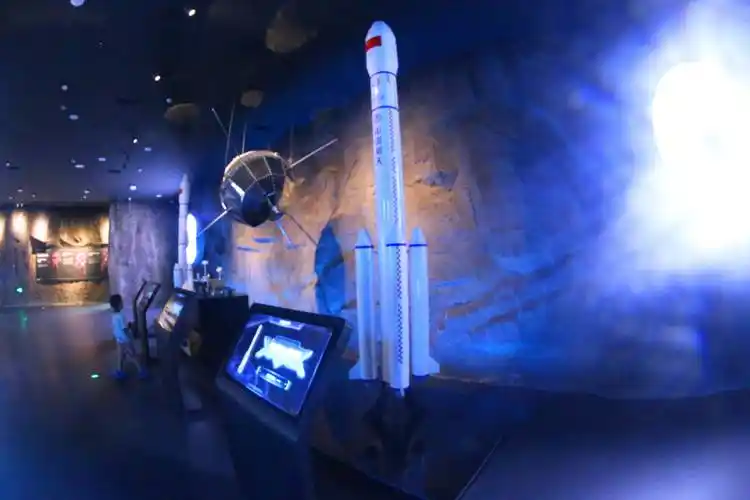
While the museum opened its current home in 2009 alongside Beijing's Olympic venues, its story begins in 1988 with a smaller predecessor. Today it claims the title of China's largest and best-equipped science education center, comparable in scope to London's Science Museum, Munich's venerable Deutsches Museum, or the Smithsonian Institution in Washington. Its mission—lifting national science literacy and showcasing Chinese innovation—echoes the Enlightenment-era ambitions that drove Europe's great 19th-century science museums, but with a distinctly Chinese perspective that honors four millennia of domestic invention. The striking building, designed by He Jingtang of the Chinese Academy of Engineering, draws its visual language from the "Luban lock"—a classical Chinese wooden puzzle of interlocking geometric blocks. The grey-white cubic volumes tumble and stack along the Olympic axis, creating a sense of playful disorder that rhymes with the industrial poetry of the neighboring Bird's Nest while asserting its own geometric identity. Across more than 100,000 square meters of floor space, the architecture itself becomes a lesson in structural logic. Inside, the ground-floor "Light of China" gallery celebrates ancient breakthroughs: visitors can crank a working south-pointing chariot and study a scale model of Su Song's astronomical clock tower—an 11th-century marvel whose escapement mechanism predates European equivalents by centuries. Floors two and three deliver a familiar mix of physics, chemistry, and biology interactives, plus lively robot demonstrations that draw the crowds. Below, eight themed zones of the children's science park turn learning into play. The fourth-floor space pavilion is the showstopper and the museum's emotional heart. The authentic Shenzhou spacecraft return capsule dominates the hall—a tangible artifact of China's crewed space program that began with Yang Liwei's 2003 orbit. Flanking it, launch simulators drop you into the astronaut's seat, while the dome theater delivers an immersive sweep through the solar system on a curved screen. For Western visitors, this floor offers a rare chance to view actual Chinese space hardware up close—something no European or American museum currently provides. The museum sits at 5 Beichen East Road, Chaoyang District, directly on the Olympic Green. Subway Line 8 reaches it via Forest Park South Gate or Olympic Park stations. There is no on-site parking, so public transit is essential. Hours run Tuesday through Sunday, 9:30 a.m. to 5 p.m.; closed Mondays. Main exhibition tickets run about 30 RMB, with separate fees for the children's park and special-effects cinema. Booking through the official WeChat account is strongly recommended, especially on weekends and holidays. Allow four to six hours for a thorough visit. A smart route runs top-down against the crowds: fourth-floor space, then third-floor robotics, second-floor physics, ground-floor ancient tech, and finally the children's park below. On-site food is pricey and uninspiring, so consider a light snack or plan lunch at the Olympic Park shopping centers. From here, the Bird's Nest and Water Cube are a ten-minute walk—a perfect pairing of cutting-edge architecture and Olympic heritage to round out your day.

Traveler reviews

China Science and Technology Museum (CHINA SCIENCE AND TECHNOLOGY MUSEUM) is a national-level comprehensive science museum, serving as a large-scale science popularization infrastructure that implements the strategies of rejuvenating the country through science and education, strengthening the nation through talent development, and driving innovation-led development, while improving scientific literacy across the population. Planning for the museum began as early as 1958, when it was originally called the "Central S...
⭐ 5 · Phoenix Lane Expand
China Science and Technology Museum is the most science-rich modern museum in China, and it's perfect for elementary, middle, and high school students to visit and learn from during holidays. You'll find introductions to ancient Chinese scientific inventions alongside displays of the world's most cutting-edge technology; there are tons of physical exhibits and models, plus plenty of hands-on experiments and interactive projects; you get everything from colorful displays of nature and human innovation to explorations of the universe and thoughts about the future. The museum also has several science film screening halls and themed sci...
⭐ 5 · Phoenix Lane Expand