Pi River Ecological Park
⭐ 3.80
Pi River Ecological Park, Jin'an District, Liu'an City, Anhui Province, China
 **Heritage and Hydrology**
The low-lying wetlands of the Pi River basin have shaped life in western Anhui for centuries, but the modern landscape owes its existence to the monumental Pi-Shi-Hang Irrigation Project, completed in the 1950s and 60s. Comparable in ambition to the Roman aqueducts or the Dutch polder systems, this engineering feat diverted water from the Pi, Shi, and Hang rivers to irrigate over a million hectares of farmland. Along the park's banks, sculptures and interpretative panels tell that story, while the nearby Lu'an Ancient City Wall, a provincial cultural relic dating to the Ming dynasty rather than to medieval Europe, offers a tangible counterpoint to the living landscape outside.
**A Yangtze Wetland Sanctuary**
Think of the park as China's answer to France's Camargue or the Wadden Sea along the Dutch-German coast: a ribbon of marsh, reed bed, and open water that serves as a critical refuelling stop for migratory birds. More than 120 bird species have been recorded, including seventeen nationally protected ones such as the stately Oriental Stork and the elegant Tundra Swan. Almost 300 species of vascular plants flourish along the riverbanks, and wetland coverage exceeds sixty percent, making this one of the most ecologically significant nodes in the lower Yangtze basin.
**Design and Layout**
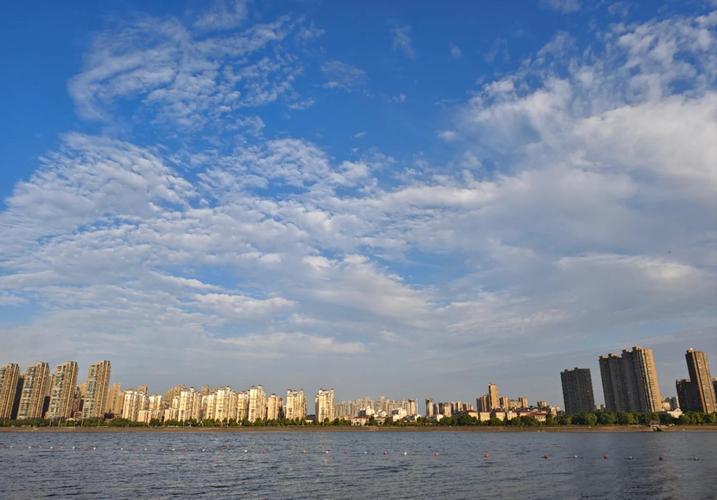
Unlike a conventional Chinese ticketed scenic area, the park is deliberately unfenced. Visitors enter freely from multiple points along the river, wandering between the Hexi Landscape Belt, the crescent-shaped Moon Island, a two-kilometre wooden boardwalk that hovers just above the water, and a sandy riverside zone for light recreation. Conservation zones are carefully restricted, while general-use areas invite morning walkers, cyclists, and the occasional light camper. The result feels less like a park and more like a piece of countryside threaded through the city.
**Seasonal Drama**
Spring brings cascading walls of roses along the Chibi Road Bridge, while summer turns the lagoons into tapestries of water lilies and yellow flag iris. Come autumn and winter, the reeds glow gold and the skies fill with geese and cranes. Photographers should aim for the hour before sunset, when the fading light and the first city lamps reflect together on the still water, a scene that locals insist rivals the harbour views of any European capital.
**Practical Information**
Admission is free and the park is open year-round. Allow two to three hours for a relaxed visit, extending to half a day if you cycle the Moon Island loop or detour to the ancient city wall. Lu'an is served by high-speed rail from Hefei (about 30 minutes) and Nanjing (roughly 1.5 hours). Plan to arrive in the early morning or late afternoon to catch the best bird activity and the softest light, and bring binoculars, sun protection, and comfortable walking shoes.
**Why Visit**
For Western travellers accustomed to fenced nature reserves, the Pi River Park offers a refreshingly open invitation to step straight from urban streets into a functioning wetland. It is a place where contemporary Chinese ecological ambition, mid-twentieth-century engineering pride, and centuries of local history converge along a single riverbank, all without an entry fee or a queue.
**Heritage and Hydrology**
The low-lying wetlands of the Pi River basin have shaped life in western Anhui for centuries, but the modern landscape owes its existence to the monumental Pi-Shi-Hang Irrigation Project, completed in the 1950s and 60s. Comparable in ambition to the Roman aqueducts or the Dutch polder systems, this engineering feat diverted water from the Pi, Shi, and Hang rivers to irrigate over a million hectares of farmland. Along the park's banks, sculptures and interpretative panels tell that story, while the nearby Lu'an Ancient City Wall, a provincial cultural relic dating to the Ming dynasty rather than to medieval Europe, offers a tangible counterpoint to the living landscape outside.
**A Yangtze Wetland Sanctuary**
Think of the park as China's answer to France's Camargue or the Wadden Sea along the Dutch-German coast: a ribbon of marsh, reed bed, and open water that serves as a critical refuelling stop for migratory birds. More than 120 bird species have been recorded, including seventeen nationally protected ones such as the stately Oriental Stork and the elegant Tundra Swan. Almost 300 species of vascular plants flourish along the riverbanks, and wetland coverage exceeds sixty percent, making this one of the most ecologically significant nodes in the lower Yangtze basin.
**Design and Layout**
Unlike a conventional Chinese ticketed scenic area, the park is deliberately unfenced. Visitors enter freely from multiple points along the river, wandering between the Hexi Landscape Belt, the crescent-shaped Moon Island, a two-kilometre wooden boardwalk that hovers just above the water, and a sandy riverside zone for light recreation. Conservation zones are carefully restricted, while general-use areas invite morning walkers, cyclists, and the occasional light camper. The result feels less like a park and more like a piece of countryside threaded through the city.
**Seasonal Drama**
Spring brings cascading walls of roses along the Chibi Road Bridge, while summer turns the lagoons into tapestries of water lilies and yellow flag iris. Come autumn and winter, the reeds glow gold and the skies fill with geese and cranes. Photographers should aim for the hour before sunset, when the fading light and the first city lamps reflect together on the still water, a scene that locals insist rivals the harbour views of any European capital.
**Practical Information**
Admission is free and the park is open year-round. Allow two to three hours for a relaxed visit, extending to half a day if you cycle the Moon Island loop or detour to the ancient city wall. Lu'an is served by high-speed rail from Hefei (about 30 minutes) and Nanjing (roughly 1.5 hours). Plan to arrive in the early morning or late afternoon to catch the best bird activity and the softest light, and bring binoculars, sun protection, and comfortable walking shoes.
**Why Visit**
For Western travellers accustomed to fenced nature reserves, the Pi River Park offers a refreshingly open invitation to step straight from urban streets into a functioning wetland. It is a place where contemporary Chinese ecological ambition, mid-twentieth-century engineering pride, and centuries of local history converge along a single riverbank, all without an entry fee or a queue.