Beijing National Aquatics Center (Water Cube)

⭐ 4.00

Inside Beijing Olympic Park, Chaoyang District, Beijing, China
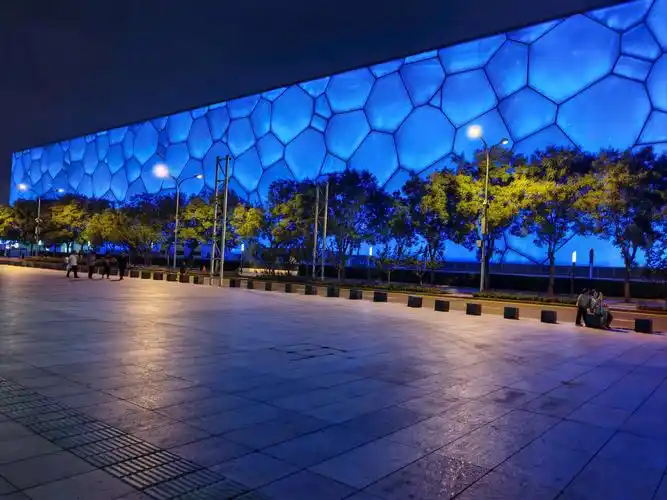
Beijing National Aquatics Center (Water Cube)
The Water Cube, officially the National Aquatics Center, occupies a storied place in Olympic history as the only venue to have hosted both Summer and Winter Games. Built for the 2008 Beijing Olympics, it witnessed Michael Phelps's record-breaking eight gold medals in its pools. When Beijing earned the 2022 Winter Games, engineers transformed this swimming cathedral into a curling arena through clever reversible adaptation—a feat rivaling London's adaptive reuse of its 2012 Olympic venues. Funding came from a remarkable source: donations from Chinese communities in Hong Kong, Macau, Taiwan, and overseas, making it a true monument to the global Chinese diaspora. Designed by Sydney-based PTW Architects with engineering by Arup, the building wraps a 177-meter cube in 3,065 ethylene tetrafluoroethylene (ETFE) cushions—an advanced polymer whose translucent bubbles resemble drifting soap foam. The same technology later enabled ambitious projects like Cornwall's Eden Project and Munich's Allianz Arena. The cushion pattern references water's molecular structure and the geometric essence of H₂O, glowing turquoise by day. After dark, programmable LEDs transform the entire facade into a kinetic canvas of shifting color, making it one of Asia's most photographed modern buildings. Standing beside Herzog & de Meuron's Bird's Nest, the Water Cube represents the audacious ambition of China's architectural coming-of-age. Together they form a dialogue between masculine steel and feminine membrane, between industrial weight and ethereal lightness. The complex embodies a new layer of Chinese modernity, suggesting how the Forbidden City once symbolized imperial permanence while Olympic Green now signals global engagement. For first-time visitors, the pairing evokes comparisons to Barcelona's Montjuïc Olympic Ring—a 1992 legacy that still defines the city today. The Cube sits in the heart of Chaoyang District's Olympic Park, a short walk from Olympic Sports Center Station on Metro Line 8. Basic tour tickets run around 30 yuan and grant access to the Olympic memorial hall, the diaspora exhibition, and upper poolside viewing platforms. The sprawling indoor water park—roughly 20,000 square meters—features more than 20 slides including the Deep Sea Tornado and Dream Drift River, with day passes at 200–260 yuan and evening passes near 180 yuan. Bring your passport for registration, your own swimwear, and book in advance via the official website or Trip.com. Plan a "play by day, glow by night" itinerary. Spend the afternoon racing down the water park slides, then emerge at dusk to witness the LED spectacle from the surrounding plaza—a free show for any stroller. Finish with the classic shot of Bird's Nest and Water Cube framed together, an image that captures twenty-first-century Beijing in a single glance. For architecture lovers, photographers, and families alike, the Water Cube ranks among the most rewarding stops in the capital.

Traveler reviews

Went to the Water Cube once before when it was brand new and everything was open. The architecture is really artistic, lots to see inside and it's huge. There were tons of kids playing in the water park too. This tim...
⭐ 4 · Charlie Brooks Expand
The Water Cube, also known as the National Aquatics Center, is one of the iconic landmarks from the 2008 Beijing Olympics. Here's a description of its stunning beauty and some nearby attractions worth visiting: The Water Cube looks like a blue crystal palace, sitting quietly on the west side of the Olympic Park. Its appearance is truly unique — it's the only fully enclosed public building in the world constructed entirely from membrane (ETFE) structures. The exterior is made up of hexagonal membrane panels, and in the sunlight, the pale blue "bubbles" seem to blend seamlessly with the blue sky and white clouds, perfectly capturing the essence of water. At night, the Water Cube transforms into a dreamy world of light and shadow. The ETFE membrane on the surface acts like a giant LCD screen, constantly shifting colors and patterns — sometimes deep ocean blue, sometimes as colorful as the aurora borealis. Nearby Attractions: - **Bird's Nest (National Stadium)**: Right next to the Water Cube, this was the main stadium for the 2008 Beijing Olympics. Its unique woven steel structure looks like a giant bird's nest and is incredibly vi...
⭐ 5 · Reese Dalton Expand