Ming Tombs

⭐ 4.20

Ming Tombs Scenic Area, Changping District, Beijing, China
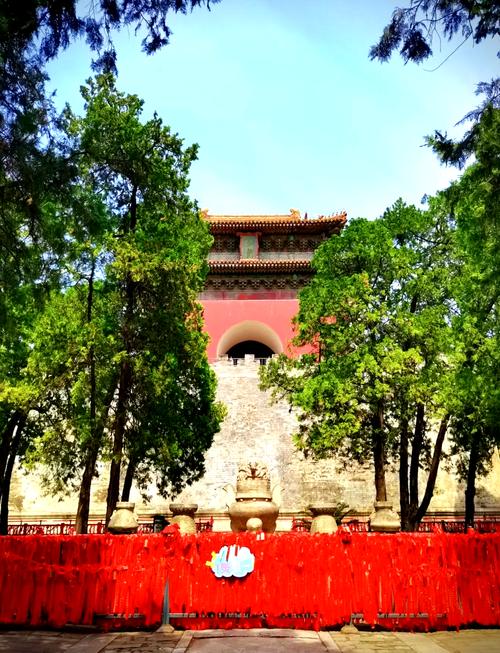
Ming Tombs
When the Yongle Emperor moved his capital to Beijing in 1421 and dispatched Admiral Zheng He's fleets across the Indian Ocean, he simultaneously commissioned this necropolis begun in 1409. Over the following 230 years, thirteen of his successors were interred here alongside their consorts—a dynasty contemporary with the Medici popes, England's Tudors, and the early Habsburgs. The site spans over 40 square kilometers across Tianshou Mountain's protective ridges, arranged according to strict feng shui principles, and joined UNESCO's World Heritage list in 2003. Think of it as China's answer to the Valley of the Kings, scaled to imperial Ming ambitions. The 7.3-kilometer Sacred Way forms the ceremonial axis of the complex. At its entrance stands the largest surviving marble archway in China, followed by the Great Red Gate, a stone bridge, and the Stele Pavilion. Beyond the Spirit Bridge, the avenue forks into individual lanes serving each tomb. Eighteen pairs of stone sentinels line the path: lions, elephants, qilin, camels, horses, and civil and military officials, all carved with weathered solemnity. The procession invites comparison with the avenues of sphinxes at Karnak, though the spirit here is unmistakably Ming—cosmic, austere, and ceremonial. Changling, the resting place of Yongle himself, is the best-preserved tomb complex on site. Its centerpiece, the Hall of Supreme Favor, spans nine bays and rises on thirty-two monolithic pillars of golden nanmu wood—each over a meter in diameter and ten meters tall, hauled from the forests of southwestern China and still faintly aromatic after six centuries. Travelers familiar with the bundled Gothic columns of Notre-Dame or the soaring stonework of Beauvais Cathedral will recognize the ambition, though the materials here achieve their grandeur through rarity and organic warmth rather than engineered mass. Dingling, tomb of the Wanli Emperor who reigned an astonishing 48 years, is the only imperial Ming tomb ever archaeologically excavated—and the only one where visitors descend into the actual burial chambers. The underground palace comprises five vaulted stone rooms, cool and perpetually dry, where the stone coffins of the emperor and his two empresses remain in place. A museum displays over 3,000 excavated treasures above ground, including the celebrated gold-filigree Wing-Tip Crown and the dazzling Twelve-Dragon Nine-Phoenix Crown inlaid with pearls and kingfisher feathers. Photography is prohibited inside the crypt. For a quieter but instructive visit, Zhao Ling offers fully restored above-ground architecture in a tranquil, lightly visited setting—the ideal place to grasp standard Ming tomb layout without crowds. The recommended itinerary is the "Three Tombs + Sacred Way" combo ticket: take the Sacred Way first, then Dingling, finishing at Changling—a sequence that builds from approach to climax and requires four to five hours total. Tour buses run from central Beijing, about ninety minutes each way. Summer demands sunscreen and water; winter temperatures plunge well below freezing despite the sunshine.

Traveler reviews

Strolled through Chang Ling at the Ming Tombs — what an awe-inspiring site with so much ancient atmosphere. The Ling'en Hall's massive golden nanmu wood columns still stand tall and remarkably intact after 600 years of weathering. Red walls, dark tiles, stele pavilions, and ancient cypresses all showcase the solemn grandeur of Ming dynasty imperial...
⭐ 5 · Quinn Lee Expand
The Ming Tombs are the burial complex of the Ming Dynasty emperors, located at the foot of Tianshou Mountain in Changping District, about 50 km outside of Beijing. The complex includes the tombs of twelve of the thirteen Ming emperors (excluding Emperor Jingtian, Zhu Qiyu), along with their empresses and concubines. Construction began with the Chang Ling tomb of Emperor Chengzu (Zhu Di) and ended with the Si Ling tomb of Emperor Sizong (Zhu Youjian). Each tomb has its own distinctive architectural style and layout, though all follow the standard Ming imperial tomb design, featuring sacred paths, spirit ways with stone statues, bright towers, and treasure cities. In 1987, the Ming Tombs were inscribed as a UNESCO World Heritage Site. In 2003,...
⭐ 5 · Jamie Cole Expand