Shizhong Thousand-Year Ancient Village
⭐ 3.60
Hongkeng Village, Hukeng Town, Yongding District, Longyan City, Fujian Province, China
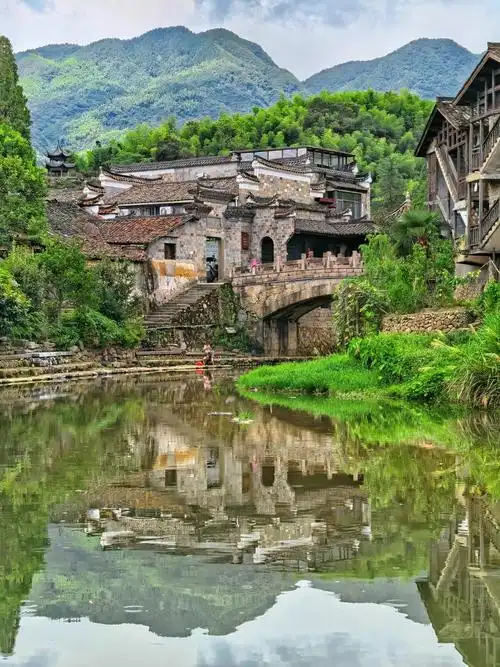 The village's origins stretch back to 1128, a date that resonates across world history. While Gufeng Lou was rising from packed earth in western Fujian, Bernard of Clairvaux was preaching the Second Crusade in Europe and Chartres Cathedral neared completion in France. Forged amid the turmoil of the Southern Song—when northern China had fallen to the Jurchen Jin—Hakka clans migrated south seeking safety. Like the Scottish Highlanders centuries later, they preserved identity through architecture, dialect, and ritual. Over the following 800 years, Shizhong's families built and rebuilt their tulou through Yuan, Ming, and Qing rule, producing what scholars consider the most complete evolutionary record of square Hakka earthen architecture in China.
The village's defining feature is its more than 100 square tulou scattered across the landscape—an unusual open layout compared to the fortress-like bastide towns of medieval France or Spain. Built entirely from rammed earth, a technique also seen in Yemen's Shibam and Morocco's kasbahs, the structures rely on thick earthen walls, wooden post-and-beam interiors, and clay-tiled roofs rather than stone. Gufeng Lou, a four-story square with an open central courtyard, still shelters Chen family descendants after nearly nine centuries. The 1784 Dianchang Lou, with 126 rooms and 44 halls arranged around twin courtyards, crowns the village—its carved wooden screens and ornate ridge decorations represent the pinnacle of western Fujian earthen craftsmanship.
Beyond bricks and mortar, Shizhong Zhongxin is a living archive of Hakka culture. Residents continue to gather for the Yu Lan Pen Festival, a Buddhist-influenced ancestral rite recognized as provincial intangible heritage, and clan genealogies passed down through generations still dictate seating at communal feasts. The village's name, meaning "moderate," reflects Confucian values of balance—a nod to the imperial and scholarly influences woven into local architecture. For travelers, this means encountering not a reconstructed heritage site but an inhabited one: elders chat on stone benches, children cycle between lanes, and ancestral halls still host weddings. It offers ethnographic depth that more commercialized sites cannot match.
Reaching Shizhong requires a little effort, which rewards curious visitors. From Longyan city, the village lies roughly 36 kilometers west along National Highway 319—about an hour by taxi or rental car; public buses are infrequent. There is no entrance fee, ticket booth, visitor center, or English signage. Spring (March–May) and autumn (October–November) bring comfortable temperatures and soft light ideal for photographing earthen facades. Allocate half a day to follow a logical loop: begin at Gufeng Lou, continue to the magnificent Dianchang Lou, then loop past Kui Lou and Qingyun Lou—the village's only five-story square tulou—before wandering the old commercial street.
Wear sturdy non-slip shoes, as lanes are uneven and shaded by tall walls. Bring plenty of water, sun protection, and a portable translation app, since most residents speak only Mandarin and the local Hakka dialect. Always ask politely before entering any occupied tulou or photographing interiors—these remain family homes with active ancestral altars, and a warm smile opens most doors. After your tour, linger over lunch at one of the village kitchens for Hakka stuffed tofu and salt-baked chicken. For Western travelers drawn to Europe's medieval villages but seeking something entirely off the well-trodden path, Shizhong Zhongxin delivers an unhurried encounter with a civilization that has built, worshipped, and dwelled within earthen walls for nearly a millennium.
The village's origins stretch back to 1128, a date that resonates across world history. While Gufeng Lou was rising from packed earth in western Fujian, Bernard of Clairvaux was preaching the Second Crusade in Europe and Chartres Cathedral neared completion in France. Forged amid the turmoil of the Southern Song—when northern China had fallen to the Jurchen Jin—Hakka clans migrated south seeking safety. Like the Scottish Highlanders centuries later, they preserved identity through architecture, dialect, and ritual. Over the following 800 years, Shizhong's families built and rebuilt their tulou through Yuan, Ming, and Qing rule, producing what scholars consider the most complete evolutionary record of square Hakka earthen architecture in China.
The village's defining feature is its more than 100 square tulou scattered across the landscape—an unusual open layout compared to the fortress-like bastide towns of medieval France or Spain. Built entirely from rammed earth, a technique also seen in Yemen's Shibam and Morocco's kasbahs, the structures rely on thick earthen walls, wooden post-and-beam interiors, and clay-tiled roofs rather than stone. Gufeng Lou, a four-story square with an open central courtyard, still shelters Chen family descendants after nearly nine centuries. The 1784 Dianchang Lou, with 126 rooms and 44 halls arranged around twin courtyards, crowns the village—its carved wooden screens and ornate ridge decorations represent the pinnacle of western Fujian earthen craftsmanship.
Beyond bricks and mortar, Shizhong Zhongxin is a living archive of Hakka culture. Residents continue to gather for the Yu Lan Pen Festival, a Buddhist-influenced ancestral rite recognized as provincial intangible heritage, and clan genealogies passed down through generations still dictate seating at communal feasts. The village's name, meaning "moderate," reflects Confucian values of balance—a nod to the imperial and scholarly influences woven into local architecture. For travelers, this means encountering not a reconstructed heritage site but an inhabited one: elders chat on stone benches, children cycle between lanes, and ancestral halls still host weddings. It offers ethnographic depth that more commercialized sites cannot match.
Reaching Shizhong requires a little effort, which rewards curious visitors. From Longyan city, the village lies roughly 36 kilometers west along National Highway 319—about an hour by taxi or rental car; public buses are infrequent. There is no entrance fee, ticket booth, visitor center, or English signage. Spring (March–May) and autumn (October–November) bring comfortable temperatures and soft light ideal for photographing earthen facades. Allocate half a day to follow a logical loop: begin at Gufeng Lou, continue to the magnificent Dianchang Lou, then loop past Kui Lou and Qingyun Lou—the village's only five-story square tulou—before wandering the old commercial street.
Wear sturdy non-slip shoes, as lanes are uneven and shaded by tall walls. Bring plenty of water, sun protection, and a portable translation app, since most residents speak only Mandarin and the local Hakka dialect. Always ask politely before entering any occupied tulou or photographing interiors—these remain family homes with active ancestral altars, and a warm smile opens most doors. After your tour, linger over lunch at one of the village kitchens for Hakka stuffed tofu and salt-baked chicken. For Western travelers drawn to Europe's medieval villages but seeking something entirely off the well-trodden path, Shizhong Zhongxin delivers an unhurried encounter with a civilization that has built, worshipped, and dwelled within earthen walls for nearly a millennium.