Longmen Rock
⭐ 3.60
Longmen Rock Scenic Area, Xinluo District, Longyan City, Fujian Province, China
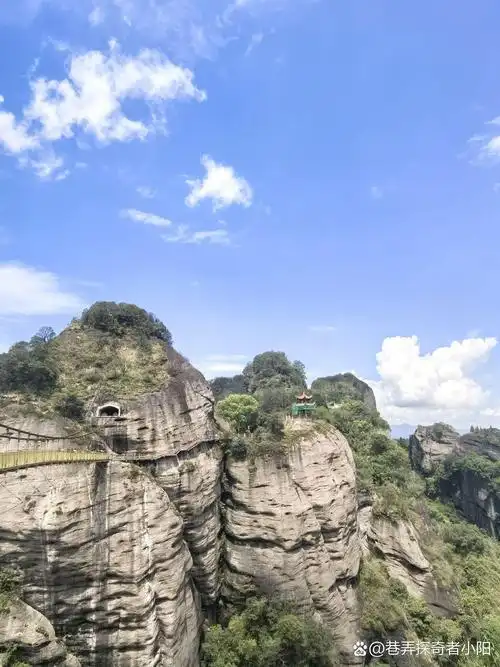 The "Dragon Gate" itself is a colossal natural stone arch—roughly the height of a four-story building—through which a tributary of the historic Tingjiang River has bored its way over millions of years. The Tingjiang once served as a vital artery connecting inland Fujian to the coast, comparable in importance to Europe's Rhine or Danube. The gorge marks a rare meeting of two distinct landform types: the rust-red sandstone of China's famed danxia formations (reminiscent of Utah's Bryce Canyon or Jordan's Petra) and the gray limestone karst familiar to visitors from Slovenia or southern France. This dual geology creates the color-streaked cliffs that give the canyon its painterly quality.
Changting County is widely recognized as one of the original homelands of the Hakka people, a Han Chinese subgroup whose diaspora now stretches from Taiwan to Malaysia, Indonesia, and beyond. Several well-preserved villages line the approach to Longmen, featuring Qing dynasty (1644–1911) and Republican-era earthen houses and ancestral halls. Their gray brick walls and upturned eaves echo the vernacular architecture of inland southern China and offer a tangible link to the migratory history that shaped much of modern Southeast Asia. Many Hakka families settled in these river valleys centuries ago, and their descendants still follow traditional ways of life.
Local communities continue centuries-old culinary traditions, including stuffed tofu (niang doufu) and taro dumplings (yuzi jiao)—dishes that travelers may recognize from Hakka restaurants across Singapore, Kuala Lumpur, or Hong Kong. Visitors are welcomed into village homes for simple, hearty meals rooted in the same recipes that have traveled the diaspora. This continuity of food culture offers Western travelers a chance to taste the authentic origins of a cuisine they may already know from abroad, turning the visit into a journey through living heritage rather than a static museum experience.
The walking route covers approximately two to three hours and follows wooden boardwalks and stone steps rated as easy to moderate, suitable for children and casual hikers. Sturdy non-slip footwear is essential, and visitors should bring their own water and snacks, as on-site facilities are limited. The best seasons are spring and autumn, though early summer mornings (7:00–9:00 AM) are equally magical when river mists rise through the gorge. Afternoon thunderstorms are common in summer, making trails slippery, so early starts are strongly advised.
Public transport to the site is limited, and self-driving or hiring a private car from Changting town or Anjie Township is highly recommended; navigation apps can locate the scenic area directly. There are no large amusement facilities; the appeal lies in stillness, geology, and cultural authenticity. For Western travelers weary of China's polished mega-attractions, Longmen offers something rare: a quiet, deeply traditional corner of Fujian where natural wonders, Hakka heritage, and slow exploration converge. It is an ideal stop for those tracing China's minority histories, photographers chasing atmospheric landscapes, or families introducing children to unspoiled wilderness.
The "Dragon Gate" itself is a colossal natural stone arch—roughly the height of a four-story building—through which a tributary of the historic Tingjiang River has bored its way over millions of years. The Tingjiang once served as a vital artery connecting inland Fujian to the coast, comparable in importance to Europe's Rhine or Danube. The gorge marks a rare meeting of two distinct landform types: the rust-red sandstone of China's famed danxia formations (reminiscent of Utah's Bryce Canyon or Jordan's Petra) and the gray limestone karst familiar to visitors from Slovenia or southern France. This dual geology creates the color-streaked cliffs that give the canyon its painterly quality.
Changting County is widely recognized as one of the original homelands of the Hakka people, a Han Chinese subgroup whose diaspora now stretches from Taiwan to Malaysia, Indonesia, and beyond. Several well-preserved villages line the approach to Longmen, featuring Qing dynasty (1644–1911) and Republican-era earthen houses and ancestral halls. Their gray brick walls and upturned eaves echo the vernacular architecture of inland southern China and offer a tangible link to the migratory history that shaped much of modern Southeast Asia. Many Hakka families settled in these river valleys centuries ago, and their descendants still follow traditional ways of life.
Local communities continue centuries-old culinary traditions, including stuffed tofu (niang doufu) and taro dumplings (yuzi jiao)—dishes that travelers may recognize from Hakka restaurants across Singapore, Kuala Lumpur, or Hong Kong. Visitors are welcomed into village homes for simple, hearty meals rooted in the same recipes that have traveled the diaspora. This continuity of food culture offers Western travelers a chance to taste the authentic origins of a cuisine they may already know from abroad, turning the visit into a journey through living heritage rather than a static museum experience.
The walking route covers approximately two to three hours and follows wooden boardwalks and stone steps rated as easy to moderate, suitable for children and casual hikers. Sturdy non-slip footwear is essential, and visitors should bring their own water and snacks, as on-site facilities are limited. The best seasons are spring and autumn, though early summer mornings (7:00–9:00 AM) are equally magical when river mists rise through the gorge. Afternoon thunderstorms are common in summer, making trails slippery, so early starts are strongly advised.
Public transport to the site is limited, and self-driving or hiring a private car from Changting town or Anjie Township is highly recommended; navigation apps can locate the scenic area directly. There are no large amusement facilities; the appeal lies in stillness, geology, and cultural authenticity. For Western travelers weary of China's polished mega-attractions, Longmen offers something rare: a quiet, deeply traditional corner of Fujian where natural wonders, Hakka heritage, and slow exploration converge. It is an ideal stop for those tracing China's minority histories, photographers chasing atmospheric landscapes, or families introducing children to unspoiled wilderness.