Jinzhai County Revolutionary Museum
⭐ 4.60
Xianghongdian Reservoir Scenic Area, Yanzihe Town, Jinzhai County, Lu'an City, Anhui Province, China
 **Historical Context**
The Dabie Mountains were one of China's most enduring revolutionary bastions, sustaining an unbroken communist presence from 1921 until the founding of the People's Republic in 1949—a remarkable 28-year span that historians call the "Red Flag Never Fell." For comparison, this longevity rivals the persistence of European partisan movements such as Yugoslavia's Tito-led resistance or the Italian Resistenza, both of which similarly transformed remote highlands into cradles of liberation. Jinzhai's contribution was staggering: from this single mountain county came 59 founding generals and three complete Red Army field armies (the Fourth, Twenty-Fifth, and Twenty-Eighth). The area's strategic position, wedged between the Yangtze and Huai rivers, gave it a mountainous geography comparable to Catalonia's role in the Spanish Civil War—a contested borderland where political conviction and terrain conspired to produce remarkable military talent.
**Architecture and Exhibitions**
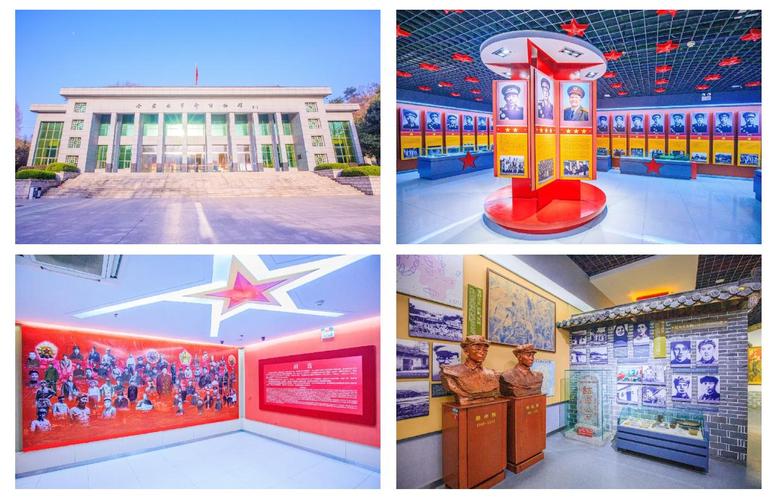
The 8,000-square-meter complex embodies the dignified monumentalism typical of China's revolutionary memorial architecture—reminiscent of the Imperial War Museum in London or Berlin's Deutsches Historisches Museum in its blend of gravitas and accessibility. The seven themed halls unfold chronologically: a prelude hall, the revolutionary history gallery, the generals' hall, the martyrs' hall, and exhibition spaces dedicated to military relics, Red Army culture, and modern commemorations. Multimedia projections, atmospheric lighting, and full-scale scene reconstructions bring the era to life. The undisputed treasure is the Red Army Public Field Stele, a stone inscription that documents the egalitarian land-distribution policies of the early Soviet period—tangible evidence of one of history's most ambitious agrarian reforms.
**Cultural and Educational Significance**
The collection comprises 2,413 catalogued items, including 162 designated as nationally precious relics—original rifles, officer uniforms, personal letters, and steles that carry the immediacy of primary sources. For Western visitors accustomed to viewing World War II memorabilia in places like Normandy or Auschwitz, Jinzhai offers a different but equally compelling perspective on twentieth-century conflict: the Chinese Communist experience of protracted revolutionary war. The museum functions as a leading center for party cadre training, school field studies, and academic research on red culture, drawing tens of thousands of pilgrims annually to honor fallen martyrs and engage with the human stories behind the political headlines.
**Practical Visit Information**
The museum welcomes visitors free of charge at Hongcun Road 35, Meishan Town, Jinzhai County, Lu'an City, Anhui (some GPS systems label the same complex as Shuangyong Road 230). Doors open daily from 8:00 a.m. to 5:00 p.m. without a lunch closure; the only regular closure falls during Spring Festival. Tours should dress in respectful, modest attire and may reserve a Mandarin-speaking docent by calling 0564-7062308—essential, as on-site signage is primarily in Chinese. Group bookings should confirm arrangements in advance. As a solemn commemorative space, visitors are asked to maintain a respectful demeanor and observe photography restrictions in certain zones.
**Tour Route and Why Visit**
Allow roughly 90 minutes to two hours for the museum proper, or extend to three to four hours for the full Red Army Square complex—begin at the Martyrs' Memorial Tower near the entrance, proceed into the main exhibition halls, then continue to the Red Army Cemetery and Memorial Hall to complete a thoughtful loop. International travelers seeking to understand modern China beyond headline narratives will find Jinzhai uniquely rewarding: it transforms abstract political history into the human-scale stories of farmers, soldiers, and teenagers who fought in their own mountains. Few sites offer such an unmediated window into the forces that shaped the world's most populous nation.
**Historical Context**
The Dabie Mountains were one of China's most enduring revolutionary bastions, sustaining an unbroken communist presence from 1921 until the founding of the People's Republic in 1949—a remarkable 28-year span that historians call the "Red Flag Never Fell." For comparison, this longevity rivals the persistence of European partisan movements such as Yugoslavia's Tito-led resistance or the Italian Resistenza, both of which similarly transformed remote highlands into cradles of liberation. Jinzhai's contribution was staggering: from this single mountain county came 59 founding generals and three complete Red Army field armies (the Fourth, Twenty-Fifth, and Twenty-Eighth). The area's strategic position, wedged between the Yangtze and Huai rivers, gave it a mountainous geography comparable to Catalonia's role in the Spanish Civil War—a contested borderland where political conviction and terrain conspired to produce remarkable military talent.
**Architecture and Exhibitions**
The 8,000-square-meter complex embodies the dignified monumentalism typical of China's revolutionary memorial architecture—reminiscent of the Imperial War Museum in London or Berlin's Deutsches Historisches Museum in its blend of gravitas and accessibility. The seven themed halls unfold chronologically: a prelude hall, the revolutionary history gallery, the generals' hall, the martyrs' hall, and exhibition spaces dedicated to military relics, Red Army culture, and modern commemorations. Multimedia projections, atmospheric lighting, and full-scale scene reconstructions bring the era to life. The undisputed treasure is the Red Army Public Field Stele, a stone inscription that documents the egalitarian land-distribution policies of the early Soviet period—tangible evidence of one of history's most ambitious agrarian reforms.
**Cultural and Educational Significance**
The collection comprises 2,413 catalogued items, including 162 designated as nationally precious relics—original rifles, officer uniforms, personal letters, and steles that carry the immediacy of primary sources. For Western visitors accustomed to viewing World War II memorabilia in places like Normandy or Auschwitz, Jinzhai offers a different but equally compelling perspective on twentieth-century conflict: the Chinese Communist experience of protracted revolutionary war. The museum functions as a leading center for party cadre training, school field studies, and academic research on red culture, drawing tens of thousands of pilgrims annually to honor fallen martyrs and engage with the human stories behind the political headlines.
**Practical Visit Information**
The museum welcomes visitors free of charge at Hongcun Road 35, Meishan Town, Jinzhai County, Lu'an City, Anhui (some GPS systems label the same complex as Shuangyong Road 230). Doors open daily from 8:00 a.m. to 5:00 p.m. without a lunch closure; the only regular closure falls during Spring Festival. Tours should dress in respectful, modest attire and may reserve a Mandarin-speaking docent by calling 0564-7062308—essential, as on-site signage is primarily in Chinese. Group bookings should confirm arrangements in advance. As a solemn commemorative space, visitors are asked to maintain a respectful demeanor and observe photography restrictions in certain zones.
**Tour Route and Why Visit**
Allow roughly 90 minutes to two hours for the museum proper, or extend to three to four hours for the full Red Army Square complex—begin at the Martyrs' Memorial Tower near the entrance, proceed into the main exhibition halls, then continue to the Red Army Cemetery and Memorial Hall to complete a thoughtful loop. International travelers seeking to understand modern China beyond headline narratives will find Jinzhai uniquely rewarding: it transforms abstract political history into the human-scale stories of farmers, soldiers, and teenagers who fought in their own mountains. Few sites offer such an unmediated window into the forces that shaped the world's most populous nation.