Zhencheng Tulou
⭐ 3.80
Zhencheng Tulou, Linjiang Town, Shanghang County, Longyan City, Fujian Province, China
 **Historical Context**
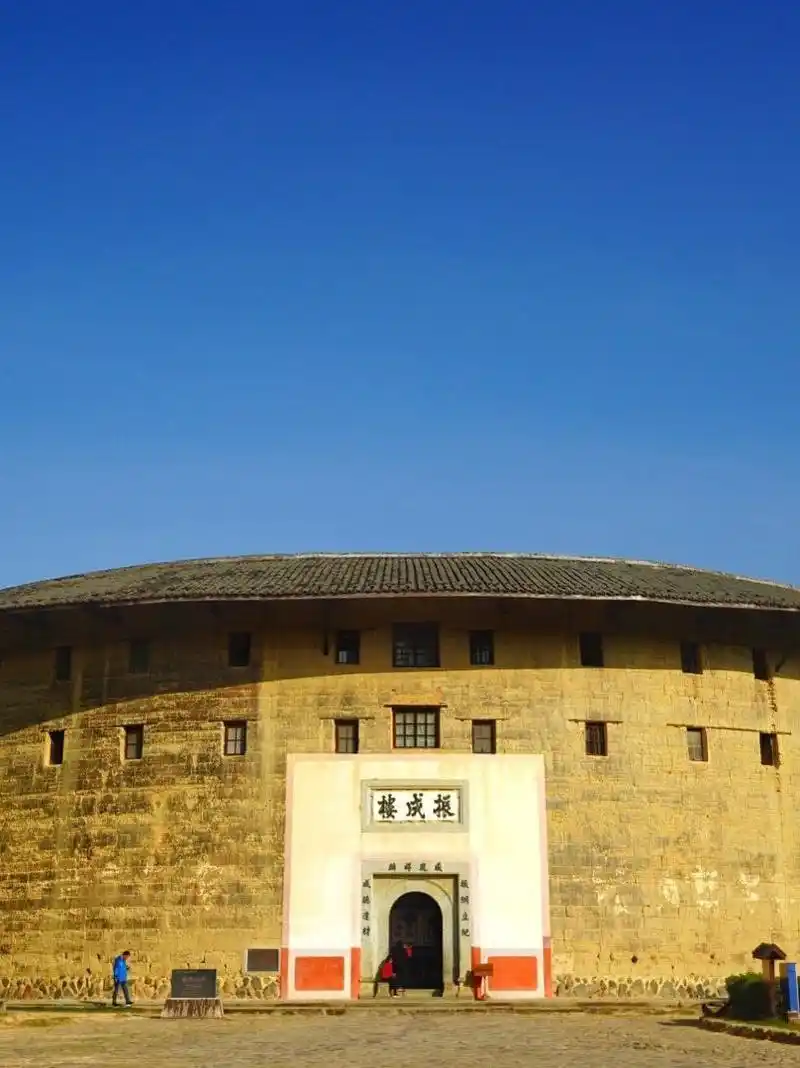
Constructed in 1912, the same year the Titanic sank and the Republic of China was being established, Zhencheng Lou represents the pinnacle of Hakka defensive architecture—a tradition born centuries earlier when the Hakka people migrated southward from northern China to escape turmoil. These massive earthen fortresses are often called "the Chinese equivalent of medieval European castles," yet they remained inhabited communities rather than purely military structures. The Lin clan still lives here today, making it one of the last functioning examples of a building style stretching back over 800 years.
**Architecture**
The building's genius lies in its dual personality: an outer ring of four traditional rammed-earth stories surrounds an inner two-story core built in Western brick-and-timber style, creating what experts call "Chinese outside, Western inside." The exterior follows the 64 hexagrams of the I Ching, divided into eight separate units by fire-resistant walls—close the doors and you have independent courtyards, open them and the entire fortress flows as one. Four seven-meter granite pillars support the ancestral hall, where a traditional opera stage still hosts performances, mirroring the cultural fusion found in early 20th-century colonial architecture from Macau to Hanoi.
**Cultural Significance**
Beyond its architectural marvels, Zhencheng Lou is a three-dimensional family album. The ground floor houses kitchens, the second stores grain reserves, and the upper levels contain bedrooms—a vertical community designed for both defense and daily life. Carved stone lintels bear calligraphic inscriptions from Republican-era dignitaries including Li Yuanhong, while iron balustrades, stone carvings, and family mottos inscribed on pillars transform every surface into a cultural document. The side wings, shaped like traditional magistrate's hat flaps, once served as a school and workshops.
**Practical Visit Information**
Zhencheng Lou is included in the Hongkeng Tulou Cluster joint ticket, typically around 90 RMB for adults. The site welcomes visitors from 7:30 AM to 8:30 PM daily, though arriving in the early morning or late afternoon rewards travelers with softer light for photography and fewer tour groups. Plan for at least one to two hours, longer if you hire a guide—recommended for unlocking the Ba Gua symbolism and the building's many hidden details. Guides can usually be arranged on-site for a modest fee.
**Why Visit and Connections**
This is a rare chance to step inside a UNESCO World Heritage treasure that functions as a real neighborhood, where residents hang laundry and tend vegetable gardens against walls older than most European capitals. Pair your visit with neighboring Fuyu Lou and Kuiju Lou to compare architectural variations, then sample local Hakka lei cha (pounded tea) and the region's medicinal wanying herbal tea. For travelers who have explored the Colosseum or Carcassonne, Zhencheng Lou offers something those European monuments cannot—a living, breathing community still thriving within its ancient walls.
**Historical Context**
Constructed in 1912, the same year the Titanic sank and the Republic of China was being established, Zhencheng Lou represents the pinnacle of Hakka defensive architecture—a tradition born centuries earlier when the Hakka people migrated southward from northern China to escape turmoil. These massive earthen fortresses are often called "the Chinese equivalent of medieval European castles," yet they remained inhabited communities rather than purely military structures. The Lin clan still lives here today, making it one of the last functioning examples of a building style stretching back over 800 years.
**Architecture**
The building's genius lies in its dual personality: an outer ring of four traditional rammed-earth stories surrounds an inner two-story core built in Western brick-and-timber style, creating what experts call "Chinese outside, Western inside." The exterior follows the 64 hexagrams of the I Ching, divided into eight separate units by fire-resistant walls—close the doors and you have independent courtyards, open them and the entire fortress flows as one. Four seven-meter granite pillars support the ancestral hall, where a traditional opera stage still hosts performances, mirroring the cultural fusion found in early 20th-century colonial architecture from Macau to Hanoi.
**Cultural Significance**
Beyond its architectural marvels, Zhencheng Lou is a three-dimensional family album. The ground floor houses kitchens, the second stores grain reserves, and the upper levels contain bedrooms—a vertical community designed for both defense and daily life. Carved stone lintels bear calligraphic inscriptions from Republican-era dignitaries including Li Yuanhong, while iron balustrades, stone carvings, and family mottos inscribed on pillars transform every surface into a cultural document. The side wings, shaped like traditional magistrate's hat flaps, once served as a school and workshops.
**Practical Visit Information**
Zhencheng Lou is included in the Hongkeng Tulou Cluster joint ticket, typically around 90 RMB for adults. The site welcomes visitors from 7:30 AM to 8:30 PM daily, though arriving in the early morning or late afternoon rewards travelers with softer light for photography and fewer tour groups. Plan for at least one to two hours, longer if you hire a guide—recommended for unlocking the Ba Gua symbolism and the building's many hidden details. Guides can usually be arranged on-site for a modest fee.
**Why Visit and Connections**
This is a rare chance to step inside a UNESCO World Heritage treasure that functions as a real neighborhood, where residents hang laundry and tend vegetable gardens against walls older than most European capitals. Pair your visit with neighboring Fuyu Lou and Kuiju Lou to compare architectural variations, then sample local Hakka lei cha (pounded tea) and the region's medicinal wanying herbal tea. For travelers who have explored the Colosseum or Carcassonne, Zhencheng Lou offers something those European monuments cannot—a living, breathing community still thriving within its ancient walls.