Dabie Mountains Main Peak Scenic Area
⭐ 4.20
Dabie Mountains Main Peak Scenic Area, Macheng City, Huanggang City, Hubei Province, China
 The Dabie range carries deep geological memory, its ancient granites and metamorphic rocks formed some 1.4 billion years ago when supercontinents broke apart—older than the Himalayas and comparable in age to Scotland's Cairngorms or Norway's Hardangervidda plateau. Designated a UNESCO Global Geopark, the area straddles the watershed dividing the Yangtze and Huai River basins, a topographical feature that shaped centuries of military history. The mountains served as a redoubt for imperial refugees and rebel forces alike, most famously sheltering the founders of the Ming Dynasty in the fourteenth century. Today, this same rugged terrain protects one of central China's last extensive old-growth forests, earning the park designation as a national forest and recognition as one of China's premier "forest oxygen bars."
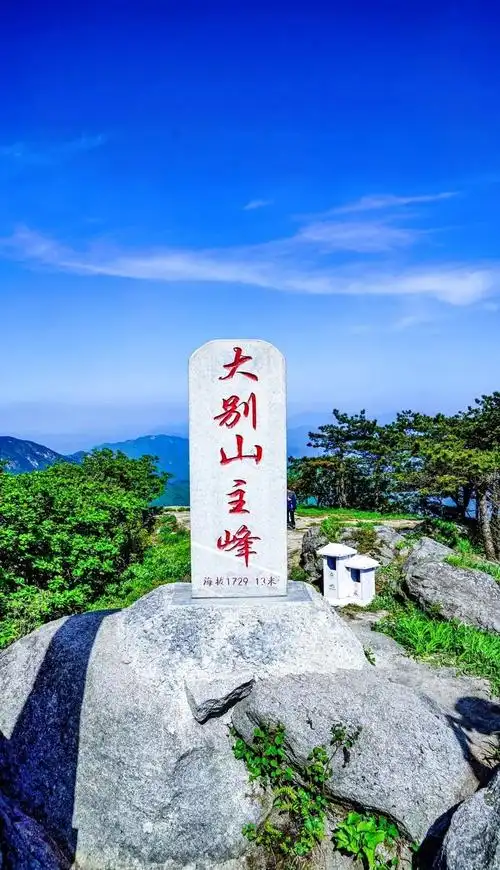
Tiantangzhai's main peak—literally "Heavenly Village Stronghold"—anchors the park's most dramatic scenery. Visitors glide upward via cable car to a summit often wreathed in clouds, where twisted pines cling to granite outcrops reminiscent of Huangshan or even Spain's Montserrat. On clear mornings the ridge reveals a sweeping panorama across the Jianghuai watershed, while photographers prize the post-rain moments when mist boils through the valleys below. At 1,729 meters, the peak forms the highest point on the Hubei-Anhui border, making it both a spiritual aspiration and a serious hiking objective for those who prefer to climb the three-hour trail on foot.
Beneath the summit, Longtan Gorge unfolds as a refreshing counterpoint to the lofty heights. The "Nine Pools and Eighteen Waterfalls" thread through primeval woodland in a sequence that rivals Portugal's Peneda-Gerês or Slovenia's Vintgar Gorge. Emerald basins collect mountain snowmelt filtered through ancient stone, while cascades plunge from mossy cliffs into inviting swimming holes. Summer visitors can wade upstream through cool rivulets, picnic beside the pools, or simply listen to the constant percussion of falling water—a natural symphony that has drawn poets and pilgrims to these slopes for centuries.
The South Wudang cultural zone adds a striking philosophical dimension to the wild landscape. As one of the southern cradles of Wudang Taoist martial tradition—the northern counterpart to the famed Wudang Mountains of Hubei—these temples echo practices refined during the Ming Dynasty, when Taoist sage Zhang Sanfeng reportedly codified the taijiquan forms still practiced worldwide today. The Wusheng Palace, Lingdian Hall, and Taiji Plaza blend religious architecture with the surrounding peaks, recalling the monastic harmony of Mount Athos or certain Tibetan Buddhist enclaves. Visitors may encounter practitioners performing flowing sword forms against a backdrop of forested ridges, bridging contemplative discipline with mountain adventure.
Practical planning rewards careful timing. The park operates daily from 8:00 a.m. to 5:30 p.m., with last entry at 4:00 p.m.; tickets run approximately 100–120 RMB. A private vehicle or chartered car is strongly recommended, as the three-hour drive from Wuhan passes through scenic countryside but lacks convenient public options. May through October offers the prime season, with late April bringing spectacular rhododendron blooms and winter occasionally cloaking the peaks in snow (though some facilities close). A two-day itinerary—one day ascending to the summit, another exploring the gorge—allows travelers to experience both the soaring grandeur and the intimate waters of this remarkable mountain sanctuary.
The Dabie range carries deep geological memory, its ancient granites and metamorphic rocks formed some 1.4 billion years ago when supercontinents broke apart—older than the Himalayas and comparable in age to Scotland's Cairngorms or Norway's Hardangervidda plateau. Designated a UNESCO Global Geopark, the area straddles the watershed dividing the Yangtze and Huai River basins, a topographical feature that shaped centuries of military history. The mountains served as a redoubt for imperial refugees and rebel forces alike, most famously sheltering the founders of the Ming Dynasty in the fourteenth century. Today, this same rugged terrain protects one of central China's last extensive old-growth forests, earning the park designation as a national forest and recognition as one of China's premier "forest oxygen bars."
Tiantangzhai's main peak—literally "Heavenly Village Stronghold"—anchors the park's most dramatic scenery. Visitors glide upward via cable car to a summit often wreathed in clouds, where twisted pines cling to granite outcrops reminiscent of Huangshan or even Spain's Montserrat. On clear mornings the ridge reveals a sweeping panorama across the Jianghuai watershed, while photographers prize the post-rain moments when mist boils through the valleys below. At 1,729 meters, the peak forms the highest point on the Hubei-Anhui border, making it both a spiritual aspiration and a serious hiking objective for those who prefer to climb the three-hour trail on foot.
Beneath the summit, Longtan Gorge unfolds as a refreshing counterpoint to the lofty heights. The "Nine Pools and Eighteen Waterfalls" thread through primeval woodland in a sequence that rivals Portugal's Peneda-Gerês or Slovenia's Vintgar Gorge. Emerald basins collect mountain snowmelt filtered through ancient stone, while cascades plunge from mossy cliffs into inviting swimming holes. Summer visitors can wade upstream through cool rivulets, picnic beside the pools, or simply listen to the constant percussion of falling water—a natural symphony that has drawn poets and pilgrims to these slopes for centuries.
The South Wudang cultural zone adds a striking philosophical dimension to the wild landscape. As one of the southern cradles of Wudang Taoist martial tradition—the northern counterpart to the famed Wudang Mountains of Hubei—these temples echo practices refined during the Ming Dynasty, when Taoist sage Zhang Sanfeng reportedly codified the taijiquan forms still practiced worldwide today. The Wusheng Palace, Lingdian Hall, and Taiji Plaza blend religious architecture with the surrounding peaks, recalling the monastic harmony of Mount Athos or certain Tibetan Buddhist enclaves. Visitors may encounter practitioners performing flowing sword forms against a backdrop of forested ridges, bridging contemplative discipline with mountain adventure.
Practical planning rewards careful timing. The park operates daily from 8:00 a.m. to 5:30 p.m., with last entry at 4:00 p.m.; tickets run approximately 100–120 RMB. A private vehicle or chartered car is strongly recommended, as the three-hour drive from Wuhan passes through scenic countryside but lacks convenient public options. May through October offers the prime season, with late April bringing spectacular rhododendron blooms and winter occasionally cloaking the peaks in snow (though some facilities close). A two-day itinerary—one day ascending to the summit, another exploring the gorge—allows travelers to experience both the soaring grandeur and the intimate waters of this remarkable mountain sanctuary.