Yi'ai Lake Park
⭐ 4.30
Yi'ai Lake Park, Huangzhou District, Huanggang City, Hubei Province, China
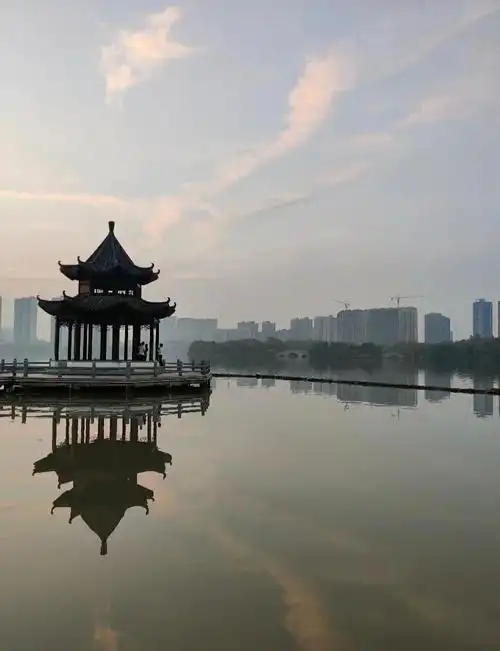 **A Literary Exile in a Song Dynasty Athens**
Yiai Lake Park derives its name from Su Shi's essay "Record of the Yiai Pavilion," written during his demotion to a minor military post in Huangzhou from 1080 to 1084. Su Shi—often ranked alongside Shakespeare or Goethe in his cultural stature—was a poet, calligrapher, painter, and engineer whose works, including the immortal "Ode to the Red Cliff," shaped East Asian literary tradition for nearly a millennium. His banishment parallels Ovid's exile to the Black Sea or Dante's Florentine wanderings: a setback that produced timeless art. The park transforms his verses into walkable scenery, making it a pilgrimage site for admirers of classical Chinese letters.
**Twelve Scenes and Living Poetry**
At the park's heart lies the "Twelve Scenes of Yiai," a sequence of pavilions, islands, and gardens each inspired by a specific Su Shi poem. Visitors encounter "Misty Rain in a Straw Coat," "Fragrance of Lotus by the Water," and the violin-shaped Qin Island, where plum blossoms frame views reminiscent of Monet's Giverny. The design echoes the narrative landscape tradition of European estates like Stowe or Wörlitz, where mythology and memory are mapped onto terrain. Every turn of the 20-kilometer lakeside path reveals another verse made visible.
**Memorial Architecture and Cultural Landmarks**
The Su Dongpo Memorial Hall anchors the park's cultural programming with artifacts, manuscripts, and multimedia exhibits tracing the poet's Huangzhou years. Nearby, the original Yiai Pavilion, the elegant Yunxiang Pavilion, the Three Sus Pavilion honoring Su Shi and his sons, and the Cold Food Forest stele gallery form an open-air museum of Song dynasty heritage. For Western travelers familiar with how Stratford-upon-Avon treats Shakespeare, this complex offers a comparable immersion into a writer's life and times.
**Wetland Ecology and Seasonal Beauty**
Beyond culture, the lake is a thriving urban wetland, where submerged forest restoration projects have cleaned the water and attracted herons, egrets, and kingfishers. Spring brings cherry and crabapple blossoms, summer floods the lotus beds, autumn ignites the maple groves, and winter showcases resilient red plum blossoms. A dedicated birdwatching zone and a photogenic windmill-lined corridor make the park a favorite among photographers and families with strollers alike.
**Practical Information for Visitors**
The park is open free of charge around the clock at the intersection of Chibi Avenue and Dongpo Avenue in Huangzhou District. City buses 6, 8, 16, and 21 stop nearby, and taxis from Huanggang Station are inexpensive. The Su Dongpo Memorial Hall may require advance booking through the official WeChat account "黄冈遗爱湖"; boat rides and sightseeing carts are sold on-site. Spring (March to May) and autumn (September to November) offer the most comfortable weather and the finest foliage.
**Why Western Travelers Should Visit**
Few destinations combine such rich literary heritage with such accessible, modern recreation. In a single afternoon, visitors can trace the footsteps of one of history's greatest poet-exiles, pedal past lotus-filled bays, photograph islands shaped like stringed instruments, and share a lakeside sunset with local joggers. Yiai Lake Park is a refreshing counterpoint to China's megacity skylines—a quiet, culturally resonant green space where Song dynasty poetry still seems to drift on the breeze.
**A Literary Exile in a Song Dynasty Athens**
Yiai Lake Park derives its name from Su Shi's essay "Record of the Yiai Pavilion," written during his demotion to a minor military post in Huangzhou from 1080 to 1084. Su Shi—often ranked alongside Shakespeare or Goethe in his cultural stature—was a poet, calligrapher, painter, and engineer whose works, including the immortal "Ode to the Red Cliff," shaped East Asian literary tradition for nearly a millennium. His banishment parallels Ovid's exile to the Black Sea or Dante's Florentine wanderings: a setback that produced timeless art. The park transforms his verses into walkable scenery, making it a pilgrimage site for admirers of classical Chinese letters.
**Twelve Scenes and Living Poetry**
At the park's heart lies the "Twelve Scenes of Yiai," a sequence of pavilions, islands, and gardens each inspired by a specific Su Shi poem. Visitors encounter "Misty Rain in a Straw Coat," "Fragrance of Lotus by the Water," and the violin-shaped Qin Island, where plum blossoms frame views reminiscent of Monet's Giverny. The design echoes the narrative landscape tradition of European estates like Stowe or Wörlitz, where mythology and memory are mapped onto terrain. Every turn of the 20-kilometer lakeside path reveals another verse made visible.
**Memorial Architecture and Cultural Landmarks**
The Su Dongpo Memorial Hall anchors the park's cultural programming with artifacts, manuscripts, and multimedia exhibits tracing the poet's Huangzhou years. Nearby, the original Yiai Pavilion, the elegant Yunxiang Pavilion, the Three Sus Pavilion honoring Su Shi and his sons, and the Cold Food Forest stele gallery form an open-air museum of Song dynasty heritage. For Western travelers familiar with how Stratford-upon-Avon treats Shakespeare, this complex offers a comparable immersion into a writer's life and times.
**Wetland Ecology and Seasonal Beauty**
Beyond culture, the lake is a thriving urban wetland, where submerged forest restoration projects have cleaned the water and attracted herons, egrets, and kingfishers. Spring brings cherry and crabapple blossoms, summer floods the lotus beds, autumn ignites the maple groves, and winter showcases resilient red plum blossoms. A dedicated birdwatching zone and a photogenic windmill-lined corridor make the park a favorite among photographers and families with strollers alike.
**Practical Information for Visitors**
The park is open free of charge around the clock at the intersection of Chibi Avenue and Dongpo Avenue in Huangzhou District. City buses 6, 8, 16, and 21 stop nearby, and taxis from Huanggang Station are inexpensive. The Su Dongpo Memorial Hall may require advance booking through the official WeChat account "黄冈遗爱湖"; boat rides and sightseeing carts are sold on-site. Spring (March to May) and autumn (September to November) offer the most comfortable weather and the finest foliage.
**Why Western Travelers Should Visit**
Few destinations combine such rich literary heritage with such accessible, modern recreation. In a single afternoon, visitors can trace the footsteps of one of history's greatest poet-exiles, pedal past lotus-filled bays, photograph islands shaped like stringed instruments, and share a lakeside sunset with local joggers. Yiai Lake Park is a refreshing counterpoint to China's megacity skylines—a quiet, culturally resonant green space where Song dynasty poetry still seems to drift on the breeze.