Dongpo Red Cliff
⭐ 4.00
Dongpo Chibi Scenic Area Management Office, Huangzhou District, Huanggang City
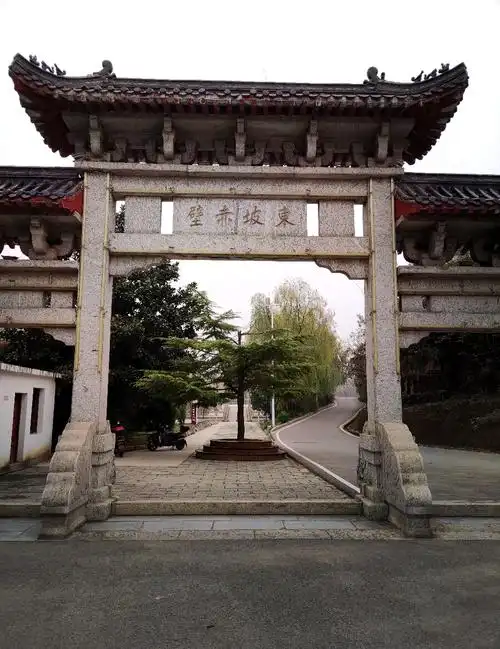 In 1080 the Song dynasty poet Su Shi—often hailed as China's Shakespeare for his lyric mastery—was exiled to Huangzhou for opposing the reformer Wang Anshi. For four years he wandered the Yangtze cliffs, gazing at the same waters where Zhou Yu had crushed Cao Cao's armada in 208 AD. Here he composed the celebrated song lyric "Reminiscing on Red Cliff" and the two "Red Cliff Rhapsodies," redefining a military landmark as a meditation on mortality, time, and the enduring power of art—much as Virgil recast Homer's Troy to meditate on Rome, or Petrarch drew literary life from the stones of Vaucluse.
The Ming-Qing architectural ensemble rises in terraces along the cliff, following traditional feng shui principles. Erfu Hall, the principal structure, houses towering wooden plaques carved with Su Shi's two rhapsodies; its name plaque is attributed to Qing statesman Li Hongzhang. Higher up, Poxian Pavilion shelters a wild-cursive poem stele considered the spiritual heart of the site, while Qixia Tower—a four-story belvedere at the summit—commands the finest view over the Yangtze and old Huangzhou town. Smaller pavilions trace the imagined route of Su Shi's moonlit boat journey.
The site's other treasure is its open-air stele forest: nearly 300 inscribed stones spanning centuries, with over 100 attributed to Su Shi himself. The crown jewel is the 126-stone "Jingsu Garden Tie," a comprehensive anthology of his calligraphy compiled during the Qing dynasty—comparable in ambition to a cathedral treasury of medieval manuscripts. Annual Dongpo Cultural Festivals and poetry recitations keep the tradition alive, drawing scholars and verse enthusiasts from across East Asia.
Located at 11 Park Road, Huangzhou District, the site backs onto mountains and faces the river, a 15-minute taxi ride from Huanggang West high-speed rail station (roughly one hour from Wuhan). Open daily 08:00–17:30 year-round, with adult tickets around 20–40 RMB. Allow two to three hours; the recommended route runs South Gate—Stele Pavilion—Erfu Hall—Poxian Pavilion—Leijiang Pavilion—Qixia Tower. Reading the rhapsodies and poem in advance will deepen the experience considerably.
A note for visitors: the Yangtze has shifted course over nine centuries, so the dramatic "surging waves pounding the shore" Su Shi described no longer crashes directly below the cliff. Travelers seeking raw natural spectacle may be underwhelmed; those arriving for literature, calligraphy, and atmosphere will find it unforgettable. Like a literary pilgrimage to Keats's house in Hampstead or Shakespeare's Stratford, the reward here is communion with a genius whose words have shaped a civilization for a millennium.
In 1080 the Song dynasty poet Su Shi—often hailed as China's Shakespeare for his lyric mastery—was exiled to Huangzhou for opposing the reformer Wang Anshi. For four years he wandered the Yangtze cliffs, gazing at the same waters where Zhou Yu had crushed Cao Cao's armada in 208 AD. Here he composed the celebrated song lyric "Reminiscing on Red Cliff" and the two "Red Cliff Rhapsodies," redefining a military landmark as a meditation on mortality, time, and the enduring power of art—much as Virgil recast Homer's Troy to meditate on Rome, or Petrarch drew literary life from the stones of Vaucluse.
The Ming-Qing architectural ensemble rises in terraces along the cliff, following traditional feng shui principles. Erfu Hall, the principal structure, houses towering wooden plaques carved with Su Shi's two rhapsodies; its name plaque is attributed to Qing statesman Li Hongzhang. Higher up, Poxian Pavilion shelters a wild-cursive poem stele considered the spiritual heart of the site, while Qixia Tower—a four-story belvedere at the summit—commands the finest view over the Yangtze and old Huangzhou town. Smaller pavilions trace the imagined route of Su Shi's moonlit boat journey.
The site's other treasure is its open-air stele forest: nearly 300 inscribed stones spanning centuries, with over 100 attributed to Su Shi himself. The crown jewel is the 126-stone "Jingsu Garden Tie," a comprehensive anthology of his calligraphy compiled during the Qing dynasty—comparable in ambition to a cathedral treasury of medieval manuscripts. Annual Dongpo Cultural Festivals and poetry recitations keep the tradition alive, drawing scholars and verse enthusiasts from across East Asia.
Located at 11 Park Road, Huangzhou District, the site backs onto mountains and faces the river, a 15-minute taxi ride from Huanggang West high-speed rail station (roughly one hour from Wuhan). Open daily 08:00–17:30 year-round, with adult tickets around 20–40 RMB. Allow two to three hours; the recommended route runs South Gate—Stele Pavilion—Erfu Hall—Poxian Pavilion—Leijiang Pavilion—Qixia Tower. Reading the rhapsodies and poem in advance will deepen the experience considerably.
A note for visitors: the Yangtze has shifted course over nine centuries, so the dramatic "surging waves pounding the shore" Su Shi described no longer crashes directly below the cliff. Travelers seeking raw natural spectacle may be underwhelmed; those arriving for literature, calligraphy, and atmosphere will find it unforgettable. Like a literary pilgrimage to Keats's house in Hampstead or Shakespeare's Stratford, the reward here is communion with a genius whose words have shaped a civilization for a millennium.