Ma'anshan Mine Pit Park
⭐ 3.50
Caishi Riverside, Yushan District, Ma'anshan City, Anhui Province, China
 Aoshan's iron ore was first extracted in 1917. Over the following century the open-pit mine became one of the largest of its kind in Asia, fueling China's industrial modernization and the steel mills that drove Ma'anshan's growth. Closure came in 2017, after decades of extraction had carved a colossal wound into the landscape. Comparable in spirit to Germany's Ruhr Valley regeneration—think the Zollverein complex or Emscher Park—the site underwent deliberate ecological restoration, reopening in February 2022 as a public park. In 2024, it earned national AAA scenic designation, marking its formal recognition as both heritage site and recreational space.
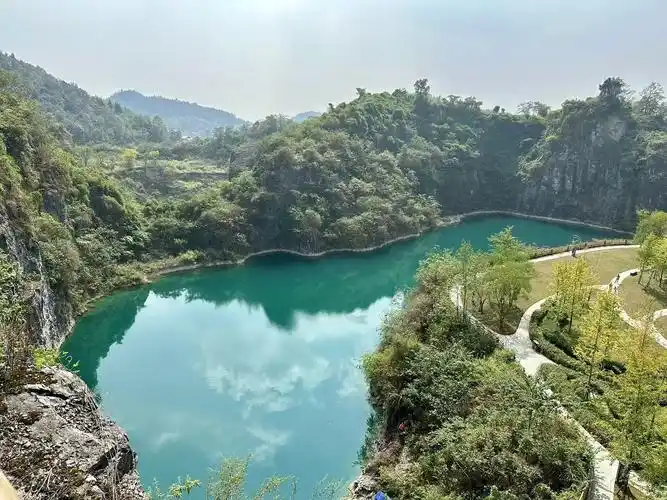
The park's showpiece is Aoshan Lake, a startling 210-meter-deep body of water holding roughly 1.5 million cubic meters of mineral-rich liquid. Dissolved elements tint the water in shifting hues of turquoise and emerald, earning the unofficial nickname "Emerald Lake." Sheer cliffs rise about one hundred meters above the surface, creating a dramatic amphitheater where mineral-stained rock meets impossibly blue water. From the circular viewing platform above, the sensation is genuinely otherworldly—like a giant gemstone set into the earth.
Rather than clearing the site, planners preserved much of the original mining hardware. Massive rotary drills, electric shovels, and other "iron beasts" stand where they were last operated, silent monuments to the labor that built modern China. Information panels and cultural walls trace the mine's hundred-year story, making the park an open-air classroom for industrial and geological education. This blend of raw ruin and reclaimed nature—a kind of Chinese answer to Cornwall's Tin Coast or Wales's Big Pit—has made the park popular with photographers chasing that post-industrial aesthetic.
Spanning roughly 60,000 square meters, the park is designed around a single, almost architectural gesture: a 2.2-kilometer flat lakeside boardwalk that traces the water's edge without intruding on the dramatic cliffs. The circular observation deck offers the commanding aerial view most visitors seek, while a nearby railway crossing provides a classic shot of passing trains framed against the pit. There are no cafés, shops, or restaurants inside; the appeal lies in stark minimalism, allowing the geology and silent machinery to speak for themselves.
Entry is free, and the loop takes a comfortable 1.5 to 2 hours at an easy pace. Self-driving is most convenient—navigate directly to "Aoshan Geological Cultural Park"—with free parking at the entrance. On weekends and holidays, a dedicated bus (route 807) connects the city to the site; on weekdays, a taxi or ride-hailing car is recommended. Crucially for international visitors: signage is Chinese only, with no multilingual audio guides. Shade is minimal, so spring and autumn are the best seasons; summer visitors should bring sun protection and prepare for mosquitoes and sudden gusts that funnel down through the pit.
For travelers accustomed to the manicured gardens of Suzhou or the imperial grandeur of Beijing, Aoshan offers something refreshingly different: an unscripted encounter with China's industrial soul, set against a landscape of accidental beauty. It pairs naturally with a visit to the nearby Daqingshan Wildlife Park, or with the Li Bai Cultural Garden in central Ma'anshan, a leafy complex celebrating the Tang dynasty poet who left verses across the Yangtze region. Together they make an unconventional but rewarding day out in a city most foreign tourists overlook.
Aoshan's iron ore was first extracted in 1917. Over the following century the open-pit mine became one of the largest of its kind in Asia, fueling China's industrial modernization and the steel mills that drove Ma'anshan's growth. Closure came in 2017, after decades of extraction had carved a colossal wound into the landscape. Comparable in spirit to Germany's Ruhr Valley regeneration—think the Zollverein complex or Emscher Park—the site underwent deliberate ecological restoration, reopening in February 2022 as a public park. In 2024, it earned national AAA scenic designation, marking its formal recognition as both heritage site and recreational space.
The park's showpiece is Aoshan Lake, a startling 210-meter-deep body of water holding roughly 1.5 million cubic meters of mineral-rich liquid. Dissolved elements tint the water in shifting hues of turquoise and emerald, earning the unofficial nickname "Emerald Lake." Sheer cliffs rise about one hundred meters above the surface, creating a dramatic amphitheater where mineral-stained rock meets impossibly blue water. From the circular viewing platform above, the sensation is genuinely otherworldly—like a giant gemstone set into the earth.
Rather than clearing the site, planners preserved much of the original mining hardware. Massive rotary drills, electric shovels, and other "iron beasts" stand where they were last operated, silent monuments to the labor that built modern China. Information panels and cultural walls trace the mine's hundred-year story, making the park an open-air classroom for industrial and geological education. This blend of raw ruin and reclaimed nature—a kind of Chinese answer to Cornwall's Tin Coast or Wales's Big Pit—has made the park popular with photographers chasing that post-industrial aesthetic.
Spanning roughly 60,000 square meters, the park is designed around a single, almost architectural gesture: a 2.2-kilometer flat lakeside boardwalk that traces the water's edge without intruding on the dramatic cliffs. The circular observation deck offers the commanding aerial view most visitors seek, while a nearby railway crossing provides a classic shot of passing trains framed against the pit. There are no cafés, shops, or restaurants inside; the appeal lies in stark minimalism, allowing the geology and silent machinery to speak for themselves.
Entry is free, and the loop takes a comfortable 1.5 to 2 hours at an easy pace. Self-driving is most convenient—navigate directly to "Aoshan Geological Cultural Park"—with free parking at the entrance. On weekends and holidays, a dedicated bus (route 807) connects the city to the site; on weekdays, a taxi or ride-hailing car is recommended. Crucially for international visitors: signage is Chinese only, with no multilingual audio guides. Shade is minimal, so spring and autumn are the best seasons; summer visitors should bring sun protection and prepare for mosquitoes and sudden gusts that funnel down through the pit.
For travelers accustomed to the manicured gardens of Suzhou or the imperial grandeur of Beijing, Aoshan offers something refreshingly different: an unscripted encounter with China's industrial soul, set against a landscape of accidental beauty. It pairs naturally with a visit to the nearby Daqingshan Wildlife Park, or with the Li Bai Cultural Garden in central Ma'anshan, a leafy complex celebrating the Tang dynasty poet who left verses across the Yangtze region. Together they make an unconventional but rewarding day out in a city most foreign tourists overlook.