Li Bai Cultural Park
⭐ 3.80
Li Bai Cultural Park, Yushan District, Ma'anshan City, Anhui Province, China
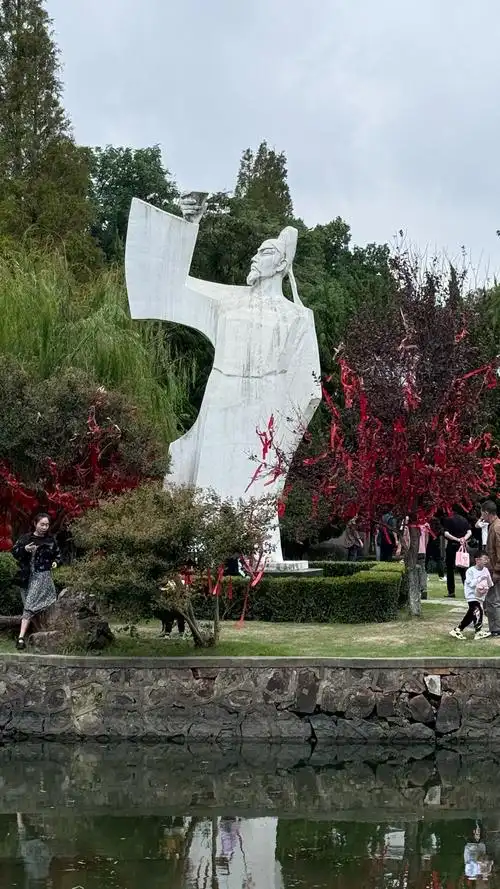 The garden's history stretches back to 762 CE, when Li Bai passed away in Dangtu at the age of sixty-one, in the twilight years of the Tang Dynasty—an era roughly contemporary with the rise of the Umayyad Caliphate and the Anglo-Saxon kingdoms of early medieval Europe. Originally buried at Caishiji along the Yangtze, his remains were later relocated to this tranquil hillside. Over the centuries, the tomb was repaired and embellished through the Song, Yuan, Ming, and Qing dynasties, with Song-era steles and epitaphs still surviving. Expanded into a memorial park in the modern era, the site now draws admirers from across the world who, like pilgrims to Stratford-upon-Avon or Florence's Dante sites, come to pay homage to one of history's greatest literary voices.
The architecture follows the elegant Ming–Qing Huizhou vernacular style, with sweeping upturned eaves, whitewashed walls, and grey-tiled roofs recalling the restrained grace of a classical Italian villa or an English Palladian manor. At the heart of the complex stands the Taibai Ancestral Hall, where a white-marble seated statue of the poet presides over displays of his later manuscripts and calligraphy. The surrounding Stele Forest is a treasure trove: over one hundred carved stone tablets reproduce immortal verses such as "Quiet Night Thoughts" and "Bring in the Wine," rendered in running, cursive, clerical, and seal scripts—a tradition of monumental inscription that one might compare to the literary reliefs adorning the baptistery in Florence or Westminster Abbey's poetic memorials.
Beyond its physical beauty, the park embodies the cultural devotion Li Bai inspires—a reverence comparable to the way Europeans venerate Homer or Virgil. The grounds trace his life arc through landscape: from the youthful idealism of his "Green Lotus" sobriquet, through the bold ambition of his wandering years, to the poignant final chapter spent in Dangtu. Each spring during the Qingming Festival, scholars and poetry lovers gather here to pour wine and recite verses, keeping the poet's spirit alive. This living tradition of literary pilgrimage sets the garden apart from a mere museum, transforming it into a place where Tang Dynasty brilliance remains vividly present.
Practical details make a visit straightforward and rewarding. Standard admission is 30 RMB per person, with half-price concessions for seniors and students, and the site generally opens from 8:30 a.m. to 5:30 p.m. The compact layout rewards a leisurely two-to-three-hour stroll, allowing time to read the inscriptions and absorb the atmosphere. Spring (March to May) and autumn (September to November) offer the most pleasant weather, with soft morning and evening light ideal for photography and quiet contemplation. The garden is also easily combined with the nearby Caishiji Scenic Area, where Li Bai's symbolic cenotaph lies just twenty kilometres away—a perfect full-day literary excursion tracing the poet's final footsteps along the Yangtze.
For Western travelers, the Li Bai Cultural Garden offers something rare in modern tourism: an unfiltered encounter with one of the world's truly immortal poets in a setting that has scarcely changed in fifteen centuries. Visitors are encouraged to wear muted, simple clothing—traditionally inspired attire like hanfu blends seamlessly into the garden's classical mood—and to move quietly and respectfully, as this is an active place of remembrance. Whether you arrive as a devoted reader of Chinese poetry or simply a curious traveler drawn to Tang Dynasty romance, you will leave with a deeper understanding of why Li Bai, like Shakespeare in the English-speaking world, remains a figure whose words transcend time and geography.
The garden's history stretches back to 762 CE, when Li Bai passed away in Dangtu at the age of sixty-one, in the twilight years of the Tang Dynasty—an era roughly contemporary with the rise of the Umayyad Caliphate and the Anglo-Saxon kingdoms of early medieval Europe. Originally buried at Caishiji along the Yangtze, his remains were later relocated to this tranquil hillside. Over the centuries, the tomb was repaired and embellished through the Song, Yuan, Ming, and Qing dynasties, with Song-era steles and epitaphs still surviving. Expanded into a memorial park in the modern era, the site now draws admirers from across the world who, like pilgrims to Stratford-upon-Avon or Florence's Dante sites, come to pay homage to one of history's greatest literary voices.
The architecture follows the elegant Ming–Qing Huizhou vernacular style, with sweeping upturned eaves, whitewashed walls, and grey-tiled roofs recalling the restrained grace of a classical Italian villa or an English Palladian manor. At the heart of the complex stands the Taibai Ancestral Hall, where a white-marble seated statue of the poet presides over displays of his later manuscripts and calligraphy. The surrounding Stele Forest is a treasure trove: over one hundred carved stone tablets reproduce immortal verses such as "Quiet Night Thoughts" and "Bring in the Wine," rendered in running, cursive, clerical, and seal scripts—a tradition of monumental inscription that one might compare to the literary reliefs adorning the baptistery in Florence or Westminster Abbey's poetic memorials.
Beyond its physical beauty, the park embodies the cultural devotion Li Bai inspires—a reverence comparable to the way Europeans venerate Homer or Virgil. The grounds trace his life arc through landscape: from the youthful idealism of his "Green Lotus" sobriquet, through the bold ambition of his wandering years, to the poignant final chapter spent in Dangtu. Each spring during the Qingming Festival, scholars and poetry lovers gather here to pour wine and recite verses, keeping the poet's spirit alive. This living tradition of literary pilgrimage sets the garden apart from a mere museum, transforming it into a place where Tang Dynasty brilliance remains vividly present.
Practical details make a visit straightforward and rewarding. Standard admission is 30 RMB per person, with half-price concessions for seniors and students, and the site generally opens from 8:30 a.m. to 5:30 p.m. The compact layout rewards a leisurely two-to-three-hour stroll, allowing time to read the inscriptions and absorb the atmosphere. Spring (March to May) and autumn (September to November) offer the most pleasant weather, with soft morning and evening light ideal for photography and quiet contemplation. The garden is also easily combined with the nearby Caishiji Scenic Area, where Li Bai's symbolic cenotaph lies just twenty kilometres away—a perfect full-day literary excursion tracing the poet's final footsteps along the Yangtze.
For Western travelers, the Li Bai Cultural Garden offers something rare in modern tourism: an unfiltered encounter with one of the world's truly immortal poets in a setting that has scarcely changed in fifteen centuries. Visitors are encouraged to wear muted, simple clothing—traditionally inspired attire like hanfu blends seamlessly into the garden's classical mood—and to move quietly and respectfully, as this is an active place of remembrance. Whether you arrive as a devoted reader of Chinese poetry or simply a curious traveler drawn to Tang Dynasty romance, you will leave with a deeper understanding of why Li Bai, like Shakespeare in the English-speaking world, remains a figure whose words transcend time and geography.