Caishiji Scenic Area
⭐ 4.60
Caishiji Scenic Area, Yushan District, Ma'anshan City, Anhui Province, China
 **A Strategic River Crossing Through the Ages**
For more than fifteen centuries, Caishiji served as a critical military chokepoint along the lower Yangtze, much like the fortress bluffs overlooking the Rhine or the Dardanelles in classical antiquity. During the Three Kingdoms era (220-280 AD), Sun Ce defeated rival warlord Liu You in battle here; in 1161, Song general Yu Yunwen used the same cliffs to repel a massive Jin invasion fleet in one of medieval China's most celebrated naval victories. These layered histories transform the bluff from a mere scenic outlook into an open-air archive of imperial strategy—comparable in resonance to visitors exploring the cliff-top castles of the Rhine Gorge.
**Landscape, Cliffs, and Cliffside Engineering**
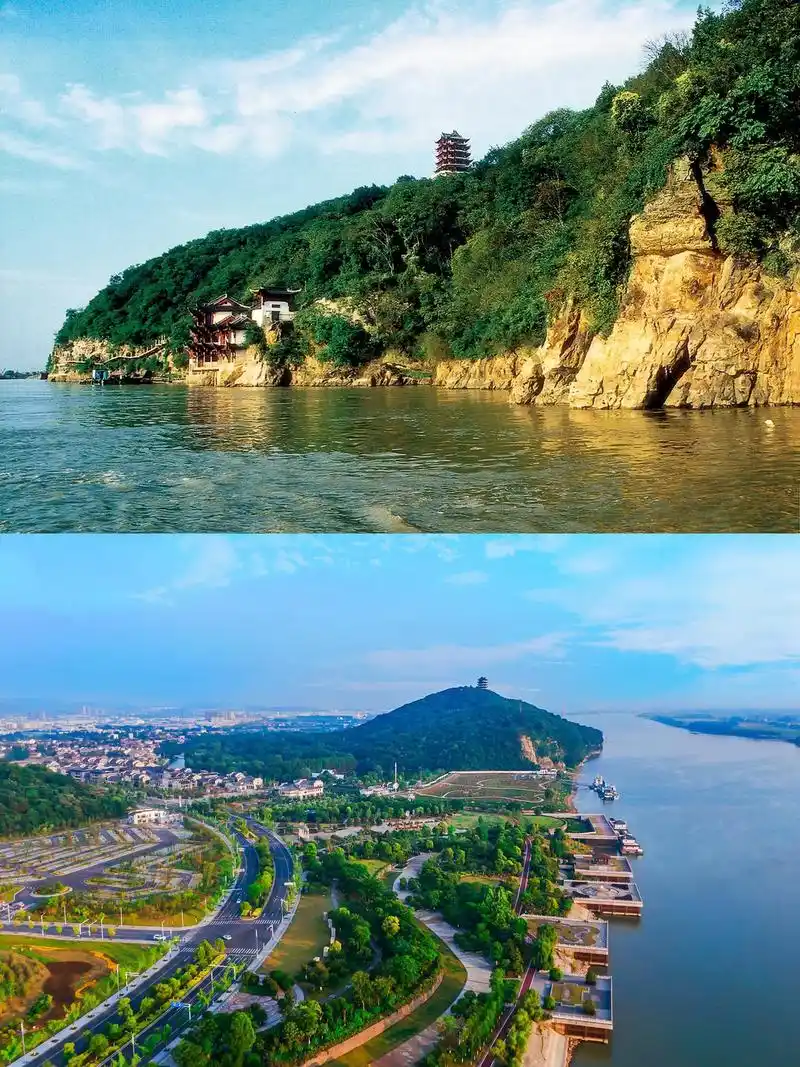
Though Cuiluo Mountain's summit reaches only 131 meters, its vertical drop straight into the Yangtze creates an outsized drama reminiscent of Switzerland's Rhine Falls or the chalk cliffs of Normandy. An 800-meter suspended walkway bolts directly into the cliff face, threading past the三元洞 (Sanyuan Cave) carved into the rock and the precarious联璧台 (Lianbi Terrace), a stone platform jutting boldly over the water. Crowning the peak, the three-tiered Santai Pavilion offers commanding panoramas where the Yangtze unrolls like a silver ribbon toward distant blue hills—a view rivals of any grand European river terrace.
**The Spirit of Li Bai**
The bluff's true magnetism lies with Tang dynasty poet Li Bai (701-762), often called China's Keats or Byron for his romantic intoxication with wine, moon, and nature. He is said to have visited seven times, and local legend immortalizes his final night here: drunk and luminous, he leapt from a boat to embrace the moon's reflection and was lost to the river. The Taibai Tower, built in the Tang dynasty and standing shoulder-to-shoulder with the famed Yueyang and Yellow Crane Towers as one of the "Three Towers and One Pavilion of the Yangtze," houses exhibits on his life, while his cenotaph and the poetic Zhexiang Garden preserve his legacy—offering visitors a pilgrimage site akin to Shakespeare's Stratford or Petrarch's Vaucluse.
**Planning Your Visit**
The scenic area sits at No. 1 Tangxian Street, Yushan District, Ma'anshan. Standard admission is 68 RMB, with frequent discounts and free-entry days; opening hours run roughly 08:30-17:30 from May through October. Public buses 4, You-1, and 26 connect from downtown Ma'anshan, while drivers can reach the Caishiji River exit off the Nanjing-Wuhu Expressway in about twenty minutes. From Nanjing, take Metro Line S2 to Ma'anshan and transfer to bus 909. Shuttle buses within the park spare tired legs on the climb.
**An Ideal Route and Final Tips**
For the richest experience, enter through the North Gate and begin indoors at Taibai Tower and the Li Bai Memorial Hall—perfect for escaping midday heat—before descending to the cliff walkway via Sanyuan Cave and ascending to Santai Pavilion for sunset. Two to two and a half hours covers the highlights; add another hour for the riverside wetland, finless porpoise bay, and the Lin Sanzhi Art Museum. Golden hour transforms the river into molten light and the distant mountains into ink wash. Wear sturdy non-slip shoes, bring sunscreen and water, and check weather forecasts—the walkway closes during thunderstorms for safety.
**A Strategic River Crossing Through the Ages**
For more than fifteen centuries, Caishiji served as a critical military chokepoint along the lower Yangtze, much like the fortress bluffs overlooking the Rhine or the Dardanelles in classical antiquity. During the Three Kingdoms era (220-280 AD), Sun Ce defeated rival warlord Liu You in battle here; in 1161, Song general Yu Yunwen used the same cliffs to repel a massive Jin invasion fleet in one of medieval China's most celebrated naval victories. These layered histories transform the bluff from a mere scenic outlook into an open-air archive of imperial strategy—comparable in resonance to visitors exploring the cliff-top castles of the Rhine Gorge.
**Landscape, Cliffs, and Cliffside Engineering**
Though Cuiluo Mountain's summit reaches only 131 meters, its vertical drop straight into the Yangtze creates an outsized drama reminiscent of Switzerland's Rhine Falls or the chalk cliffs of Normandy. An 800-meter suspended walkway bolts directly into the cliff face, threading past the三元洞 (Sanyuan Cave) carved into the rock and the precarious联璧台 (Lianbi Terrace), a stone platform jutting boldly over the water. Crowning the peak, the three-tiered Santai Pavilion offers commanding panoramas where the Yangtze unrolls like a silver ribbon toward distant blue hills—a view rivals of any grand European river terrace.
**The Spirit of Li Bai**
The bluff's true magnetism lies with Tang dynasty poet Li Bai (701-762), often called China's Keats or Byron for his romantic intoxication with wine, moon, and nature. He is said to have visited seven times, and local legend immortalizes his final night here: drunk and luminous, he leapt from a boat to embrace the moon's reflection and was lost to the river. The Taibai Tower, built in the Tang dynasty and standing shoulder-to-shoulder with the famed Yueyang and Yellow Crane Towers as one of the "Three Towers and One Pavilion of the Yangtze," houses exhibits on his life, while his cenotaph and the poetic Zhexiang Garden preserve his legacy—offering visitors a pilgrimage site akin to Shakespeare's Stratford or Petrarch's Vaucluse.
**Planning Your Visit**
The scenic area sits at No. 1 Tangxian Street, Yushan District, Ma'anshan. Standard admission is 68 RMB, with frequent discounts and free-entry days; opening hours run roughly 08:30-17:30 from May through October. Public buses 4, You-1, and 26 connect from downtown Ma'anshan, while drivers can reach the Caishiji River exit off the Nanjing-Wuhu Expressway in about twenty minutes. From Nanjing, take Metro Line S2 to Ma'anshan and transfer to bus 909. Shuttle buses within the park spare tired legs on the climb.
**An Ideal Route and Final Tips**
For the richest experience, enter through the North Gate and begin indoors at Taibai Tower and the Li Bai Memorial Hall—perfect for escaping midday heat—before descending to the cliff walkway via Sanyuan Cave and ascending to Santai Pavilion for sunset. Two to two and a half hours covers the highlights; add another hour for the riverside wetland, finless porpoise bay, and the Lin Sanzhi Art Museum. Golden hour transforms the river into molten light and the distant mountains into ink wash. Wear sturdy non-slip shoes, bring sunscreen and water, and check weather forecasts—the walkway closes during thunderstorms for safety.