Xinyang City Library
⭐ 2.00
Northwest Side of the Intersection of Hudong Avenue and Beijing Road, Shihe District, Xinyang City, Henan Province, China
 The Xinyang City Library opened in its present form in late 2002, though its institutional roots trace to 1999. As a "national first-grade" facility, it belongs to China's top tier of public libraries—a classification system designed to standardize cultural services nationwide. Western visitors may draw parallels to the Carnegie library tradition of the early twentieth century, when industrial philanthropists funded thousands of free public reading rooms across Europe and North America. Like those institutions, Xinyang's library embodies the democratic ideal that knowledge should be freely accessible to all citizens, regardless of income. Today, it anchors the city's cultural infrastructure alongside museums and theaters.
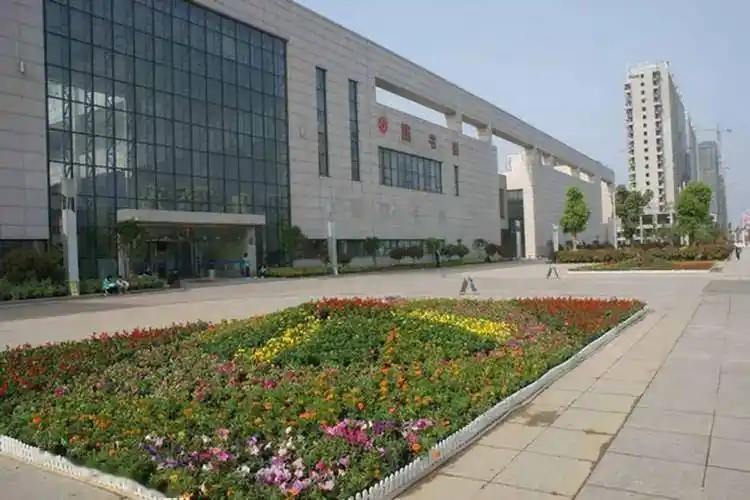
Occupying approximately 13,000 square meters, the library rises in the planned Yangshan New District, a modern urban quarter constructed in the early 2000s to relocate Xinyang's administrative core. The building follows contemporary Chinese institutional design: clean lines, generous windows, and functional interiors divided into reading halls, lending areas, quiet study rooms, and a multi-purpose event auditorium. Hot water dispensers and purified drinking fountains serve visitors throughout the day. Inside, the atmosphere resembles a Western university library—orderly, hushed, and bathed in natural light—though the clientele reflects Xinyang's distinctive regional character rather than that of an international academic community.
The library safeguards a dedicated Xinyang Local Literature Collection, preserving municipal gazetteers, regional histories, and ephemera that document the city's three-thousand-year heritage in southern Henan. This repository connects readers to Xinyang's role as a former tea capital and southern gateway between the North China Plain and the Yangtze basin—an identity comparable to Montpellier's position in Mediterranean France. Beyond preservation, the library functions as a vibrant social hub, hosting more than a hundred annual programs: author talks, parent-child reading sessions, book fairs where patrons choose titles the library then purchases, and themed board-game afternoons. These activities support the national reading promotion campaign launched in 2014.
The library sits at 99 Xinwu Avenue, just southwest of the municipal government complex. Bus routes 22 and 25 stop nearby. Summer hours run 8:30 a.m. to 6:00 p.m.; winter hours 8:30 a.m. to 5:30 p.m. The facility closes on Mondays except during national holidays. Foreign visitors should bring their original passport—staff can issue a temporary reading pass on the spot or help arrange a full borrowing card. All main signage and services operate in Chinese, though front-desk librarians are accustomed to assisting non-Chinese speakers with basic registration. Smoking, food, and beverages are prohibited throughout the building.
A library may seem an unlikely tourist attraction, yet travelers who skip it miss one of the most revealing windows into contemporary Chinese society. Within these walls, you will observe students preparing for examinations, retirees reading newspapers, and children attending weekend storytelling sessions—a cross-section of urban life rarely visible in curated tourist venues. The experience offers a contemplative counterpoint to the dramatic landscapes surrounding Xinyang, particularly nearby Nanwan Lake and Jingji Mountain. For visitors interested in modern culture, education, or simply finding a peaceful retreat, the library delivers an authentic encounter with the rhythm of a regional Chinese city.
The Xinyang City Library opened in its present form in late 2002, though its institutional roots trace to 1999. As a "national first-grade" facility, it belongs to China's top tier of public libraries—a classification system designed to standardize cultural services nationwide. Western visitors may draw parallels to the Carnegie library tradition of the early twentieth century, when industrial philanthropists funded thousands of free public reading rooms across Europe and North America. Like those institutions, Xinyang's library embodies the democratic ideal that knowledge should be freely accessible to all citizens, regardless of income. Today, it anchors the city's cultural infrastructure alongside museums and theaters.
Occupying approximately 13,000 square meters, the library rises in the planned Yangshan New District, a modern urban quarter constructed in the early 2000s to relocate Xinyang's administrative core. The building follows contemporary Chinese institutional design: clean lines, generous windows, and functional interiors divided into reading halls, lending areas, quiet study rooms, and a multi-purpose event auditorium. Hot water dispensers and purified drinking fountains serve visitors throughout the day. Inside, the atmosphere resembles a Western university library—orderly, hushed, and bathed in natural light—though the clientele reflects Xinyang's distinctive regional character rather than that of an international academic community.
The library safeguards a dedicated Xinyang Local Literature Collection, preserving municipal gazetteers, regional histories, and ephemera that document the city's three-thousand-year heritage in southern Henan. This repository connects readers to Xinyang's role as a former tea capital and southern gateway between the North China Plain and the Yangtze basin—an identity comparable to Montpellier's position in Mediterranean France. Beyond preservation, the library functions as a vibrant social hub, hosting more than a hundred annual programs: author talks, parent-child reading sessions, book fairs where patrons choose titles the library then purchases, and themed board-game afternoons. These activities support the national reading promotion campaign launched in 2014.
The library sits at 99 Xinwu Avenue, just southwest of the municipal government complex. Bus routes 22 and 25 stop nearby. Summer hours run 8:30 a.m. to 6:00 p.m.; winter hours 8:30 a.m. to 5:30 p.m. The facility closes on Mondays except during national holidays. Foreign visitors should bring their original passport—staff can issue a temporary reading pass on the spot or help arrange a full borrowing card. All main signage and services operate in Chinese, though front-desk librarians are accustomed to assisting non-Chinese speakers with basic registration. Smoking, food, and beverages are prohibited throughout the building.
A library may seem an unlikely tourist attraction, yet travelers who skip it miss one of the most revealing windows into contemporary Chinese society. Within these walls, you will observe students preparing for examinations, retirees reading newspapers, and children attending weekend storytelling sessions—a cross-section of urban life rarely visible in curated tourist venues. The experience offers a contemplative counterpoint to the dramatic landscapes surrounding Xinyang, particularly nearby Nanwan Lake and Jingji Mountain. For visitors interested in modern culture, education, or simply finding a peaceful retreat, the library delivers an authentic encounter with the rhythm of a regional Chinese city.