St. Michael's Cathedral
⭐ 4.50
No. 11, Zhongshan Road, Shinan District, Qingdao, Shandong, China
 Qingdao's skyline still whispers of the late 19th-century "Scramble for Concessions," when European powers carved treaty ports along China's coast. Germany seized Jiaozhou Bay in 1898 following the murder of two missionaries, transforming a quiet fishing village into a showcase colonial city of beer halls, railways, and Gothic churches. St. Michael's was completed in 1934, well after Germany lost its colony to Japan in World War I and the territory was eventually returned to China in 1922. Its consecration—the only such ceremony ever held at a Catholic church in China—reflects the tangled religious and political currents of interwar East Asia. Today the cathedral is a nationally protected heritage site and a proud entry in the "20th Century Architectural Heritage of China" register.
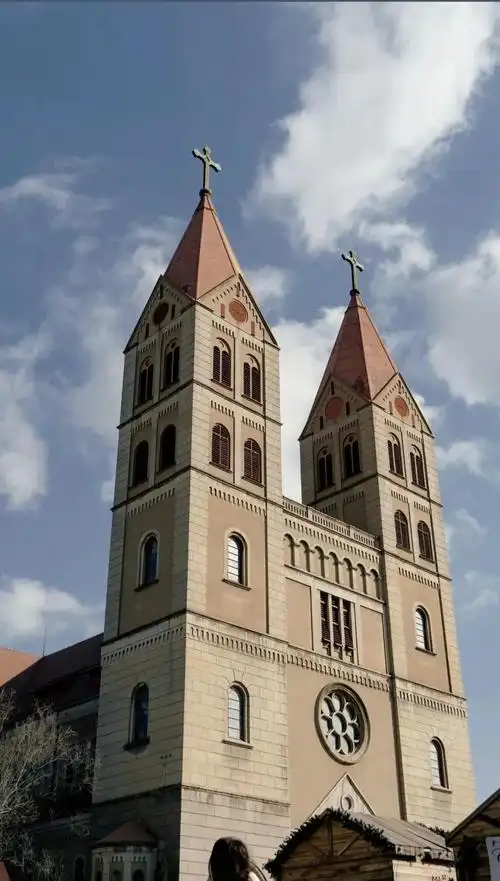
Designed by a German architect, the church fuses Gothic verticality with Romanesque solidity in a way that feels unmistakably European yet subtly adapted to coastal China. Its twin towers soar to 56 meters, dwarfing the surrounding red-tiled rooftops and offering a silhouette often compared to a smaller Cologne Cathedral. The structure combines locally quarried granite with reinforced concrete, while bronze-cast doors and intricately carved stone reliefs adorn the entrance. Inside, the cavernous nave is illuminated by jewel-toned stained glass that filters Yellow Sea sunlight into kaleidoscopic patterns, and a vast ceiling fresco crowns the altar with delicate, almost Byzantine brushwork.
As the only Catholic church in China ever to host a full consecration rite, St. Michael's holds a singular place in the country's religious history. The interior preserves treasures that bridge East and West, from a century-old tracker pipe organ to altar ornaments that quietly incorporate Chinese motifs into traditional Catholic iconography. Every Sunday, local worshippers gather for the principal Mass, turning the cathedral into a window onto Qingdao's living faith community rather than a static museum. Whether you attend out of devotion or curiosity, you witness a rare continuity of practice in a country where religious expression has often been interrupted.
The exterior square is open free of charge year-round and serves as a favorite backdrop for wedding photographers and travel influencers alike. To enter the church itself, tickets cost just 10 yuan, with reductions for students and seniors. The interior closes on Mondays but opens Tuesday through Saturday from 8:30 a.m. to 5:00 p.m. On Sundays, the building is reserved for morning Mass and admits visitors only after noon. Silence is expected inside, and flash photography is strictly prohibited to protect the stained glass and artworks. Allow about one hour for a relaxed visit.
For the best photographs, arrive on a weekday between 9 and 10:30 a.m., when soft light bathes the façade and crowds thin out; after 4 p.m., the lowering sun sets the stained glass aglow from within. Modest dress is appreciated as a sign of respect. The cathedral sits at the heart of Qingdao's historic old town, making it easy to combine with the nearby Zhanqiao Pier, the bustling Zhongshan Road shopping street, and Signal Hill Park, where panoramic views reveal the harmonious blend of red roofs, green trees, and church spires that defines the city's distinctive charm.
Qingdao's skyline still whispers of the late 19th-century "Scramble for Concessions," when European powers carved treaty ports along China's coast. Germany seized Jiaozhou Bay in 1898 following the murder of two missionaries, transforming a quiet fishing village into a showcase colonial city of beer halls, railways, and Gothic churches. St. Michael's was completed in 1934, well after Germany lost its colony to Japan in World War I and the territory was eventually returned to China in 1922. Its consecration—the only such ceremony ever held at a Catholic church in China—reflects the tangled religious and political currents of interwar East Asia. Today the cathedral is a nationally protected heritage site and a proud entry in the "20th Century Architectural Heritage of China" register.
Designed by a German architect, the church fuses Gothic verticality with Romanesque solidity in a way that feels unmistakably European yet subtly adapted to coastal China. Its twin towers soar to 56 meters, dwarfing the surrounding red-tiled rooftops and offering a silhouette often compared to a smaller Cologne Cathedral. The structure combines locally quarried granite with reinforced concrete, while bronze-cast doors and intricately carved stone reliefs adorn the entrance. Inside, the cavernous nave is illuminated by jewel-toned stained glass that filters Yellow Sea sunlight into kaleidoscopic patterns, and a vast ceiling fresco crowns the altar with delicate, almost Byzantine brushwork.
As the only Catholic church in China ever to host a full consecration rite, St. Michael's holds a singular place in the country's religious history. The interior preserves treasures that bridge East and West, from a century-old tracker pipe organ to altar ornaments that quietly incorporate Chinese motifs into traditional Catholic iconography. Every Sunday, local worshippers gather for the principal Mass, turning the cathedral into a window onto Qingdao's living faith community rather than a static museum. Whether you attend out of devotion or curiosity, you witness a rare continuity of practice in a country where religious expression has often been interrupted.
The exterior square is open free of charge year-round and serves as a favorite backdrop for wedding photographers and travel influencers alike. To enter the church itself, tickets cost just 10 yuan, with reductions for students and seniors. The interior closes on Mondays but opens Tuesday through Saturday from 8:30 a.m. to 5:00 p.m. On Sundays, the building is reserved for morning Mass and admits visitors only after noon. Silence is expected inside, and flash photography is strictly prohibited to protect the stained glass and artworks. Allow about one hour for a relaxed visit.
For the best photographs, arrive on a weekday between 9 and 10:30 a.m., when soft light bathes the façade and crowds thin out; after 4 p.m., the lowering sun sets the stained glass aglow from within. Modest dress is appreciated as a sign of respect. The cathedral sits at the heart of Qingdao's historic old town, making it easy to combine with the nearby Zhanqiao Pier, the bustling Zhongshan Road shopping street, and Signal Hill Park, where panoramic views reveal the harmonious blend of red roofs, green trees, and church spires that defines the city's distinctive charm.