Qingdao Former German Governor's Residence Museum
⭐ 4.60
Shinan District, Qingdao City, Shandong Province, China
 After the 1898 lease of Kiautschou Bay—a trophy of Bismarck's Weltpolitik and Germany's late arrival on the colonial stage—Berlin poured resources into making Qingdao (then Tsingtao) a model German outpost. Built 1905 to 1907 as the imperial governor's mansion, the residence was the crown jewel of a venture modeled on Wilhelmine ideals of permanence and prestige. Like Hong Kong's Peak or Shanghai's Bund, it became a symbol of European presence on the Chinese coast; yet Qingdao retained heavier layers of German planning, including the breweries that gave the world Tsingtao Beer. With Japan's 1914 seizure and the post-WWI handover, the building's meaning kept shifting—empire, occupation, and national recovery—giving it a richer story than most colonial mansions in Asia.
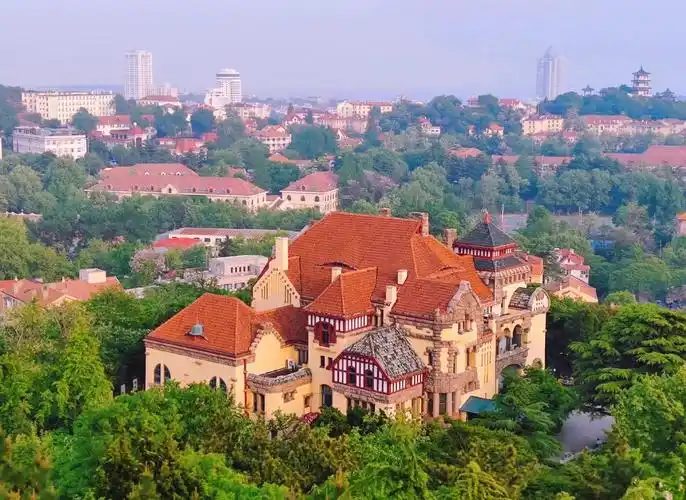
Architect Curt Rothkegel blended the monumental Wilhelmine style of Imperial Germany with the lighter, organic motifs of Jugendstil, a combination that recalls grand buildings from Berlin's Wilhelmstraße to Budapest's Gellért Baths. Locally quarried granite anchors the buff-yellow walls; crowning the eaves, the famous "Norman dragon-head" gargoyles gaze seaward, lending the structure its fairy-tale silhouette. Photographed from Signal Hill above, the castle is one of the signature images behind Qingdao's celebrated "red tiles, green trees, blue sea, blue sky" identity. Few buildings in Asia convey so vividly the architectural ambitions of a brief, ambitious colonial era.
Inside, the gilded hall evokes a Bavarian palace of the late 1900s. Wood-paneled reception rooms, the grand dining hall, and private quarters retain their original Wilhelmine fittings—an ivory-keyed Steinway piano, jeweled chandeliers, ceramic-tiled fireplaces, and a hot-water heating system still working through cast-iron pipes a century on. The craftsmanship astonishes: joints still flush, parquet polished, brass hardware gleaming. Beyond its aristocratic ambiance, the house carries a layered second history as Japanese garrison headquarters after 1914, then as the residence of Republic of China officials in the 1930s. In 1957, Mao Zedong himself stayed here—an event now commemorated inside the museum, giving the building an unexpected place in the story of the People's Republic.
The museum sits at 9 Longshan Road in the Shinan District, easily reachable by metro or city bus. Peak-season hours run 8:30 to 17:30, with some halls staying open to 19:00; the museum closes on Mondays. Admission is just 20 yuan for adults (students half-price), and seniors, disabled visitors, military personnel, and many other groups enter free—an extraordinary value for a national first-class museum. Tickets should be reserved online in advance; bring a passport or ID to exchange for entry. Photography is prohibited inside, but multilingual audio guides and guided tours (typically hourly) are highly recommended.
A visit takes 60 to 90 minutes and pairs naturally with Signal Hill Park, which rises just behind the museum and rewards climbers with the classic postcard panorama of red rooftops tumbling toward the Yellow Sea. From there, allow time for Badaguan's quiet garden lanes—the former European hill station—or the viewpoints of Xiaoyu Hill, both within a few kilometers. For travelers interested in colonial-era architecture, decorative arts, or the layered political history of modern China, the Governor's Residence is the single most atmospheric stop in Qingdao: a place where imperial ambition, twentieth-century upheaval, and contemporary commemoration share the same gilded, granite-walled house.
After the 1898 lease of Kiautschou Bay—a trophy of Bismarck's Weltpolitik and Germany's late arrival on the colonial stage—Berlin poured resources into making Qingdao (then Tsingtao) a model German outpost. Built 1905 to 1907 as the imperial governor's mansion, the residence was the crown jewel of a venture modeled on Wilhelmine ideals of permanence and prestige. Like Hong Kong's Peak or Shanghai's Bund, it became a symbol of European presence on the Chinese coast; yet Qingdao retained heavier layers of German planning, including the breweries that gave the world Tsingtao Beer. With Japan's 1914 seizure and the post-WWI handover, the building's meaning kept shifting—empire, occupation, and national recovery—giving it a richer story than most colonial mansions in Asia.
Architect Curt Rothkegel blended the monumental Wilhelmine style of Imperial Germany with the lighter, organic motifs of Jugendstil, a combination that recalls grand buildings from Berlin's Wilhelmstraße to Budapest's Gellért Baths. Locally quarried granite anchors the buff-yellow walls; crowning the eaves, the famous "Norman dragon-head" gargoyles gaze seaward, lending the structure its fairy-tale silhouette. Photographed from Signal Hill above, the castle is one of the signature images behind Qingdao's celebrated "red tiles, green trees, blue sea, blue sky" identity. Few buildings in Asia convey so vividly the architectural ambitions of a brief, ambitious colonial era.
Inside, the gilded hall evokes a Bavarian palace of the late 1900s. Wood-paneled reception rooms, the grand dining hall, and private quarters retain their original Wilhelmine fittings—an ivory-keyed Steinway piano, jeweled chandeliers, ceramic-tiled fireplaces, and a hot-water heating system still working through cast-iron pipes a century on. The craftsmanship astonishes: joints still flush, parquet polished, brass hardware gleaming. Beyond its aristocratic ambiance, the house carries a layered second history as Japanese garrison headquarters after 1914, then as the residence of Republic of China officials in the 1930s. In 1957, Mao Zedong himself stayed here—an event now commemorated inside the museum, giving the building an unexpected place in the story of the People's Republic.
The museum sits at 9 Longshan Road in the Shinan District, easily reachable by metro or city bus. Peak-season hours run 8:30 to 17:30, with some halls staying open to 19:00; the museum closes on Mondays. Admission is just 20 yuan for adults (students half-price), and seniors, disabled visitors, military personnel, and many other groups enter free—an extraordinary value for a national first-class museum. Tickets should be reserved online in advance; bring a passport or ID to exchange for entry. Photography is prohibited inside, but multilingual audio guides and guided tours (typically hourly) are highly recommended.
A visit takes 60 to 90 minutes and pairs naturally with Signal Hill Park, which rises just behind the museum and rewards climbers with the classic postcard panorama of red rooftops tumbling toward the Yellow Sea. From there, allow time for Badaguan's quiet garden lanes—the former European hill station—or the viewpoints of Xiaoyu Hill, both within a few kilometers. For travelers interested in colonial-era architecture, decorative arts, or the layered political history of modern China, the Governor's Residence is the single most atmospheric stop in Qingdao: a place where imperial ambition, twentieth-century upheaval, and contemporary commemoration share the same gilded, granite-walled house.