Xiaoyushan
⭐ 4.80
Xiaoyushan Park, Shinan District, Qingdao, Shandong Province, China
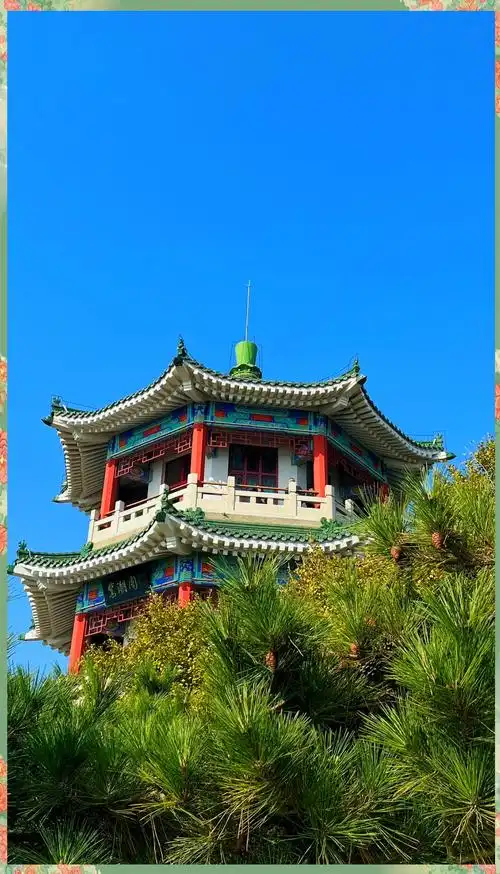 Despite its modest 60-meter elevation, Xiaoyushan has served as a natural landmark along Qingdao's southern coast since time immemorial, its rounded silhouette resembling a crouching fish. The hill took on its modern identity in the mid-1980s when the municipal government transformed it into Qingdao's first classically styled Chinese garden, opening to the public in 1985. The celebrated calligrapher and scholar Qi Gong inscribed its name, and the vista of "Fish Hill Inviting the Moon" was soon named among Qingdao's Ten New Sights. The park stands as both a cultural artifact and a memorial to the city's layered history under German, Japanese, and Chinese administration.
The park's layout follows the poetic "Three Hills, Ten Scenes" principle familiar from imperial Chinese gardens such as those at Suzhou or Chengde. At the summit rises the three-tiered octagonal Lanchao Pavilion, whose upswept eaves recall the towers of Beijing's Temple of Heaven in miniature. Down the slopes, the Bibo Pavilion frames views across Huiquan Bay, while the Yongcui Pavilion nestles among cedars on the eastern flank. Pavilions are decorated with murals drawing on legends such as the Eight Immortals Crossing the Sea, weaving classical Chinese aesthetics into the maritime setting in a manner quite unlike the seaside gardens of Nice or Monaco.
Beyond its scenery, Xiaoyushan functions as a three-dimensional portrait of Qingdao's hundred-year urban story. From the hilltop, the German colonial villas of the early 1900s sit shoulder-to-shoulder with sleek modern towers and the curving coastline, embodying the "red tiles, green trees, blue sea, azure sky" imagery that earned Qingdao its reputation as the "Switzerland of the Orient." For visitors seeking to grasp how mountains, sea, and city intertwine here in a manner reminiscent of Rio de Janeiro or the Amalfi Coast, this single viewpoint delivers more insight than hours of guidebook reading.
Practical details make visiting straightforward. Entry requires advance reservation via the WeChat official account or Meituán platform. The park is open from 6 a.m. to 8 p.m. between April 1 and October 31, with tickets priced at just 5 RMB; children, seniors, and military personnel enter free with identification. The address is 24 Fushan Zhilu, Shinan District, and the nearest metro station is People's Hall (Renmin Huitang), Exit B, on Line 3, followed by an 800-meter walk. Weekends and holidays draw crowds, so off-peak timing is strongly recommended.
The ideal visit begins after 4:30 p.m., when the slanting light gilds the red-tiled rooftops and softens the entire bay into a watercolor scene. Visitors timing their summit for roughly 7:10 p.m. can catch the sun sinking into the Yellow Sea, a spectacle that rivals Santorini or Cape Town's Atlantic seaboard. Allow 30 to 60 minutes for the full climb, and wear non-slip sneakers as the stone steps are steep in places. Smoking, picnicking, and pets are prohibited. For a memorable half-day, pair Xiaoyushan with the nearby University Road café strip, Lu Xun Park, and the Navy Museum, tracing a graceful arc through Qingdao's literary, natural, and maritime heritage.
Despite its modest 60-meter elevation, Xiaoyushan has served as a natural landmark along Qingdao's southern coast since time immemorial, its rounded silhouette resembling a crouching fish. The hill took on its modern identity in the mid-1980s when the municipal government transformed it into Qingdao's first classically styled Chinese garden, opening to the public in 1985. The celebrated calligrapher and scholar Qi Gong inscribed its name, and the vista of "Fish Hill Inviting the Moon" was soon named among Qingdao's Ten New Sights. The park stands as both a cultural artifact and a memorial to the city's layered history under German, Japanese, and Chinese administration.
The park's layout follows the poetic "Three Hills, Ten Scenes" principle familiar from imperial Chinese gardens such as those at Suzhou or Chengde. At the summit rises the three-tiered octagonal Lanchao Pavilion, whose upswept eaves recall the towers of Beijing's Temple of Heaven in miniature. Down the slopes, the Bibo Pavilion frames views across Huiquan Bay, while the Yongcui Pavilion nestles among cedars on the eastern flank. Pavilions are decorated with murals drawing on legends such as the Eight Immortals Crossing the Sea, weaving classical Chinese aesthetics into the maritime setting in a manner quite unlike the seaside gardens of Nice or Monaco.
Beyond its scenery, Xiaoyushan functions as a three-dimensional portrait of Qingdao's hundred-year urban story. From the hilltop, the German colonial villas of the early 1900s sit shoulder-to-shoulder with sleek modern towers and the curving coastline, embodying the "red tiles, green trees, blue sea, azure sky" imagery that earned Qingdao its reputation as the "Switzerland of the Orient." For visitors seeking to grasp how mountains, sea, and city intertwine here in a manner reminiscent of Rio de Janeiro or the Amalfi Coast, this single viewpoint delivers more insight than hours of guidebook reading.
Practical details make visiting straightforward. Entry requires advance reservation via the WeChat official account or Meituán platform. The park is open from 6 a.m. to 8 p.m. between April 1 and October 31, with tickets priced at just 5 RMB; children, seniors, and military personnel enter free with identification. The address is 24 Fushan Zhilu, Shinan District, and the nearest metro station is People's Hall (Renmin Huitang), Exit B, on Line 3, followed by an 800-meter walk. Weekends and holidays draw crowds, so off-peak timing is strongly recommended.
The ideal visit begins after 4:30 p.m., when the slanting light gilds the red-tiled rooftops and softens the entire bay into a watercolor scene. Visitors timing their summit for roughly 7:10 p.m. can catch the sun sinking into the Yellow Sea, a spectacle that rivals Santorini or Cape Town's Atlantic seaboard. Allow 30 to 60 minutes for the full climb, and wear non-slip sneakers as the stone steps are steep in places. Smoking, picnicking, and pets are prohibited. For a memorable half-day, pair Xiaoyushan with the nearby University Road café strip, Lu Xun Park, and the Navy Museum, tracing a graceful arc through Qingdao's literary, natural, and maritime heritage.