Signal Hill Park
⭐ 4.60
Signal Hill Park, Shinan District, Qingdao, Shandong Province, China
 Signal Hill takes its name from the signal flags once hoisted here to guide steamships into Qingdao harbor—a function that earned it the Chinese nickname "Mountain That Talks to Ships." The hill was pressed into service during the German colonial era (1898–1914), when Qingdao served as the Kaiserliche Marine's Pacific foothold, comparable in strategic ambition to Britain's Hong Kong or France's Kwangchowan. After the Japanese interregnum and its return to China, the summit gradually shed its military role and opened to the public, making it today both a scenic lookout and a quiet reminder of the city's layered 20th-century history.
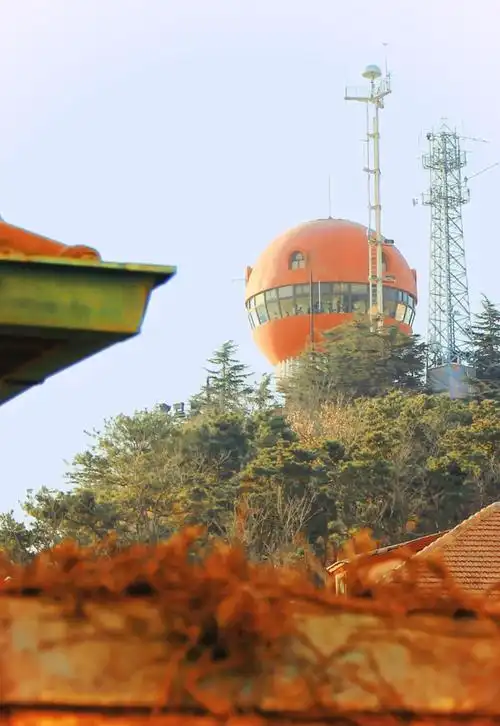
The park's most photographed feature is its trio of red-domed structures, locally called the "red mushrooms." The tallest houses a revolving observation deck that completes a slow 360° turn every half hour, allowing visitors to take in the panorama without moving. Inside, small exhibits trace the evolution of maritime communication, while a fifth-floor tea lounge invites a pause. The surrounding verandas and a graceful Magnolia Pavilion employ classical Chinese garden design, creating an appealing East-meets-West fusion when paired with the red cupolas and surrounding pines.
Culturally, Signal Hill condenses Qingdao's signature slogan—"red tiles, green trees, blue sea, and azure sky"—into a single 360-degree frame. From the summit, the German-built former governor's residence, the spire of the Gothic-style Christian Church, the yellow Huashi Villa, and the curving coastline of the old town unfold like a living diorama. Photographers, painters, and Instagrammers flock here for what many consider the definitive Qingdao skyline shot, especially as sunset paints the bay in amber and rose.
Admission to the park is free, though advance online registration is required at peak times. The revolving observation tower costs a modest ¥10 per person (concessions for students and seniors). The climb involves about 15–20 minutes of stepped walking from the west gate; the gentler north gate is recommended for those with limited mobility. Allow 1.5 to 2 hours for a comfortable visit. Opening hours run roughly 7 a.m. to 6:30 p.m., with the last observation-deck ticket sold around 4:30 p.m.
The most convenient access is via Metro Line 4, alighting at "Xinhaoshan (Qingda University Hospital)" Station and exiting through B2—a mere three-minute walk to the west gate. The park sits within easy strolling distance of Longjiang Road food street, the historic Christian Church, and the University Road café district, making it a natural anchor for a half-day "old town walk." For the best experience, arrive after 4 p.m., ascend for sunset, then descend for dinner and the glittering night view of the illuminated colonial quarter. Bring your own water, as summit prices run high, and check the weather—clear skies are essential to fully appreciate the panoramic reward.
Signal Hill takes its name from the signal flags once hoisted here to guide steamships into Qingdao harbor—a function that earned it the Chinese nickname "Mountain That Talks to Ships." The hill was pressed into service during the German colonial era (1898–1914), when Qingdao served as the Kaiserliche Marine's Pacific foothold, comparable in strategic ambition to Britain's Hong Kong or France's Kwangchowan. After the Japanese interregnum and its return to China, the summit gradually shed its military role and opened to the public, making it today both a scenic lookout and a quiet reminder of the city's layered 20th-century history.
The park's most photographed feature is its trio of red-domed structures, locally called the "red mushrooms." The tallest houses a revolving observation deck that completes a slow 360° turn every half hour, allowing visitors to take in the panorama without moving. Inside, small exhibits trace the evolution of maritime communication, while a fifth-floor tea lounge invites a pause. The surrounding verandas and a graceful Magnolia Pavilion employ classical Chinese garden design, creating an appealing East-meets-West fusion when paired with the red cupolas and surrounding pines.
Culturally, Signal Hill condenses Qingdao's signature slogan—"red tiles, green trees, blue sea, and azure sky"—into a single 360-degree frame. From the summit, the German-built former governor's residence, the spire of the Gothic-style Christian Church, the yellow Huashi Villa, and the curving coastline of the old town unfold like a living diorama. Photographers, painters, and Instagrammers flock here for what many consider the definitive Qingdao skyline shot, especially as sunset paints the bay in amber and rose.
Admission to the park is free, though advance online registration is required at peak times. The revolving observation tower costs a modest ¥10 per person (concessions for students and seniors). The climb involves about 15–20 minutes of stepped walking from the west gate; the gentler north gate is recommended for those with limited mobility. Allow 1.5 to 2 hours for a comfortable visit. Opening hours run roughly 7 a.m. to 6:30 p.m., with the last observation-deck ticket sold around 4:30 p.m.
The most convenient access is via Metro Line 4, alighting at "Xinhaoshan (Qingda University Hospital)" Station and exiting through B2—a mere three-minute walk to the west gate. The park sits within easy strolling distance of Longjiang Road food street, the historic Christian Church, and the University Road café district, making it a natural anchor for a half-day "old town walk." For the best experience, arrive after 4 p.m., ascend for sunset, then descend for dinner and the glittering night view of the illuminated colonial quarter. Bring your own water, as summit prices run high, and check the weather—clear skies are essential to fully appreciate the panoramic reward.