German Style Street
⭐ 3.20
Zhongshan Road, Shinan District, Qingdao City, Shandong Province, China
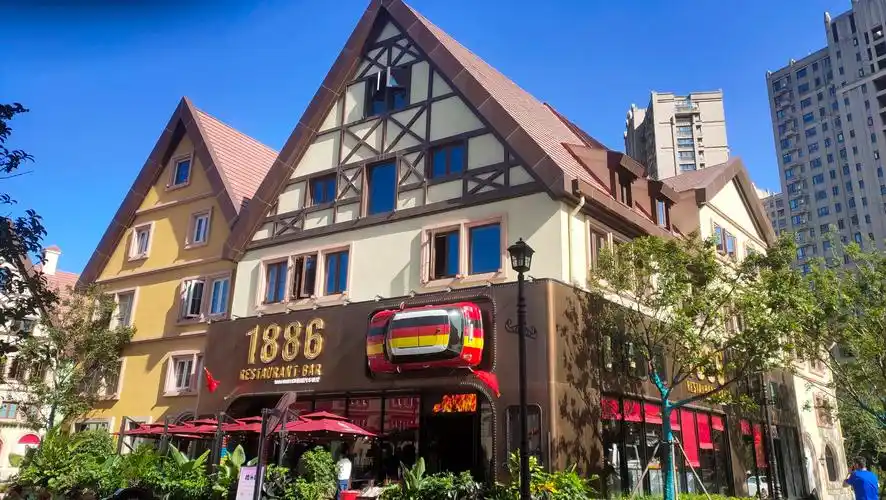 When Germany seized the Kiautschou Bay concession in 1898, Qingdao became Berlin's only true colony in Asia—a foothold in the late-19th century scramble for Chinese treaty ports that also produced Shanghai's International Settlement and Hong Kong's Victoria Harbour. Guantao Road, laid out the following year, was conceived as the colony's financial backbone. At its 1920s peak, the street hummed with branches of HSBC, the Yokohama Specie Bank, and the Korean Bank, processing trade across Shandong and the North China plain. Japanese forces seized Qingdao in 1914 during World War I—ousting Berlin as part of the wider East Asian realignment—and the road retained its banking identity through the 1930s.
The streetscape reads like a Wilhelmine postcard transported to the Yellow Sea. Most façades follow Neoclassical or Italian Renaissance Revival templates favored in late-Imperial German commercial architecture, with rusticated stone bases, arched windows, keystoned cornices, and decorative wrought-iron balconies. Standouts include the rust-red Qingdao Stock Exchange, whose columned entrance once hosted Asia's largest trading floor, and the former HSBC branch, distinguished by its symmetrical pediment and arched ground-floor arcade. The old Danish Consulate adds a touch of Nordic restraint, while the Korean Bank building showcases the heavier masonry that Japanese firms preferred. Many structures still wear their original 1900s–1920s lettering.
Guantao Road offers a layered story of Qingdao's leap from fishing village to treaty port. Where Shanghai's Bund reflects British commercial power and Tianjin's concession districts speak to multiple European occupiers, this street is uniquely German-Chinese—later Japanese-Chinese—telling how a small colonial outpost projected European capitalism onto the Shandong coast. In 2024, the district was added to a list of free film-shooting locations, sparking renewed interest among cultural tourists. Several restored buildings now host small museums, design boutiques, and coffee shops, creating an atmosphere that feels lived-in rather than sanitized.
The street is open around the clock and free to enter—no tickets required. Allow 30 minutes to 1.5 hours; architecture enthusiasts can easily stretch it longer. Reach it by Metro Line 1 or Line 2 to Qingdao Station or Zhongshan Road, then walk 10–15 minutes north; bus 214 stops directly on Guantao Road. Late afternoon light, especially the golden hour before sunset, gives the stonework a warm glow and reveals surface textures that flatter any camera. The lane is flat, paved, and wheelchair-friendly, with public restrooms and small cafés scattered along its length.
Travelers who prefer the atmospheric grit of working history over polished tourist zones will find Guantao Road rewarding. It pairs naturally with a half-day Qingdao heritage loop: start at Zhanqiao Pier on the harborfront, stroll west along Zhongshan Road's old shopping arcades, and finish among the bankers' mansions here. For a denser dose of pure German-era architecture, continue to the Badaguan villa district and Guangxi Road in Shinan District—together they reveal the full urban fabric of Germany's brief, ambitious experiment on the Yellow Sea coast.
When Germany seized the Kiautschou Bay concession in 1898, Qingdao became Berlin's only true colony in Asia—a foothold in the late-19th century scramble for Chinese treaty ports that also produced Shanghai's International Settlement and Hong Kong's Victoria Harbour. Guantao Road, laid out the following year, was conceived as the colony's financial backbone. At its 1920s peak, the street hummed with branches of HSBC, the Yokohama Specie Bank, and the Korean Bank, processing trade across Shandong and the North China plain. Japanese forces seized Qingdao in 1914 during World War I—ousting Berlin as part of the wider East Asian realignment—and the road retained its banking identity through the 1930s.
The streetscape reads like a Wilhelmine postcard transported to the Yellow Sea. Most façades follow Neoclassical or Italian Renaissance Revival templates favored in late-Imperial German commercial architecture, with rusticated stone bases, arched windows, keystoned cornices, and decorative wrought-iron balconies. Standouts include the rust-red Qingdao Stock Exchange, whose columned entrance once hosted Asia's largest trading floor, and the former HSBC branch, distinguished by its symmetrical pediment and arched ground-floor arcade. The old Danish Consulate adds a touch of Nordic restraint, while the Korean Bank building showcases the heavier masonry that Japanese firms preferred. Many structures still wear their original 1900s–1920s lettering.
Guantao Road offers a layered story of Qingdao's leap from fishing village to treaty port. Where Shanghai's Bund reflects British commercial power and Tianjin's concession districts speak to multiple European occupiers, this street is uniquely German-Chinese—later Japanese-Chinese—telling how a small colonial outpost projected European capitalism onto the Shandong coast. In 2024, the district was added to a list of free film-shooting locations, sparking renewed interest among cultural tourists. Several restored buildings now host small museums, design boutiques, and coffee shops, creating an atmosphere that feels lived-in rather than sanitized.
The street is open around the clock and free to enter—no tickets required. Allow 30 minutes to 1.5 hours; architecture enthusiasts can easily stretch it longer. Reach it by Metro Line 1 or Line 2 to Qingdao Station or Zhongshan Road, then walk 10–15 minutes north; bus 214 stops directly on Guantao Road. Late afternoon light, especially the golden hour before sunset, gives the stonework a warm glow and reveals surface textures that flatter any camera. The lane is flat, paved, and wheelchair-friendly, with public restrooms and small cafés scattered along its length.
Travelers who prefer the atmospheric grit of working history over polished tourist zones will find Guantao Road rewarding. It pairs naturally with a half-day Qingdao heritage loop: start at Zhanqiao Pier on the harborfront, stroll west along Zhongshan Road's old shopping arcades, and finish among the bankers' mansions here. For a denser dose of pure German-era architecture, continue to the Badaguan villa district and Guangxi Road in Shinan District—together they reveal the full urban fabric of Germany's brief, ambitious experiment on the Yellow Sea coast.