Zhanqiao Pier
⭐ 4.20
No. 1, Zhongshan Road, Shinan District, Qingdao, Shandong, China
 **A Century-Old Pier with Imperial Roots**
Zhanqiao Pier dates back to 1891 during the Qing Dynasty's Guangxu era, when it was constructed as Qingdao's first artificial military dock to support the new Beihai Fleet. The pier's fate changed dramatically in 1898 when Germany leased Kiautschou Bay, transforming Qingdao into a colonial port and fueling events that contributed to the outbreak of World War I in the Pacific. This layered history—Qing military origins followed by German, then Japanese occupation—makes Zhanqiao a tangible timeline of East Asia's modern geopolitical struggles, comparable to how Hamburg's harbor warehouses narrate northern Germany's mercantile past.
**Architecture: Where East Meets European Elegance**
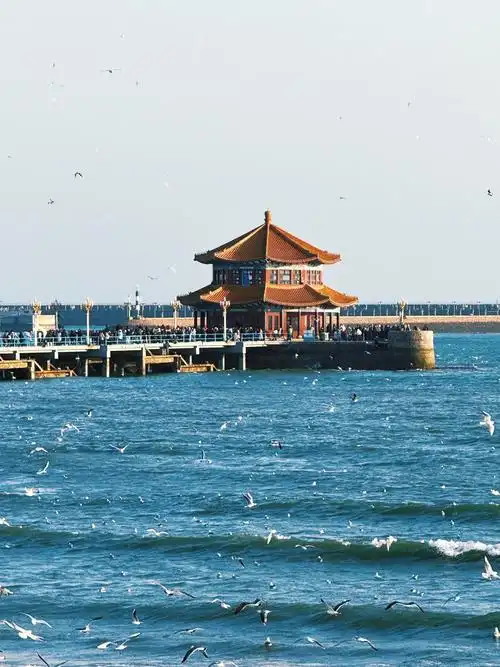
The pier itself is a straightforward 440-meter reinforced concrete walkway, 10 meters wide, lined with wrought-iron railings and vintage lampposts that evoke a turn-of-the-century European seaside promenade. The visual showpiece is Huilan Pavilion at the tip, a two-tiered octagonal hall with upturned eaves, yellow-glazed roof tiles, and vermilion columns. The pavilion's silhouette against the Yellow Sea resembles a miniature Temple of Heaven floating on water, yet its color palette and proportions carry unmistakable echoes of Bavarian baroque pavilions, a fitting architectural marriage of Qingdao's German and Chinese heritage.
**Cultural Significance and Living Symbol**
Beyond its photogenic charm, Zhanqiao functions as Qingdao's emotional compass—the image locals carry when they think of home. It anchors the Qingdao Coastal Scenic Area, the city's only national AAAA-rated seafront attraction, and has been immortalized in countless paintings, postcards, and folk songs. From the pier's vantage point, you can spot Little Qingdao Island, the historic lighthouse, and the dense cluster of colonial-era buildings along the waterfront, all in a single sweeping gaze that captures the city's maritime soul.
**Planning Your Visit: Costs, Transport, and Timing**
The pier is completely free and requires no reservation; only entry to Huilan Pavilion costs around ¥10 (roughly $1.40). Reach it via Metro Line 1 or Line 3, exiting at Qingdao Station through Exits C or G, then walking three to five minutes. Driving is discouraged due to scarce and expensive parking. The golden hours are 6:00–8:30 AM and after 5:30 PM, when soft light, cooler temperatures, and thinner crowds create ideal photography conditions. Spring brings lively waves; autumn delivers spectacular sunsets; and from November through April, thousands of Siberian seagulls migrate here, allowing visitors to feed and photograph the birds at close range—a winter experience reminiscent of feeding pigeons in Venice's St. Mark's Square.
**Seasonal Highlights and Common Pitfalls**
Summer lacks the seagulls but offers low-tide foraging on the western reef for shells and small sea creatures, while evening silhouettes against the setting sun remain stunning. Be aware that summer weekends bring heavy crowds—the narrow walkway can feel congested—and avoid street touts offering "cheap boat tickets" or unmarked seafood stalls near the entrance, which frequently overcharge. Sun protection and non-slip shoes are essential, as the pier surface becomes slippery with sea spray, and a light jacket is wise for breezy evenings when temperatures drop sharply after sunset.
**Why Zhanqiao Belongs on Your Itinerary**
Zhanqiao delivers what few Asian landmarks can: a free, walkable encounter with history paired with the sensory drama of an open sea horizon. Within a five-minute walk lie Zhongshan Road's German colonial arcades, legendary local eateries like Chunhelou's crispy chicken, and the neo-Gothic St. Michael's Cathedral. Together they form a compact, deeply atmospheric half-day circuit—one that reveals Qingdao not as a generic Chinese coastal city, but as a singular cultural crossroads where Qing dynasty ambition, German engineering, and Yellow Sea romance converge on a single stone pier.
**A Century-Old Pier with Imperial Roots**
Zhanqiao Pier dates back to 1891 during the Qing Dynasty's Guangxu era, when it was constructed as Qingdao's first artificial military dock to support the new Beihai Fleet. The pier's fate changed dramatically in 1898 when Germany leased Kiautschou Bay, transforming Qingdao into a colonial port and fueling events that contributed to the outbreak of World War I in the Pacific. This layered history—Qing military origins followed by German, then Japanese occupation—makes Zhanqiao a tangible timeline of East Asia's modern geopolitical struggles, comparable to how Hamburg's harbor warehouses narrate northern Germany's mercantile past.
**Architecture: Where East Meets European Elegance**
The pier itself is a straightforward 440-meter reinforced concrete walkway, 10 meters wide, lined with wrought-iron railings and vintage lampposts that evoke a turn-of-the-century European seaside promenade. The visual showpiece is Huilan Pavilion at the tip, a two-tiered octagonal hall with upturned eaves, yellow-glazed roof tiles, and vermilion columns. The pavilion's silhouette against the Yellow Sea resembles a miniature Temple of Heaven floating on water, yet its color palette and proportions carry unmistakable echoes of Bavarian baroque pavilions, a fitting architectural marriage of Qingdao's German and Chinese heritage.
**Cultural Significance and Living Symbol**
Beyond its photogenic charm, Zhanqiao functions as Qingdao's emotional compass—the image locals carry when they think of home. It anchors the Qingdao Coastal Scenic Area, the city's only national AAAA-rated seafront attraction, and has been immortalized in countless paintings, postcards, and folk songs. From the pier's vantage point, you can spot Little Qingdao Island, the historic lighthouse, and the dense cluster of colonial-era buildings along the waterfront, all in a single sweeping gaze that captures the city's maritime soul.
**Planning Your Visit: Costs, Transport, and Timing**
The pier is completely free and requires no reservation; only entry to Huilan Pavilion costs around ¥10 (roughly $1.40). Reach it via Metro Line 1 or Line 3, exiting at Qingdao Station through Exits C or G, then walking three to five minutes. Driving is discouraged due to scarce and expensive parking. The golden hours are 6:00–8:30 AM and after 5:30 PM, when soft light, cooler temperatures, and thinner crowds create ideal photography conditions. Spring brings lively waves; autumn delivers spectacular sunsets; and from November through April, thousands of Siberian seagulls migrate here, allowing visitors to feed and photograph the birds at close range—a winter experience reminiscent of feeding pigeons in Venice's St. Mark's Square.
**Seasonal Highlights and Common Pitfalls**
Summer lacks the seagulls but offers low-tide foraging on the western reef for shells and small sea creatures, while evening silhouettes against the setting sun remain stunning. Be aware that summer weekends bring heavy crowds—the narrow walkway can feel congested—and avoid street touts offering "cheap boat tickets" or unmarked seafood stalls near the entrance, which frequently overcharge. Sun protection and non-slip shoes are essential, as the pier surface becomes slippery with sea spray, and a light jacket is wise for breezy evenings when temperatures drop sharply after sunset.
**Why Zhanqiao Belongs on Your Itinerary**
Zhanqiao delivers what few Asian landmarks can: a free, walkable encounter with history paired with the sensory drama of an open sea horizon. Within a five-minute walk lie Zhongshan Road's German colonial arcades, legendary local eateries like Chunhelou's crispy chicken, and the neo-Gothic St. Michael's Cathedral. Together they form a compact, deeply atmospheric half-day circuit—one that reveals Qingdao not as a generic Chinese coastal city, but as a singular cultural crossroads where Qing dynasty ambition, German engineering, and Yellow Sea romance converge on a single stone pier.