Taihe Mosque
⭐ 5.00
Qingzhen Temple, Taihe County, Fuyang City, Anhui Province, China
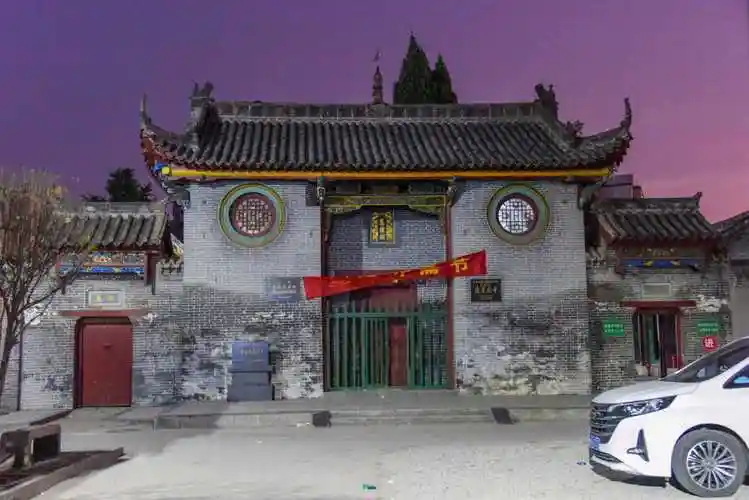 The Taihe Mosque complex traces its origins to the early Ming dynasty, when Emperor Zhu Yuanzhang reportedly ordered its construction around 1382 to honor Hui Muslim soldiers who had fought in his campaigns. This places the site within the broader sweep of Islamic civilization reaching east along the Silk Road, comparable in spirit to the historic mosques of Xi'an or Quanzhou. Both the North and South Mosques have been designated provincial cultural heritage sites, making them essential witnesses to six hundred years of Hui history in the Huai River region.
Architecturally, the South Mosque unfolds in a distinctive "Lü"-shaped palatial layout, where a moon-gazing platform, prayer hall, and lecture rooms interconnect gracefully. A spirit screen bears the inscription "Tianfang Pingfan" (Shield of Arabia), while door lintels proclaim Confucian-Islamic ideals such as "Expound the Classics" and "Spread the Sage's Words." The North Mosque is celebrated for its imposing Wansui Pavilion gate tower and the Delight Moon Pavilion, where thirty-six massive wooden pillars support a ceiling adorned with breathtaking flying-dragon carvings—a scale and ambition that rivals the great cathedrals of medieval Europe.
What sets this complex apart is its remarkable synthesis of two civilizations. Islamic calligraphic sensibility and prayer hall orientation are seamlessly woven with Chinese palace aesthetics, from the glazed tile roofs to the masterful brick, wood, and stone relief work. In the North Mosque courtyard, two cypress trees planted by the first imam six centuries ago still stand as living monuments, now protected as notable ancient specimens. The site is often called a "living fossil of Hui civilization along the middle Huai River," capturing the harmony of Han and Muslim cultures in a single place.
Both mosques sit close together along Renmin Middle Road, making it easy to visit them in sequence. Admission is free, and the grounds are typically open throughout the day, though visitors should avoid the Friday noon Jumu'ah prayer hour for a quieter experience. Mornings or afternoons are ideal. Modest dress is appreciated, and visitors should remain respectful, keeping voices low and refraining from touching worship items.
No visit would be complete without sampling Taihe's celebrated halal cuisine nearby. Local specialties like Taihe beef and banmian (flat noodles) offer a flavorful conclusion to your cultural journey. Photographers will find magic in the dappled light filtering through carved lattice windows onto stone floors—an interplay of old architecture and golden light that rewards every shutter click. Allow at least half a day to fully absorb this understated cultural treasure.
The Taihe Mosque complex traces its origins to the early Ming dynasty, when Emperor Zhu Yuanzhang reportedly ordered its construction around 1382 to honor Hui Muslim soldiers who had fought in his campaigns. This places the site within the broader sweep of Islamic civilization reaching east along the Silk Road, comparable in spirit to the historic mosques of Xi'an or Quanzhou. Both the North and South Mosques have been designated provincial cultural heritage sites, making them essential witnesses to six hundred years of Hui history in the Huai River region.
Architecturally, the South Mosque unfolds in a distinctive "Lü"-shaped palatial layout, where a moon-gazing platform, prayer hall, and lecture rooms interconnect gracefully. A spirit screen bears the inscription "Tianfang Pingfan" (Shield of Arabia), while door lintels proclaim Confucian-Islamic ideals such as "Expound the Classics" and "Spread the Sage's Words." The North Mosque is celebrated for its imposing Wansui Pavilion gate tower and the Delight Moon Pavilion, where thirty-six massive wooden pillars support a ceiling adorned with breathtaking flying-dragon carvings—a scale and ambition that rivals the great cathedrals of medieval Europe.
What sets this complex apart is its remarkable synthesis of two civilizations. Islamic calligraphic sensibility and prayer hall orientation are seamlessly woven with Chinese palace aesthetics, from the glazed tile roofs to the masterful brick, wood, and stone relief work. In the North Mosque courtyard, two cypress trees planted by the first imam six centuries ago still stand as living monuments, now protected as notable ancient specimens. The site is often called a "living fossil of Hui civilization along the middle Huai River," capturing the harmony of Han and Muslim cultures in a single place.
Both mosques sit close together along Renmin Middle Road, making it easy to visit them in sequence. Admission is free, and the grounds are typically open throughout the day, though visitors should avoid the Friday noon Jumu'ah prayer hour for a quieter experience. Mornings or afternoons are ideal. Modest dress is appreciated, and visitors should remain respectful, keeping voices low and refraining from touching worship items.
No visit would be complete without sampling Taihe's celebrated halal cuisine nearby. Local specialties like Taihe beef and banmian (flat noodles) offer a flavorful conclusion to your cultural journey. Photographers will find magic in the dappled light filtering through carved lattice windows onto stone floors—an interplay of old architecture and golden light that rewards every shutter click. Allow at least half a day to fully absorb this understated cultural treasure.