Fuyang Drum Tower
⭐ 2.50
Fuyang Drum Tower, Yingzhou District, Fuyang City, Anhui Province, China
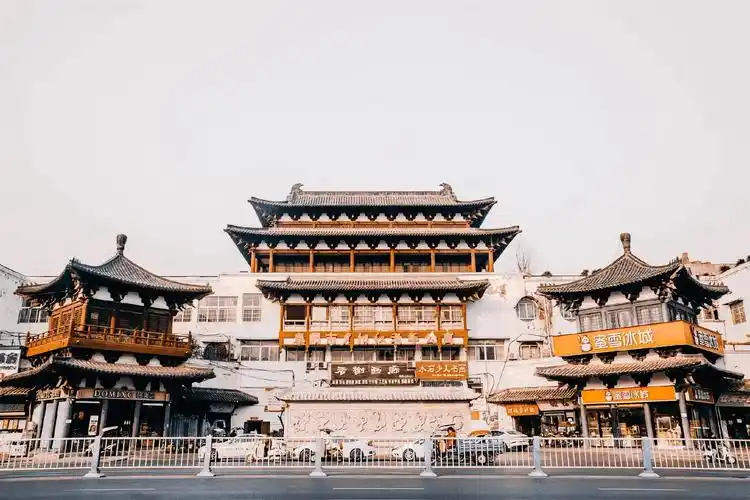 The original Zhenying Tower rose in 1376, the same era when Westminster's towers were being completed and Florence's Palazzo Vecchio already dominated its piazza. While European drum or bell towers often doubled as watchtowers and town halls, Chinese examples like this one typically marked the administrative heart of a walled city and sounded the rhythms of civic life—beating out dawn, dusk, and emergencies. Fuyang's tower survived into the twentieth century before being razed in 1954, during the urban-renewal wave that reshaped cities across both East and West. The current square, inaugurated decades later, is therefore less a relic than a contemporary homage to a vanished landmark.
Though no ancient masonry survives, the designers have evoked the past through restrained Huizhou-style flourishes: whitewashed walls capped by dark tile eaves, vermilion accents, and stone platforms that mimic the tiered bases of classical Chinese towers. At the same time, the space doubles as the so-called Drum Tower Constitution Square, where educational installations weave legal themes into the public landscape. The contrast—ancient silhouette meeting civic pedagogy—recalls similar hybrid squares found from Bologna to Beijing.
For Western visitors, the deeper draw lies not in any single structure but in the surrounding fabric of the old city. A short walk leads to Zifu Temple, a quiet Qing-dynasty sanctuary that functions much like a neighborhood chapel, and onward to the provincial-level City God Temple, originally founded in the early Ming period and famed for its imperially bestowed plaques. Together with the square's red-walled photo spots and lantern-lit evenings, these stops form a compact heritage trail—an antidote to the polished museum experience.
The square lies near Jiefang North Road in Yingzhou District, easiest reached by taxi; bus stops in this older quarter have shifted in recent years, so a navigation app is essential. Parking is scarce, and on foot is often the wisest choice. Entrance is free and unrestricted, day or night, though the golden hour between 17:00 and 20:00 rewards visitors with warm sunset light, illuminated eaves, and the lively buzz of evening strollers. Wear non-slip footwear—stone paving can be slick after rain—and bring insect repellent in summer months.
Set aside any expectation of climbing a tower; the reward here is immersion in the slow cadence of a northern Anhui county town. Photograph the red wall backdrop, then wander east and north into the alleyways for Fuyang's signature snacks—crispy rolled flatbreads stuffed with savory fillings and the celebrated Fuyang roast chicken, a regional rival to more famous styles. Travelers curious about folk crafts can check official cultural-tourism listings for occasional workshops on Fuyang paper-cutting or Yinghui dough sculpture, turning a brief stop into a richer engagement with the city's living heritage.
The original Zhenying Tower rose in 1376, the same era when Westminster's towers were being completed and Florence's Palazzo Vecchio already dominated its piazza. While European drum or bell towers often doubled as watchtowers and town halls, Chinese examples like this one typically marked the administrative heart of a walled city and sounded the rhythms of civic life—beating out dawn, dusk, and emergencies. Fuyang's tower survived into the twentieth century before being razed in 1954, during the urban-renewal wave that reshaped cities across both East and West. The current square, inaugurated decades later, is therefore less a relic than a contemporary homage to a vanished landmark.
Though no ancient masonry survives, the designers have evoked the past through restrained Huizhou-style flourishes: whitewashed walls capped by dark tile eaves, vermilion accents, and stone platforms that mimic the tiered bases of classical Chinese towers. At the same time, the space doubles as the so-called Drum Tower Constitution Square, where educational installations weave legal themes into the public landscape. The contrast—ancient silhouette meeting civic pedagogy—recalls similar hybrid squares found from Bologna to Beijing.
For Western visitors, the deeper draw lies not in any single structure but in the surrounding fabric of the old city. A short walk leads to Zifu Temple, a quiet Qing-dynasty sanctuary that functions much like a neighborhood chapel, and onward to the provincial-level City God Temple, originally founded in the early Ming period and famed for its imperially bestowed plaques. Together with the square's red-walled photo spots and lantern-lit evenings, these stops form a compact heritage trail—an antidote to the polished museum experience.
The square lies near Jiefang North Road in Yingzhou District, easiest reached by taxi; bus stops in this older quarter have shifted in recent years, so a navigation app is essential. Parking is scarce, and on foot is often the wisest choice. Entrance is free and unrestricted, day or night, though the golden hour between 17:00 and 20:00 rewards visitors with warm sunset light, illuminated eaves, and the lively buzz of evening strollers. Wear non-slip footwear—stone paving can be slick after rain—and bring insect repellent in summer months.
Set aside any expectation of climbing a tower; the reward here is immersion in the slow cadence of a northern Anhui county town. Photograph the red wall backdrop, then wander east and north into the alleyways for Fuyang's signature snacks—crispy rolled flatbreads stuffed with savory fillings and the celebrated Fuyang roast chicken, a regional rival to more famous styles. Travelers curious about folk crafts can check official cultural-tourism listings for occasional workshops on Fuyang paper-cutting or Yinghui dough sculpture, turning a brief stop into a richer engagement with the city's living heritage.