Taiping Old Street
⭐ 4.20
Taiping Old Street, Tianxin District, Changsha, Hunan, China
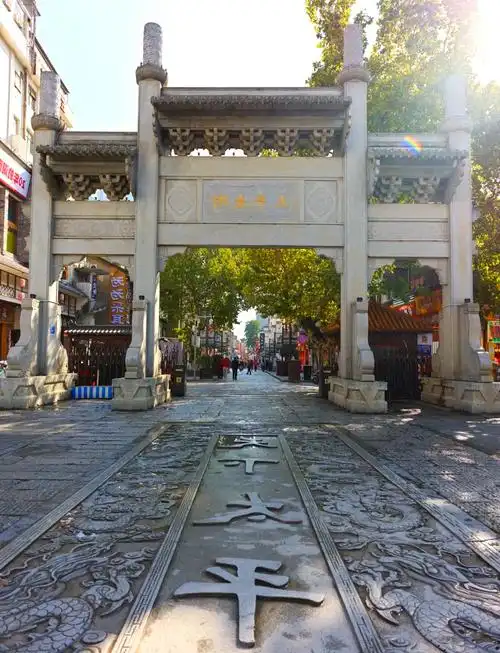 Taiping Old Street occupies the original heart of Changsha, a city founded during the Western Han dynasty (206 BCE–220 CE)—roughly contemporary with the late Roman Republic. Since then, this area has functioned as the political and cultural center of the city for over two thousand years. Within its compact lanes stand remarkable survivors: the former residence of Jia Yi, chief advisor to the King of Changsha, dating to the Han era; remains of a Ming-dynasty princely palace from the 1500s; and Qing-era grain warehouses. Much like Rome's preserved streetscapes, these layered monuments offer a tangible timeline of Chinese history compressed into a single walkable district.
The quarter covers roughly 53,000 square meters and follows an enduring "fishbone" layout—one central spine with perpendicular alleys branching off, a planning principle familiar from medieval European towns like Sarlat in southwestern France. The main thoroughfare, paved in weathered bluestone slabs and measuring seven meters wide, runs east to west past elegantly restored Ming and Qing-era buildings. Traditional features such as whitewashed walls, black-tiled roofs, distinctive stepped gables (firewalls designed to halt spreading flames), and small green tiles have been carefully preserved in the manner of heritage restoration, giving the entire area the atmospheric quality of an open-air museum.
This is Hunan culture's birthplace in urban form—a place where the famously fiery local character comes alive through both architecture and cuisine. Visitors can sample iconic Xiang-region snacks that locals have eaten for centuries: famously pungent stinky tofu, golden sugar-glazed glutinous rice cakes, and chilled mung-bean jelly noodles. Cultural stops include the lively Taipingli creative market, the Qianxing Art Museum, and workshops showcasing intangible heritage crafts. The Jia Yi Residence, often called the oldest surviving structure in Changsha, offers free entry with passport or ID and provides rare insight into how literati lived during the early imperial era.
Admission to Taiping Old Street is free and the lanes are open around the clock. Reaching the area is straightforward: take Metro Lines 1 or 2 to either Wuyi Square or Huangxing Square Station—both are roughly a five-minute walk away. The central location makes it easy to combine with nearby attractions such as Tianxin Pavilion, a Ming-dynasty city gate tower, the bustling Jiefang West Road shopping corridor, and the futuristic IFS Tower for a complete half-day urban experience. No tickets are required for general wandering, though the Jia Yi Residence should be booked in advance.
For the most evocative experience, arrive before 8:30 AM or after 5:00 PM—cooler temperatures and softer light transform the stone lanes into a photographer's dream, free from the midday tour-bus crowds. Be aware that the main street is heavily commercialized, with trendy tea shops and snack vendors clustering near the entrance. For more authentic flavors at reasonable prices, venture down the side alleys where older family-run stalls hide. Comfortable walking shoes are essential, as the polished bluestone can become slippery when wet, and modest dress is appreciated when visiting the Jia Yi Residence and other historic homes.
Taiping Old Street occupies the original heart of Changsha, a city founded during the Western Han dynasty (206 BCE–220 CE)—roughly contemporary with the late Roman Republic. Since then, this area has functioned as the political and cultural center of the city for over two thousand years. Within its compact lanes stand remarkable survivors: the former residence of Jia Yi, chief advisor to the King of Changsha, dating to the Han era; remains of a Ming-dynasty princely palace from the 1500s; and Qing-era grain warehouses. Much like Rome's preserved streetscapes, these layered monuments offer a tangible timeline of Chinese history compressed into a single walkable district.
The quarter covers roughly 53,000 square meters and follows an enduring "fishbone" layout—one central spine with perpendicular alleys branching off, a planning principle familiar from medieval European towns like Sarlat in southwestern France. The main thoroughfare, paved in weathered bluestone slabs and measuring seven meters wide, runs east to west past elegantly restored Ming and Qing-era buildings. Traditional features such as whitewashed walls, black-tiled roofs, distinctive stepped gables (firewalls designed to halt spreading flames), and small green tiles have been carefully preserved in the manner of heritage restoration, giving the entire area the atmospheric quality of an open-air museum.
This is Hunan culture's birthplace in urban form—a place where the famously fiery local character comes alive through both architecture and cuisine. Visitors can sample iconic Xiang-region snacks that locals have eaten for centuries: famously pungent stinky tofu, golden sugar-glazed glutinous rice cakes, and chilled mung-bean jelly noodles. Cultural stops include the lively Taipingli creative market, the Qianxing Art Museum, and workshops showcasing intangible heritage crafts. The Jia Yi Residence, often called the oldest surviving structure in Changsha, offers free entry with passport or ID and provides rare insight into how literati lived during the early imperial era.
Admission to Taiping Old Street is free and the lanes are open around the clock. Reaching the area is straightforward: take Metro Lines 1 or 2 to either Wuyi Square or Huangxing Square Station—both are roughly a five-minute walk away. The central location makes it easy to combine with nearby attractions such as Tianxin Pavilion, a Ming-dynasty city gate tower, the bustling Jiefang West Road shopping corridor, and the futuristic IFS Tower for a complete half-day urban experience. No tickets are required for general wandering, though the Jia Yi Residence should be booked in advance.
For the most evocative experience, arrive before 8:30 AM or after 5:00 PM—cooler temperatures and softer light transform the stone lanes into a photographer's dream, free from the midday tour-bus crowds. Be aware that the main street is heavily commercialized, with trendy tea shops and snack vendors clustering near the entrance. For more authentic flavors at reasonable prices, venture down the side alleys where older family-run stalls hide. Comfortable walking shoes are essential, as the polished bluestone can become slippery when wet, and modest dress is appreciated when visiting the Jia Yi Residence and other historic homes.